
Your guitar begins with a conversation!
Design your guitar
Here you can start thinking about your dream guitar in advance and collect ideas. The possibilities are diverse – but not every option makes sense for every instrument / every musician.
That is why every ZUCALI begins with a personal conversation.
If the general conditions, such as pricing and waiting time, work for you, we will discuss where, what and how you play guitar, your previous experience and your ideas and expectations.
Step by step, this results in an instrument in which construction, materials, sound, ergonomics and aesthetics form a coherent whole.
Your ZUCALI should not only suit you. It should support your music and open up new possibilities for you.
Model
The model provides the basis on which we design togehter your guitar.
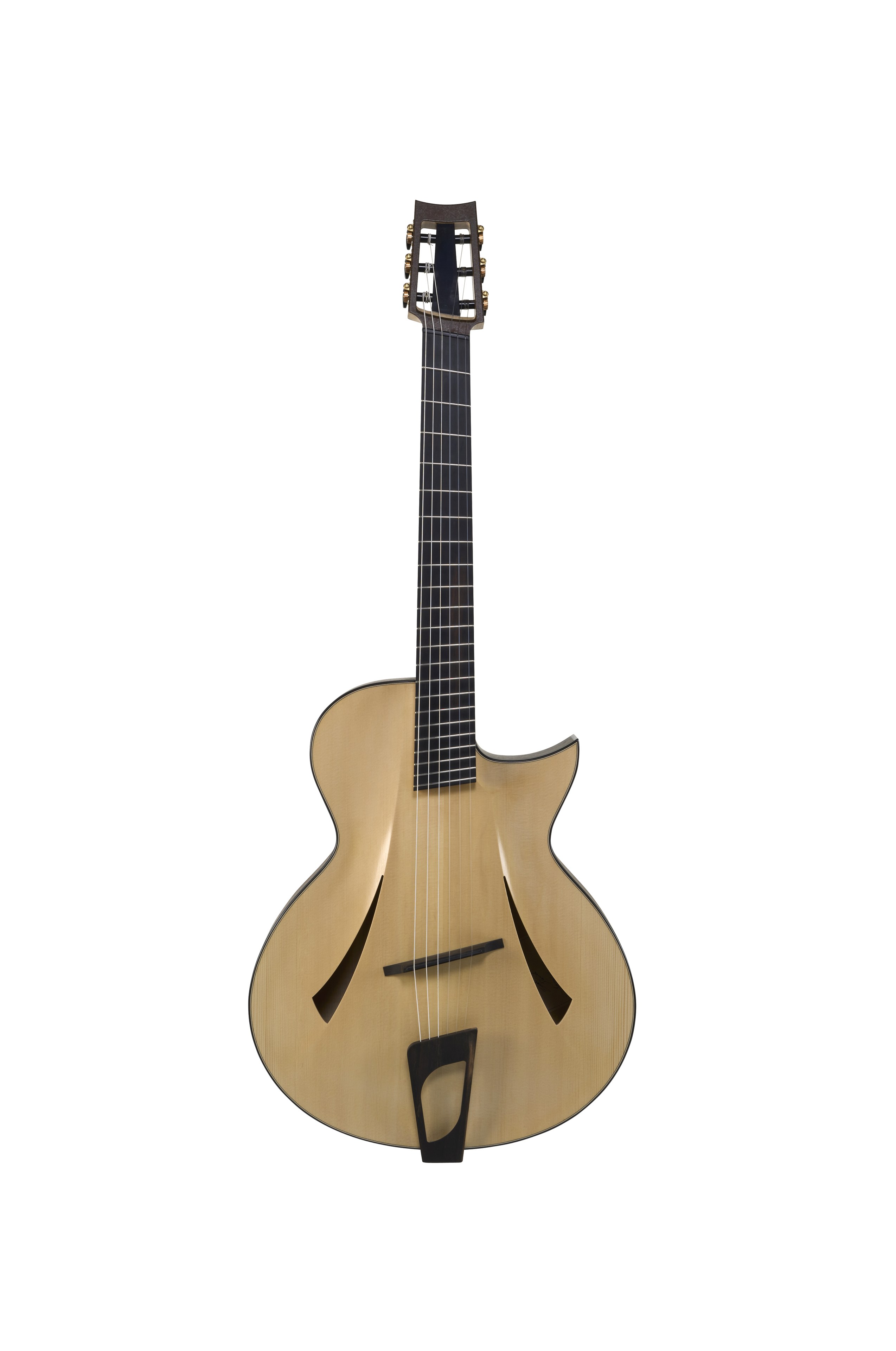
An archtop jazz guitar with nylon strings. Its low self-resonance keeps the sound clear at high volume and in a band: present, well differentiated, and without overpowering other musicians.
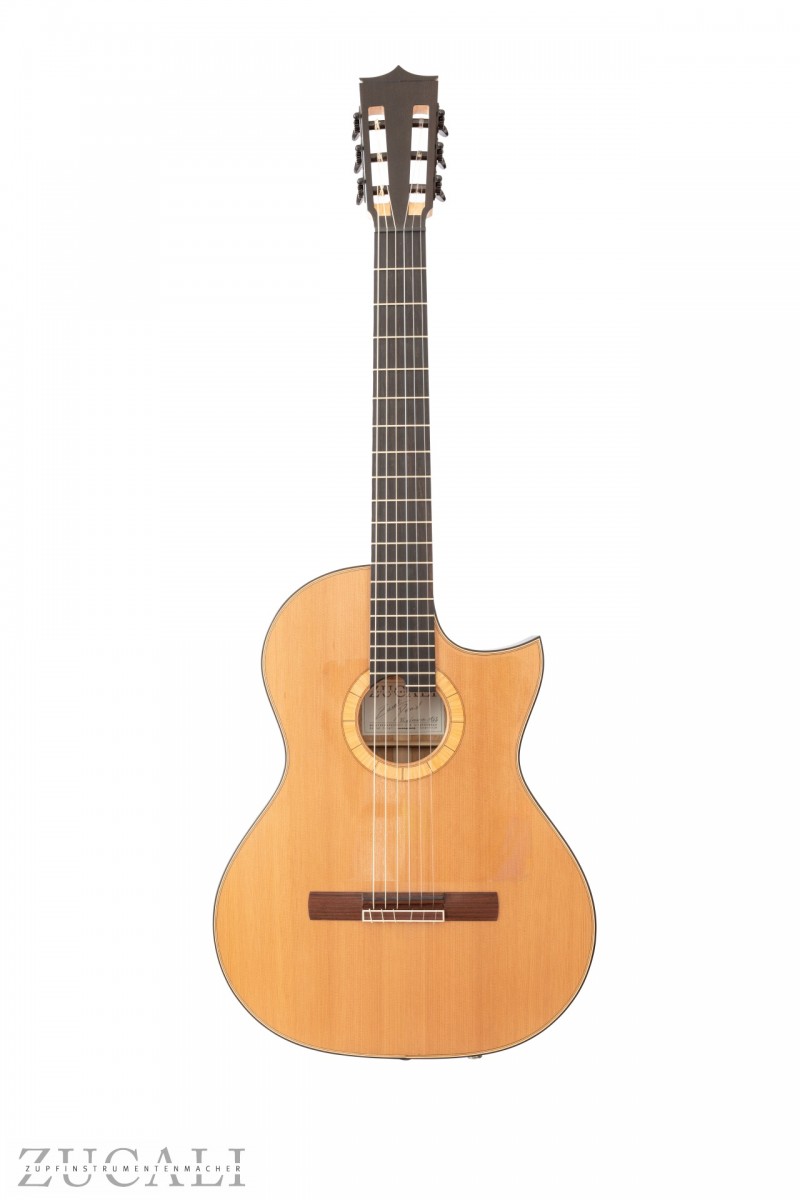
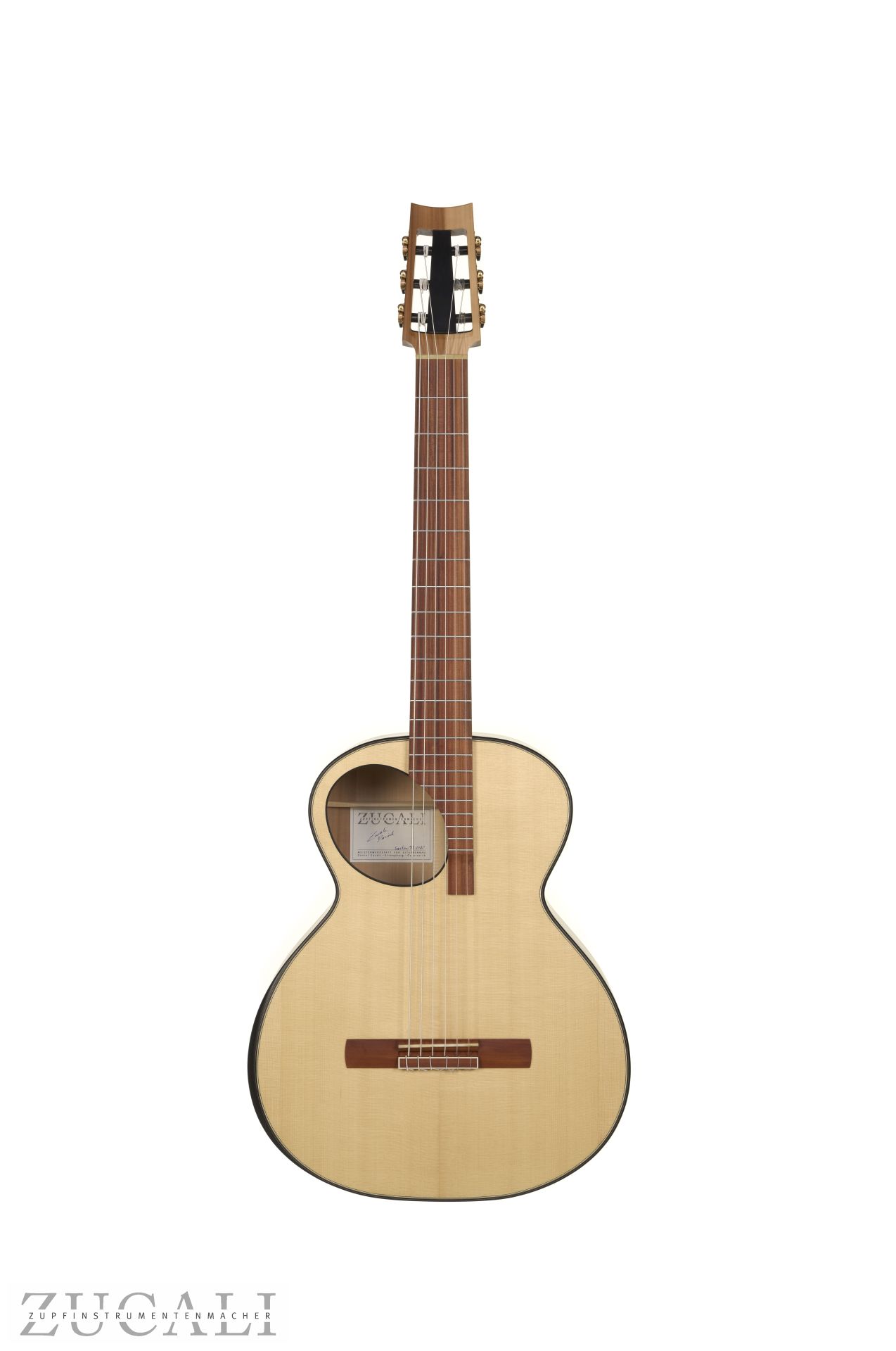
An instrument that brings together the strengths of different guitar worlds, shaped to the player and the music — from a band with drums and electric instruments to an intimate duo or trio.
Ensemble instruments in different registers, so a group has a wider range of colour and depth than a set of identical guitars.
Quintbass, a fifth below. Terzbass, a third below. Terz, a third above. Quint guitar, a fifth above.
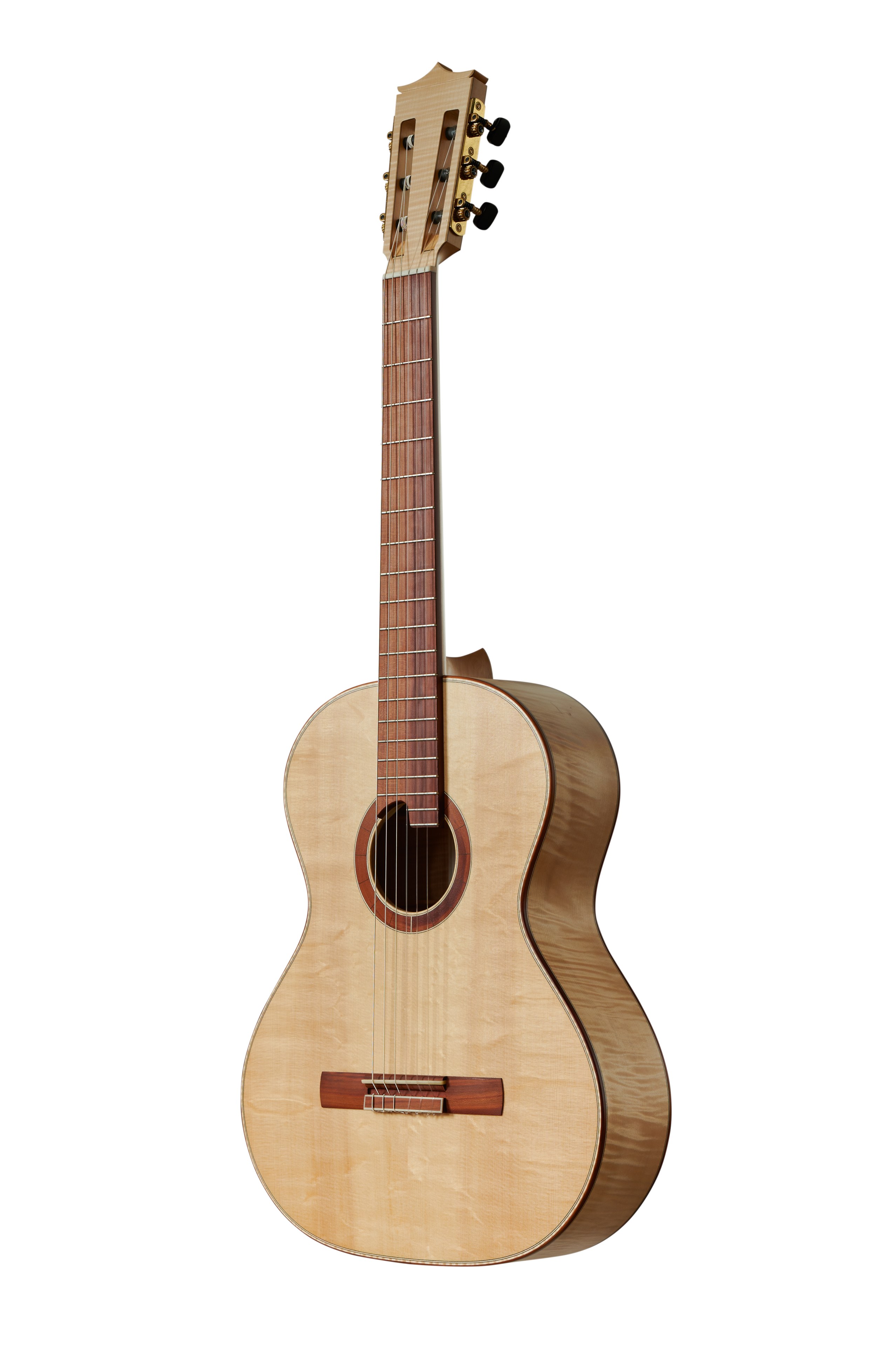
Elia and Aline are named after my children. Elia is the broad, dynamic high-end model. Aline has an elevated fingerboard and fills large halls.
Also a standard body, and a smaller body for 630 mm and 620 mm scale lengths.
Top
Top woods
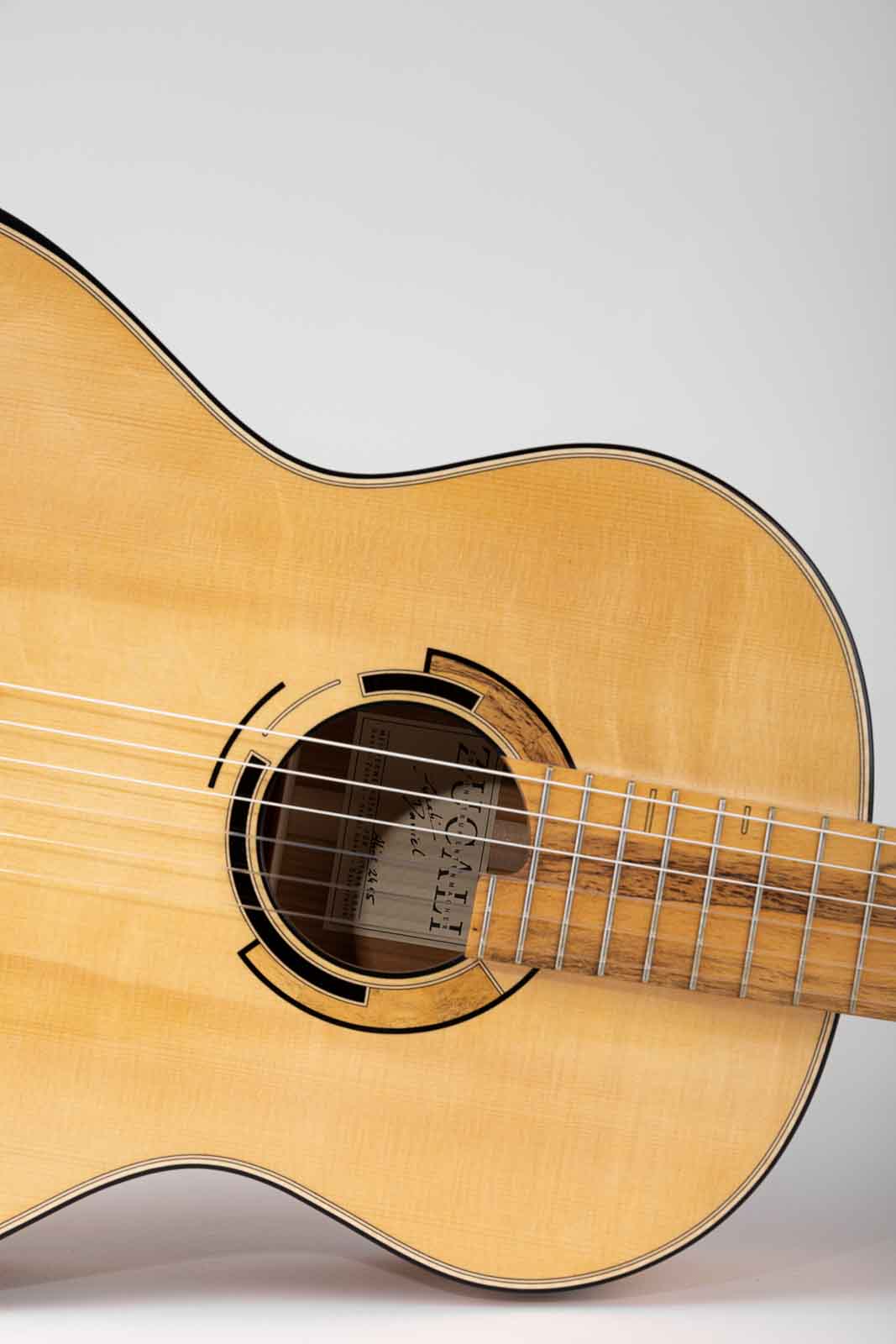
I offer Alpine spruce, most of which is also harvested according to moon phases, as well as Canadian cedar.
Each material has its own character and influences response, dynamics, tonal colour and projection. Together, we choose the wood that best suits your musical ideas.
Bracing
Depending on playing style and personal preference, I offer traditional bracing or Lattice Bracing.
Traditional bracing
A specially developed six-fan bracing system, partly with angled treble braces underneath the bridge.
Lattice Bracing
A complex, self-developed “Lattice Bracing” system – the top consists of 95 differently sized, 3D-milled surfaces with concave channels leading to braces of different heights. These are finished by hand and thereby define the flexibility and stiffness of the top.
This is the work that, in traditional top construction, is mainly achieved with a plane and through the thickness of the top.
The braces have 43 crossing points, where the connections are worked out with high precision to prevent unwanted damping.
Doubletop
Doubletop has not convinced me so far. Toxic adhesives and artificially manufactured materials have not been tested as extensively as wood and glue.
Rosettes
The rosette is one of the most visible individual details of a guitar. From simple and elegant to elaborate and artistic, patterns and materials can be created according to your preferences.
Back & Sides
Woods
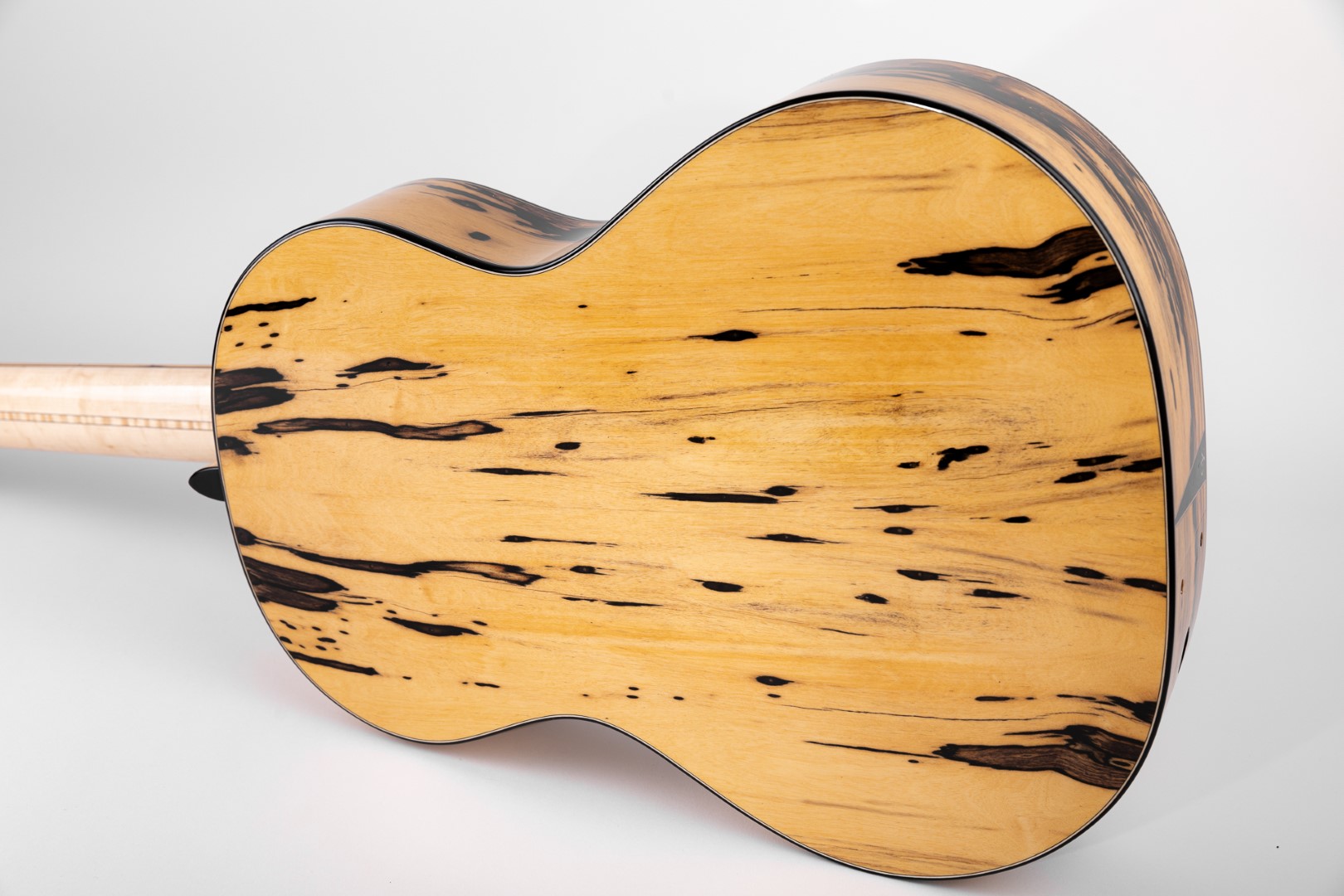
For backs and sides, I now use many local wood species such as maple, plum, serviceberry and others.
Materials listed in CITES Appendix I (e.g. Brazilian rosewood) are, of course, only used with a valid CITES certificate.
The choice of these woods changes the character of the guitar.
Local woods
- Maple
- Apple
- Plum
- Ash
- Pear
- Cherry
- Serviceberry
- Yew
- Cypress
- Olive
Other tonewoods
- Amaranth
- Bubinga
- Cocobolo
- Eldorado rosewood
- Honduran rosewood
- Brazilian rosewood – CITES certificate
- Indian rosewood
- Santos rosewood
- Kingwood
- Mahogany
- Macassar ebony
- Mango
- Padouk
- Palo Escrito
- Tineo
- Zebrano
- Wenge
- Ziricote
- and many more
Monitor Soundhole
For certain instruments, an additional soundhole positioned on the side can be useful. It allows you to hear the sound of your own instrument more directly.
Beveled Armrest
My bevels are subtle, but effective – providing greater playing comfort without disturbing the contour of the guitar.
Image gallery: Beveled Armrest
Neck
Neck woods
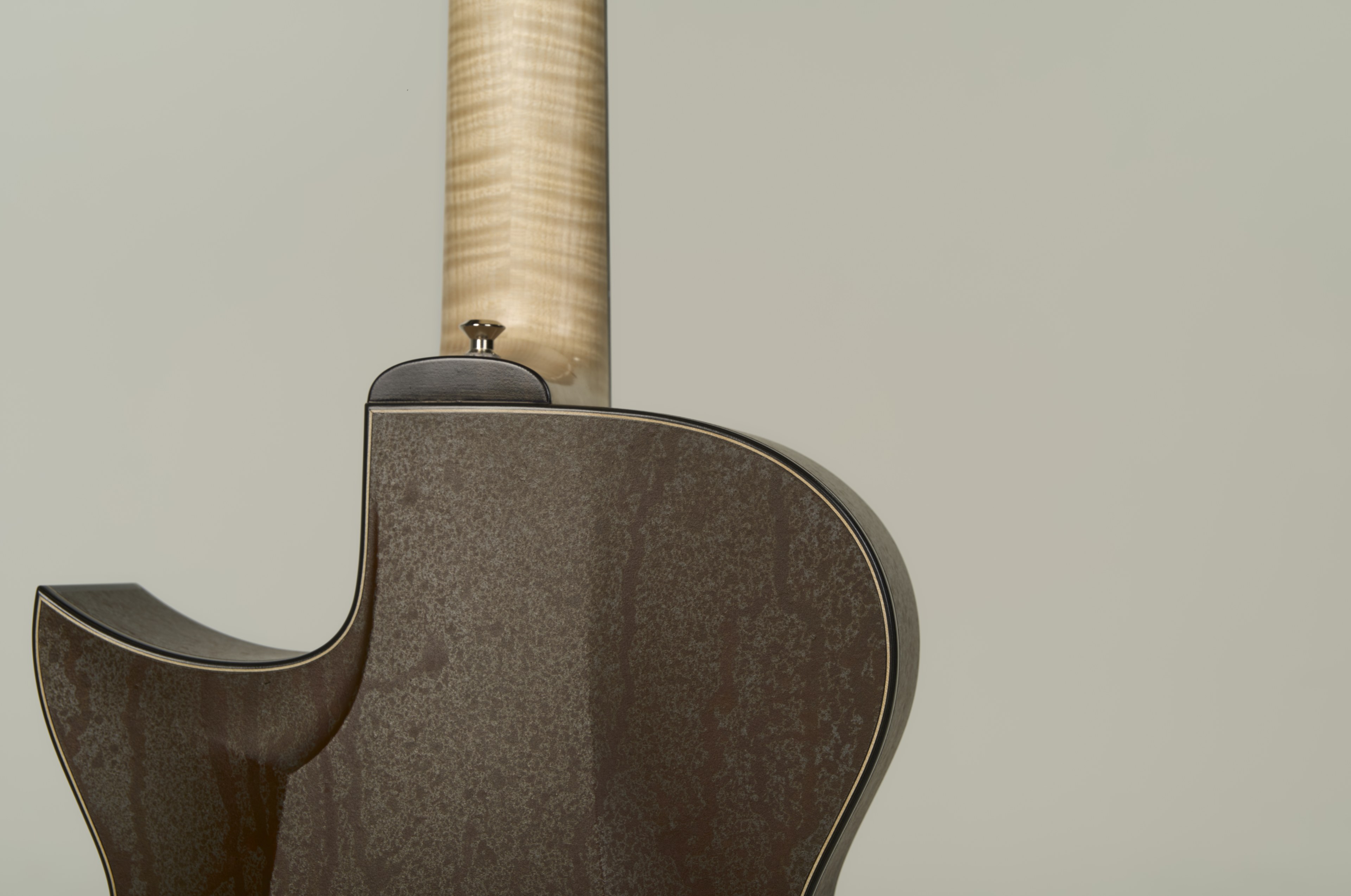
Selected woods and combinations are used for the neck. Stability, weight, appearance, etc. are taken into consideration.
- Maple
- Flamed maple
- Alder
- Walnut
- American walnut
- Cedro
- Mahogany
Scale length
The scale length – meaning the vibrating string length – influences playing feel, string tension and tone. It is selected to suit the instrument, tuning and your personal preferences.
The classical guitar is built as standard with a 650 mm scale length, while the Crossover has a 640 mm scale length.
Multiscale
Fanned frets provide ergonomic playability and balanced string tension.
As I usually shorten the treble string length (e.g. Crossover 650–630 mm), the shorter distances make it possible to play faster.
Neck width
Whether you prefer a narrower neck for a comfortable, modern playing style or a wider fingerboard for classical techniques and complex chords, the neck width is individually determined.
The standard measurement for a classical guitar is 52 mm at the nut, while my Crossover has 49 mm at the nut.
Neck shape & thickness
The neck profile has a major influence on playing feel. Round, flat, substantial or slim – the shape and thickness of the neck can be adapted to your hand and playing style.
However, my standard shape receives such good feedback that hardly anyone makes use of this option.
Neck-to-body joint
The position and design of the neck-to-body transition always depend on the model and cannot be individually changed.
Fingerboard
Fingerboard woods
Depending on the desired appearance, feel and technical requirements, various fingerboard woods are available.
- Plum
- Ebony
- Ziricote
- Rosewood
Fingerboard shape
As standard, I offer three different fingerboard shapes:
- flat
- curved – 20″
- curved – 17″–20″
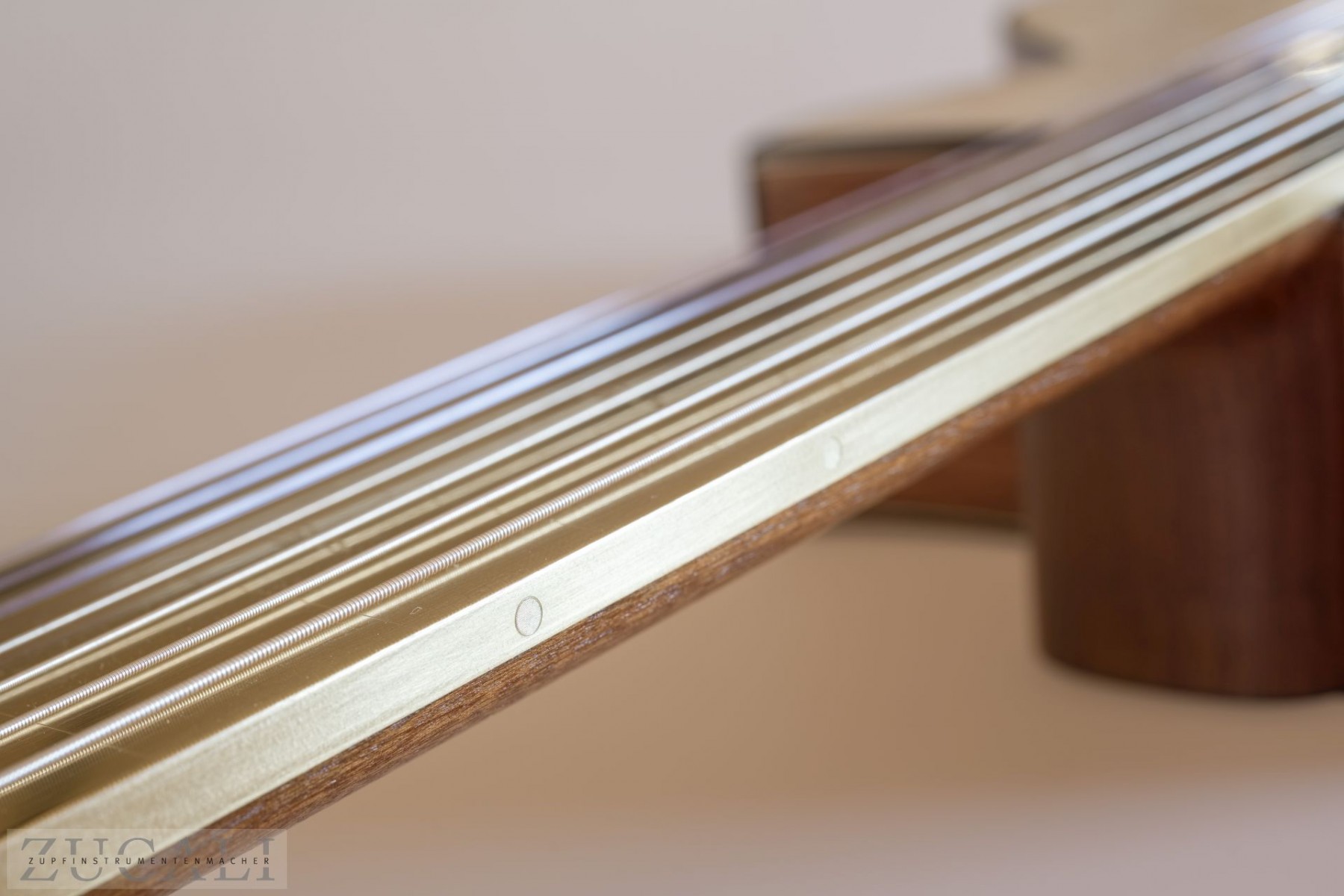
Fingerboard binding & concealed frets
- concealed fret slots on the side
- fingerboard binding
Fingerboard inlays / Side Dots
I use bone of various types, a wide range of woods, mother-of-pearl and much more.
Side dots are standard. Fingerboard inlays can be individually designed upon request (additional charge depending on the amount of work involved).
Number of frets
The number of frets is determined according to the construction, scale length and musical requirements. Special solutions for an extended range are also possible.
20 frets are standard.
Fret material
I use nickel silver for the frets.
Bridge
Bridge materials
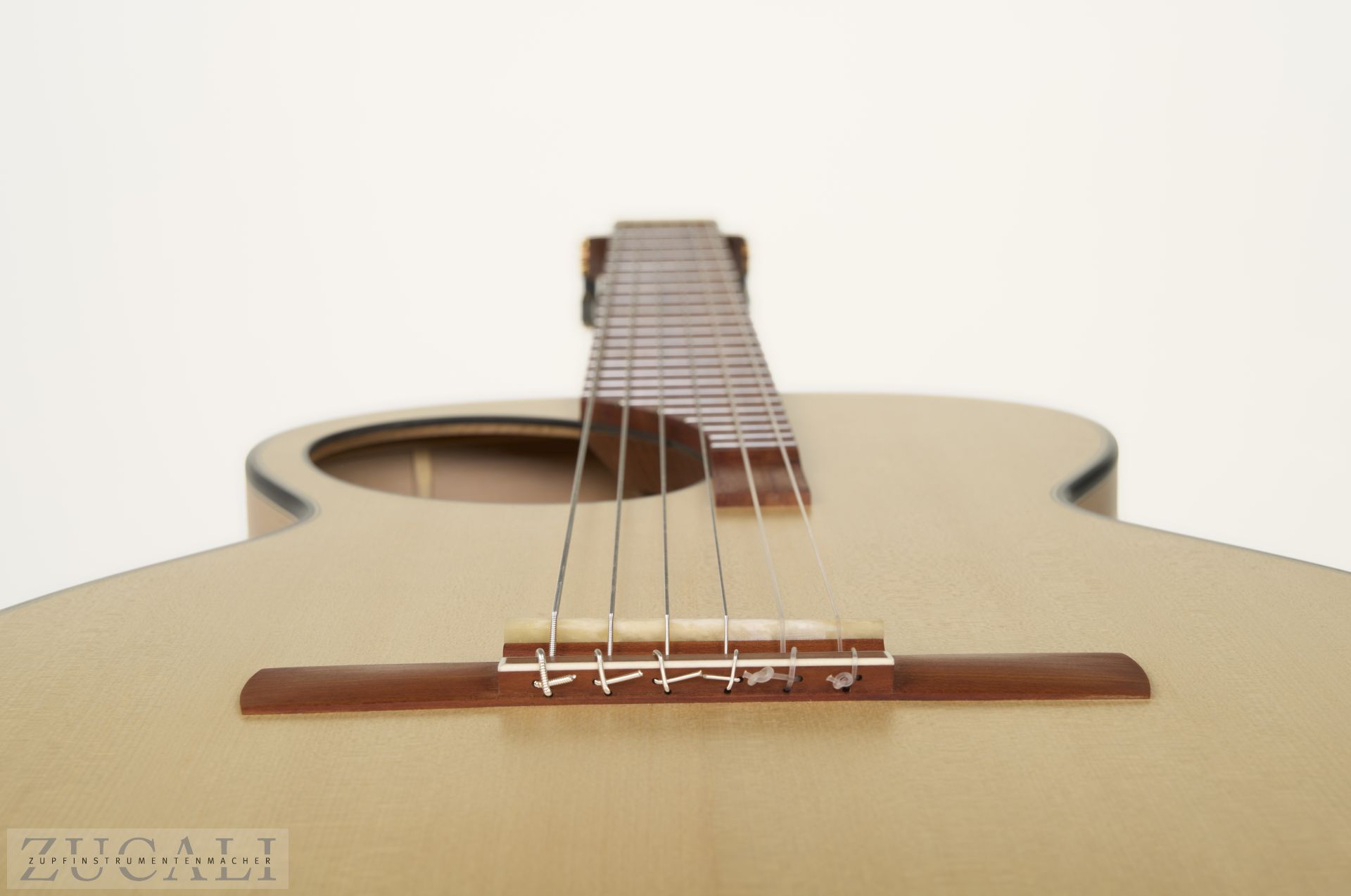
The bridge can be made from different types of wood and is matched to the instrument both visually and structurally.
- Plum
- Santos rosewood
- Brazilian rosewood
- Ziricote
- and many more
String attachment
I prefer double-hole drilling, as this clearly defines the path of the strings.
Other techniques are also possible, depending on your preference.
Compensation
The compensation of each individual string is precisely adjusted to the scale length, string gauge and tuning.
The aim is to achieve the best possible intonation across the entire fingerboard.
Cutaway
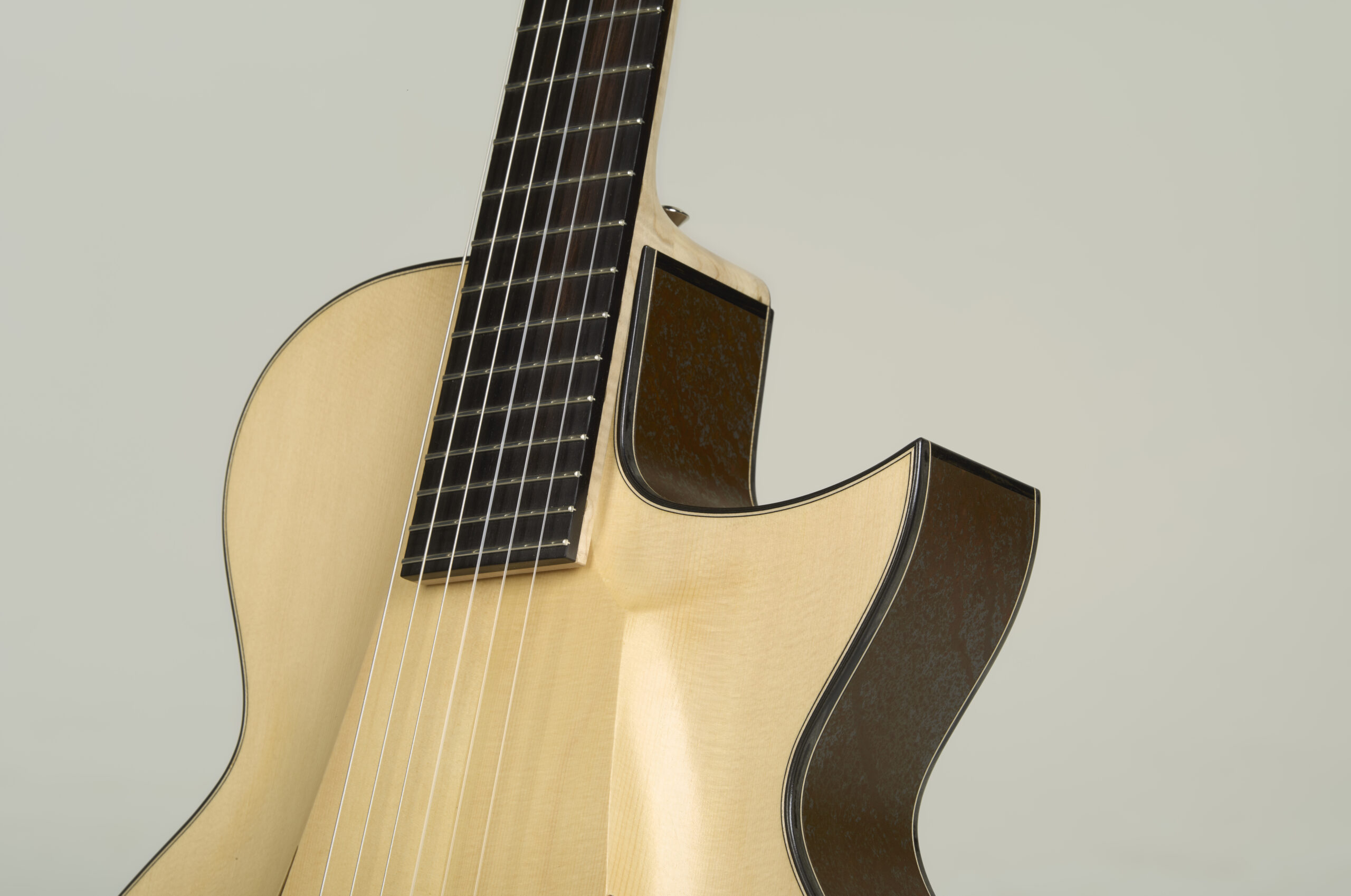
The Crossover and Jazzabella come standard with a Florentine cutaway.
A cutaway is also possible on other models upon request.
Number of Strings
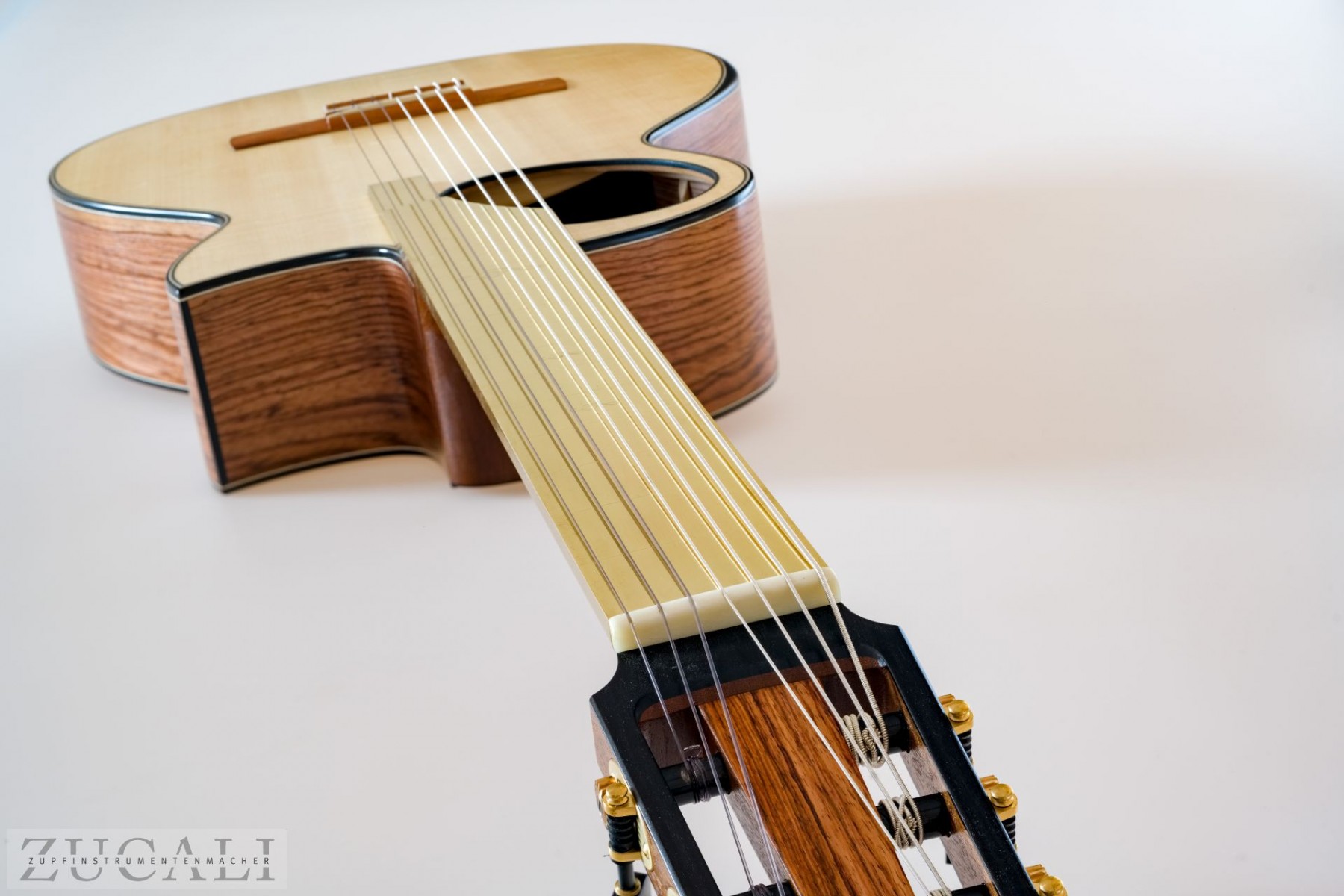
From the classic six-string guitar to instruments with 7, 10 or more strings, individual solutions are possible.
Built examples are collected on the Multi-string page.
Tuning Machines
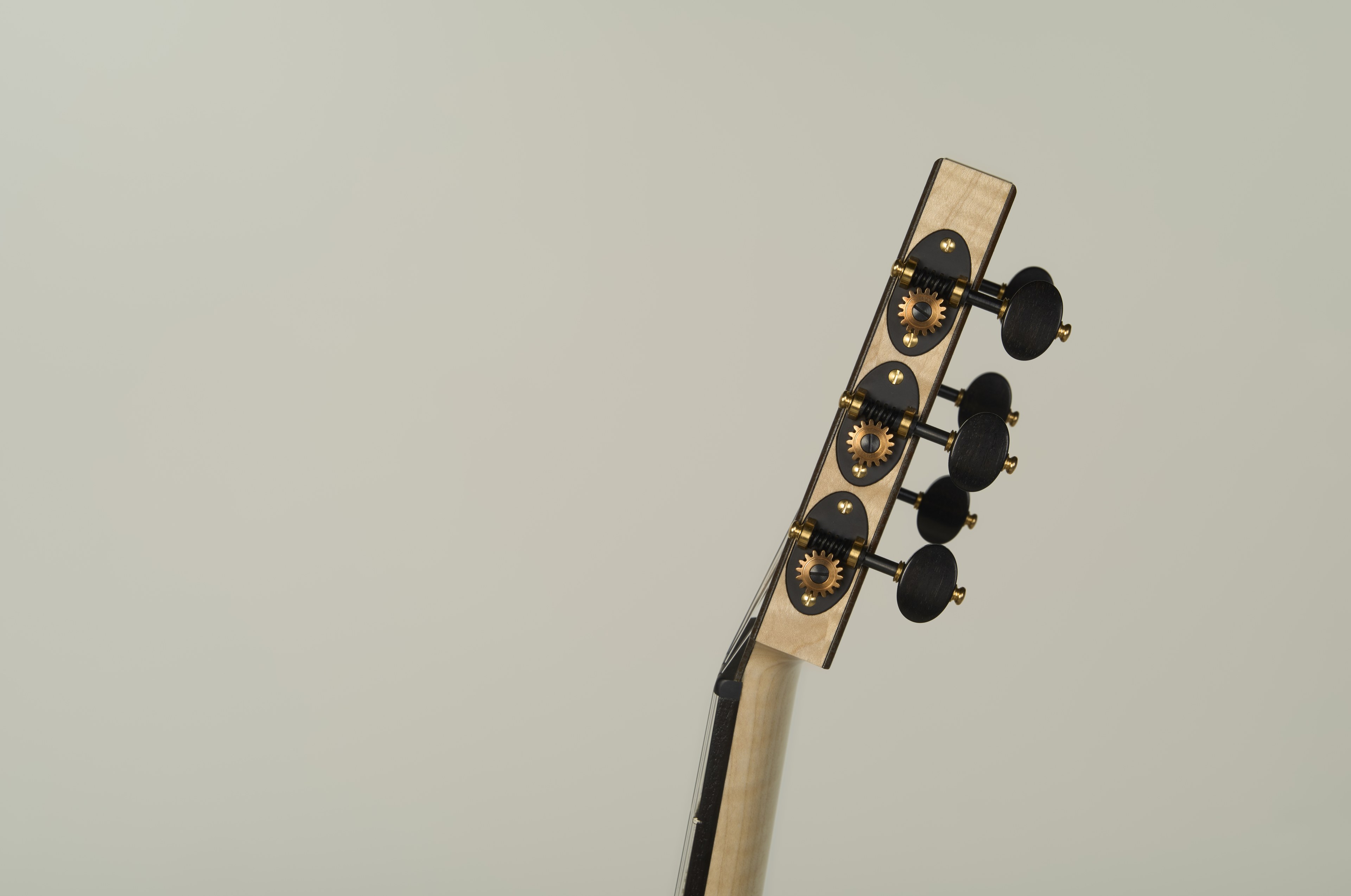
I install (almost) anything that is requested – most customers choose Scheller tuning machines, a German manufacturer offering excellent quality.
Finishes & Surfaces
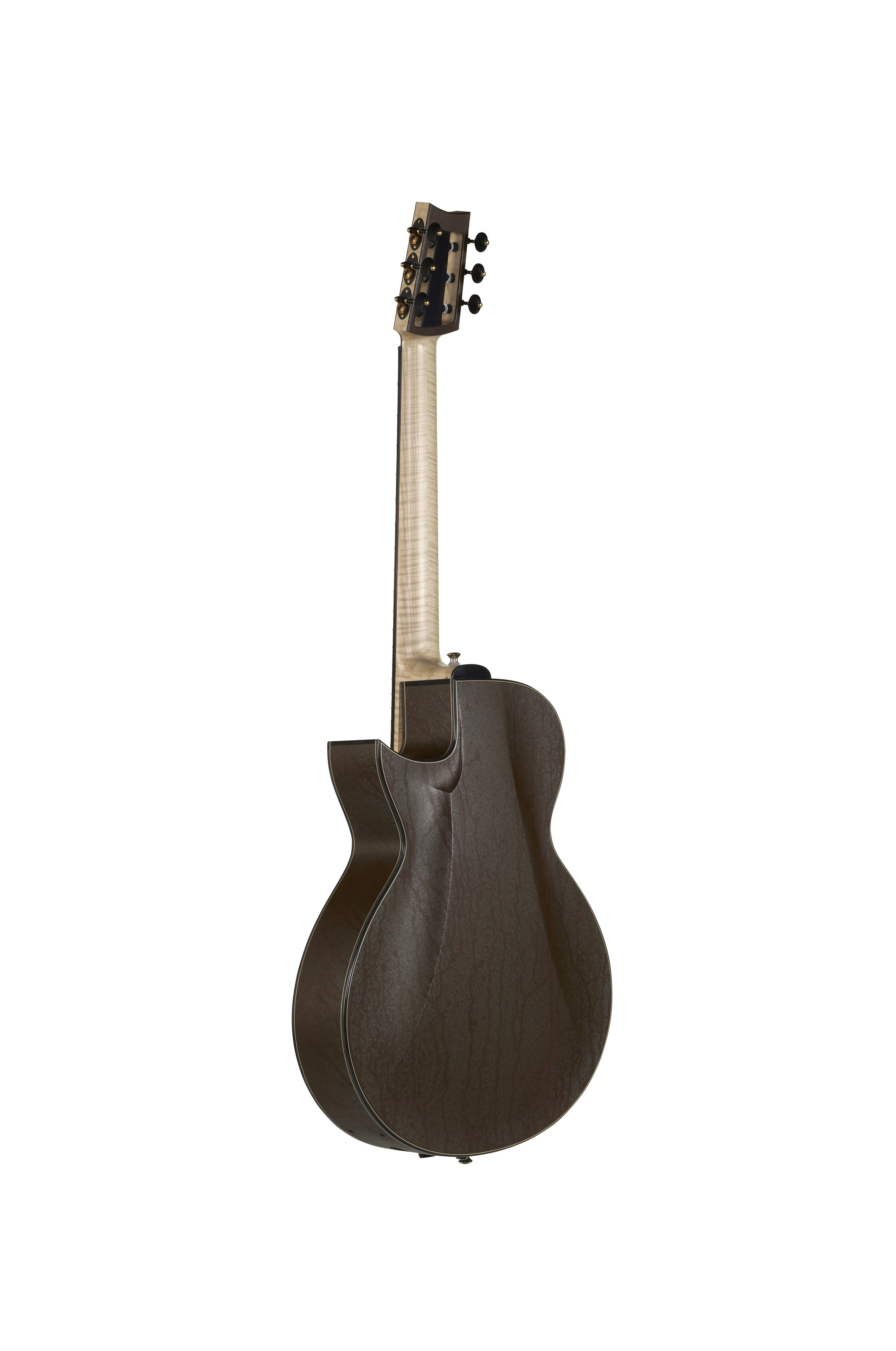
The finish protects the wood while also influencing the appearance, feel and vibration characteristics of the instrument.
The top can be finished either with French polish (shellac) or with a matt finish.
The rest of the guitar can be finished high-gloss, matt or, if desired, waxed.
The matt finish is usually made from polyurethane – it is durable, subtle and pleasant to the touch.
Access Panel
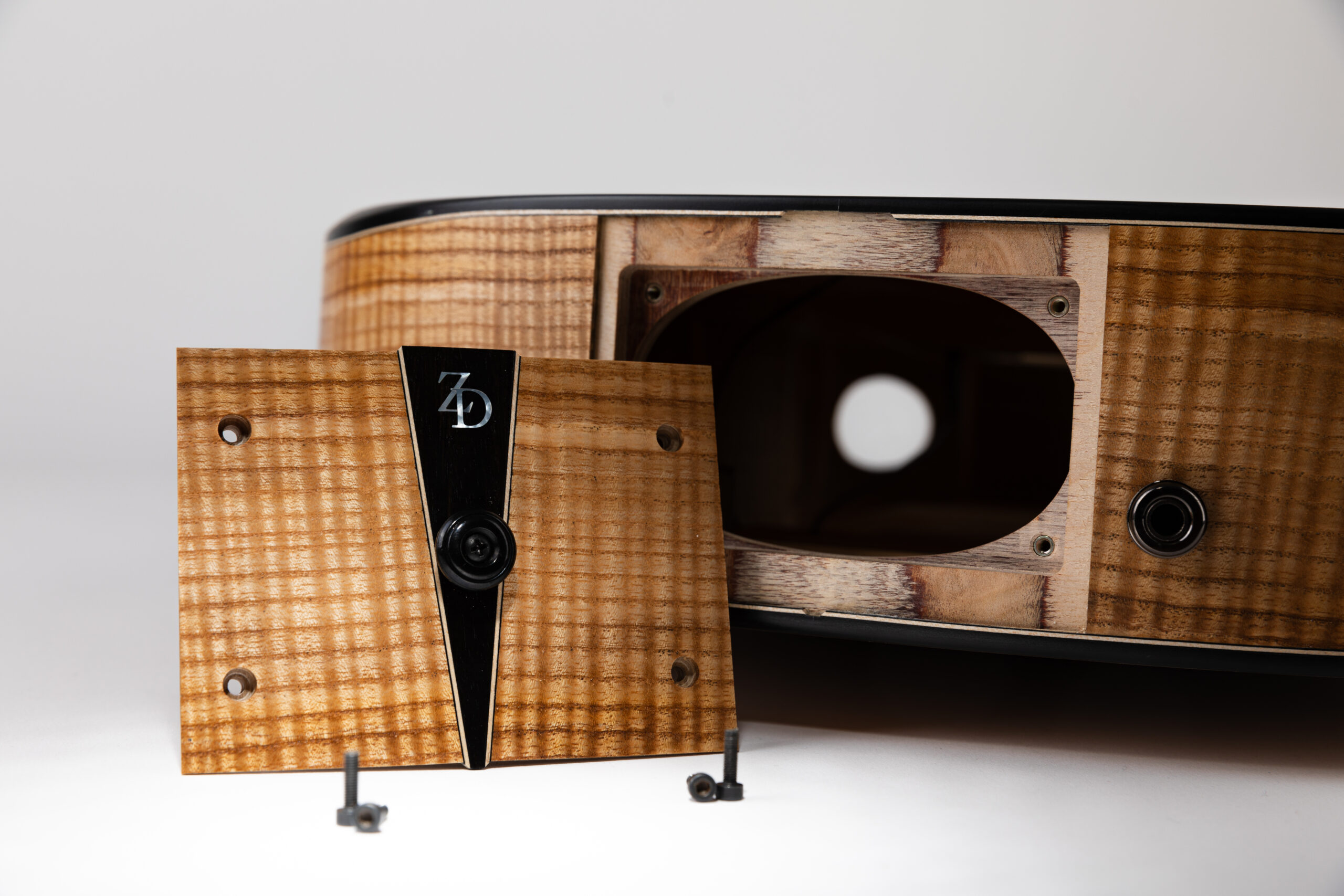
I am one of the very few guitar makers who build in access panels. They are secured with screws and are positioned either centrally at the side joint or slightly offset to the side.
Depending on your playing position, one version may be more practical than the other.
- Central access panel: jack socket below the side joint – practical when the guitar is worn with a strap or played relatively flat on the right leg.
- Access panel below the centre: Ideal for the classical playing position, as the jack socket is positioned at the side joint and therefore does not interfere with the thigh.
Strings
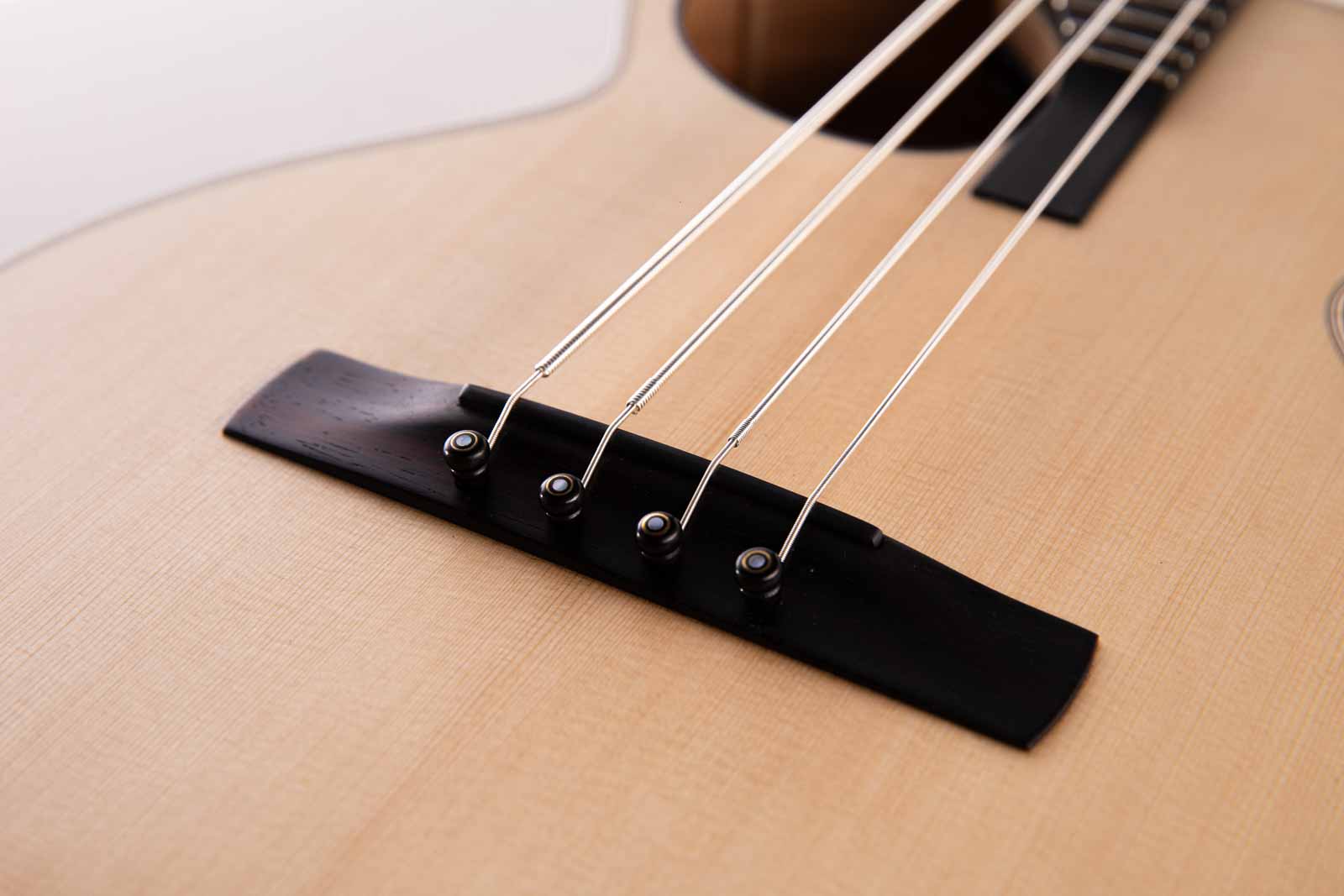
The choice of strings is an important detail. Material, tension, gauge and string type influence response, tonal colour and playing feel.
At present, I mainly use:
- Savarez 510 MRP
- Savarez 510 AJP
Ultimately, string choice is a matter of personal preference – every guitar responds differently, and over time every player finds their own favourites.
Inlays
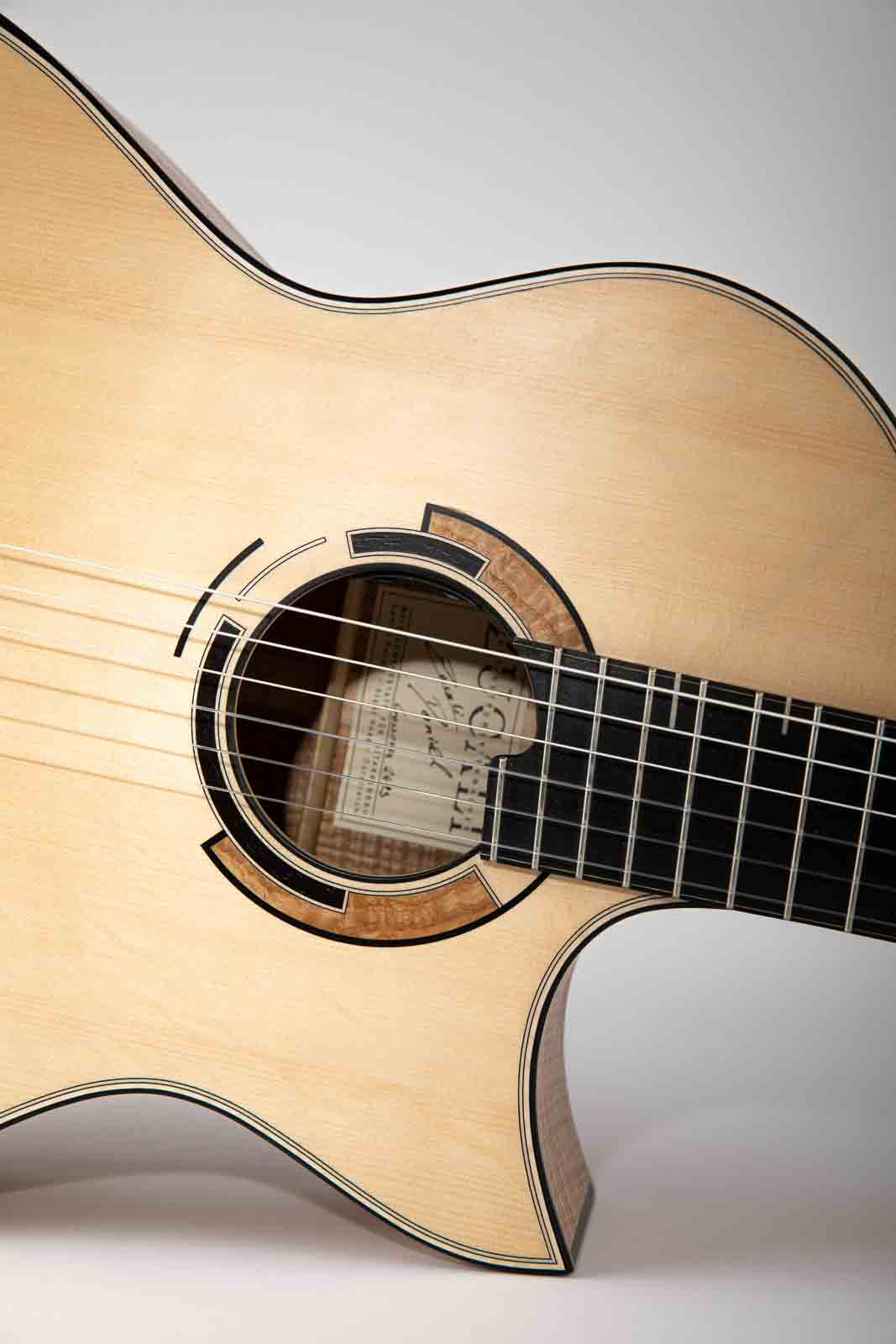
The possibilities for personalizing a guitar are virtually endless. They range from small, subtle symbols, visible only on closer inspection and perhaps holding a special meaning for the owner, to bold decorative details that turn the instrument into a real eye-catcher.
There is also plenty of room to explore different materials. Mother-of-pearl, bone, and a wide variety of woods offer an array of colours, textures, and design possibilities. Whether you prefer something understated and elegant or elaborate and expressive, we can create a design for your guitar that reflects your personal vision.