Guitar building
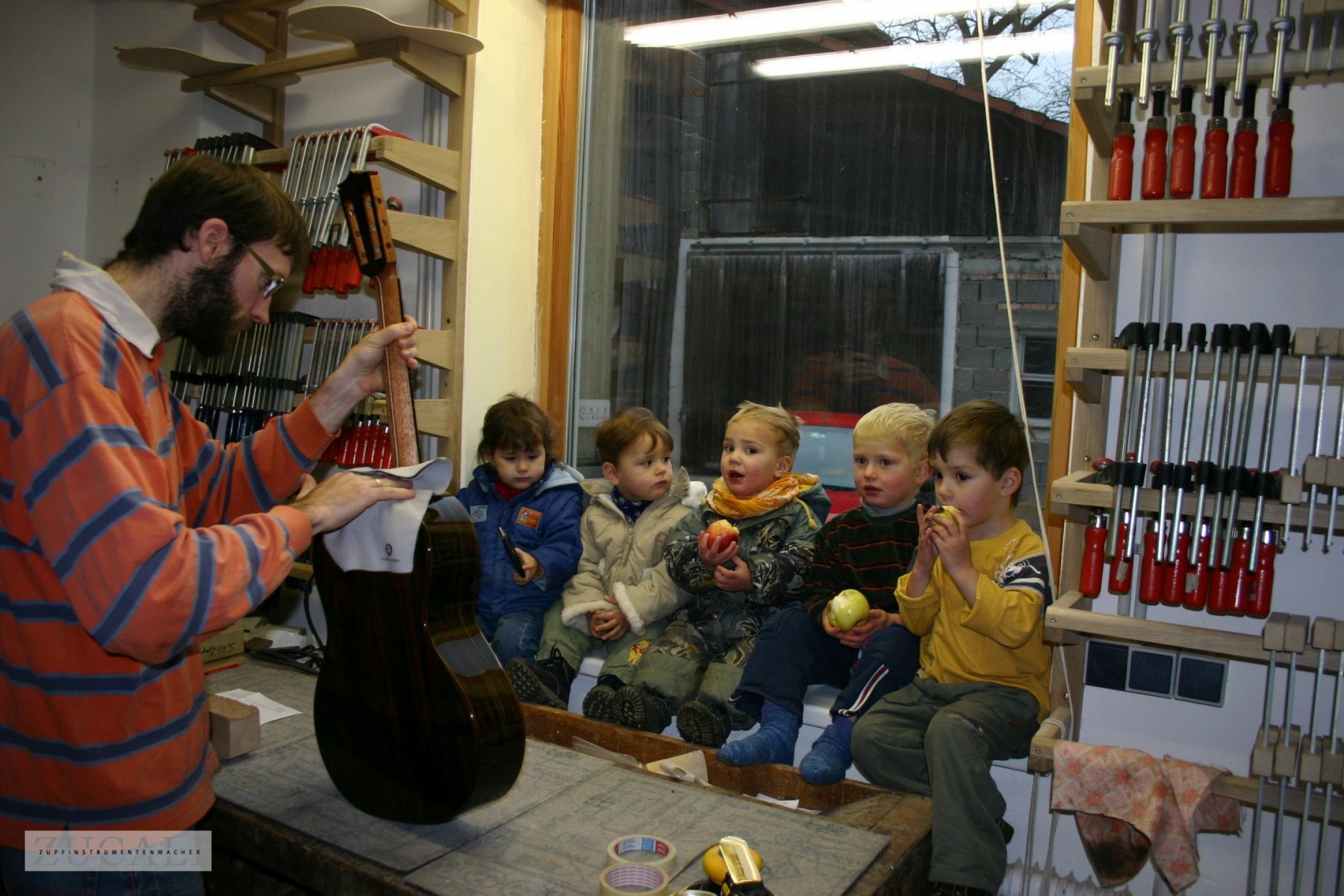
Anyone working in a creative and constructive profession knows the feeling of a deep connection to their works. Each guitar tells its own story from the very beginning. My instruments are individually crafted and each carries a piece of soul within.
Watch your thoughts! They are the initiation of your actions.Chinese wise proverb
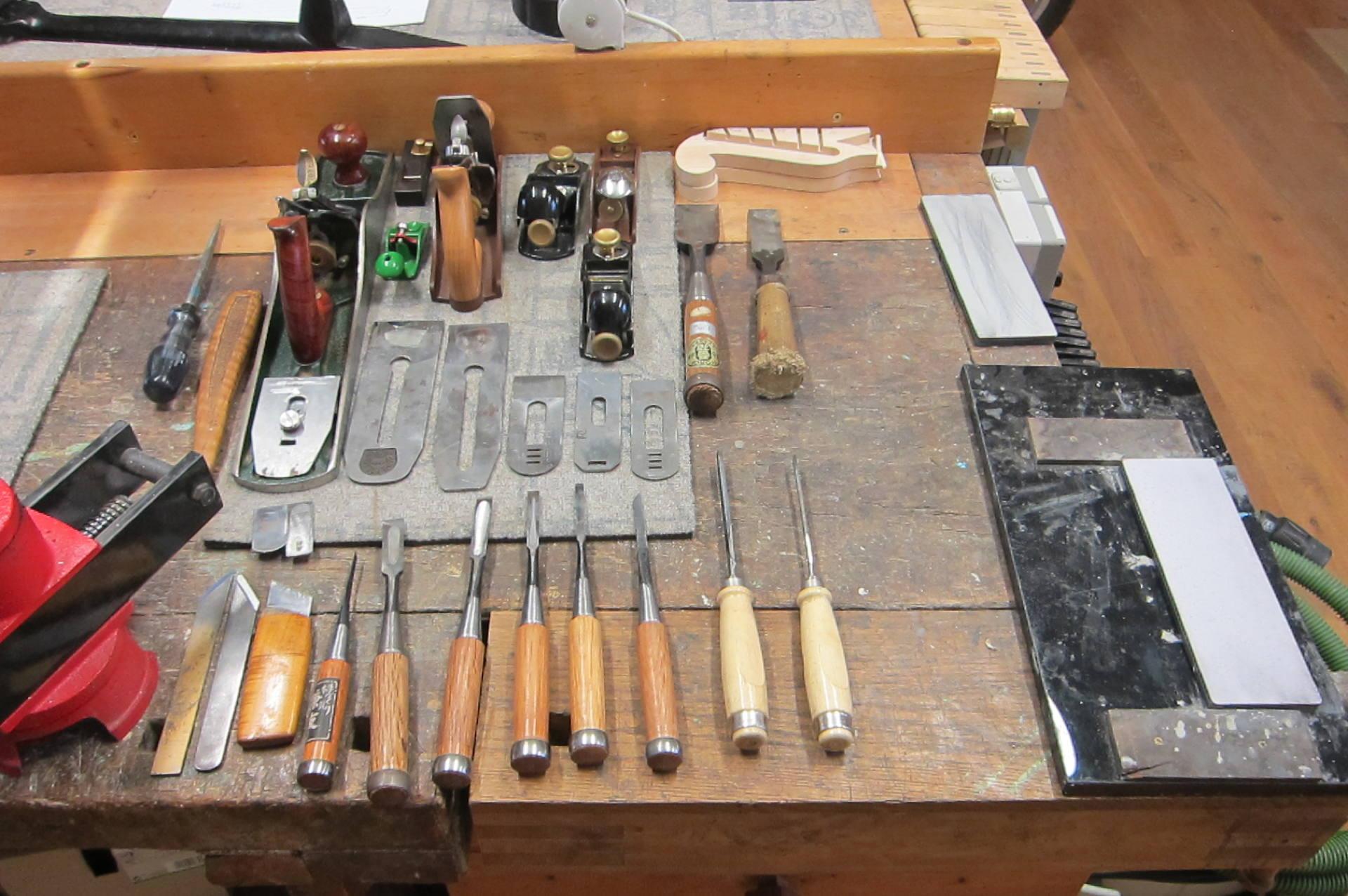
Planning
Before a guitar can be built, many decisions must be made and plans drawn.
Most of the time, I build guitars to order. In a relaxed conversation, I listen to what kind of music the person plays, what preferences they have, and of course, how they play the guitar. Based on the information I receive, I plan the guitar together with the musician.
The more unusual the requests become, the longer this process takes. Once all the details are finally settled, the client chooses the wood.
This is the beginning of every guitar …
Fantasy is more important than knowledge for knowledge is limited and fantasy surrounds the entire world.Albert Einstein (1879 – 1955)
Beauty is no quality in things themselves: It exists merely in the mind which contemplates them; and each mind perceives a different beauty.David Hume (1711 – 1776)
Surface Treatment
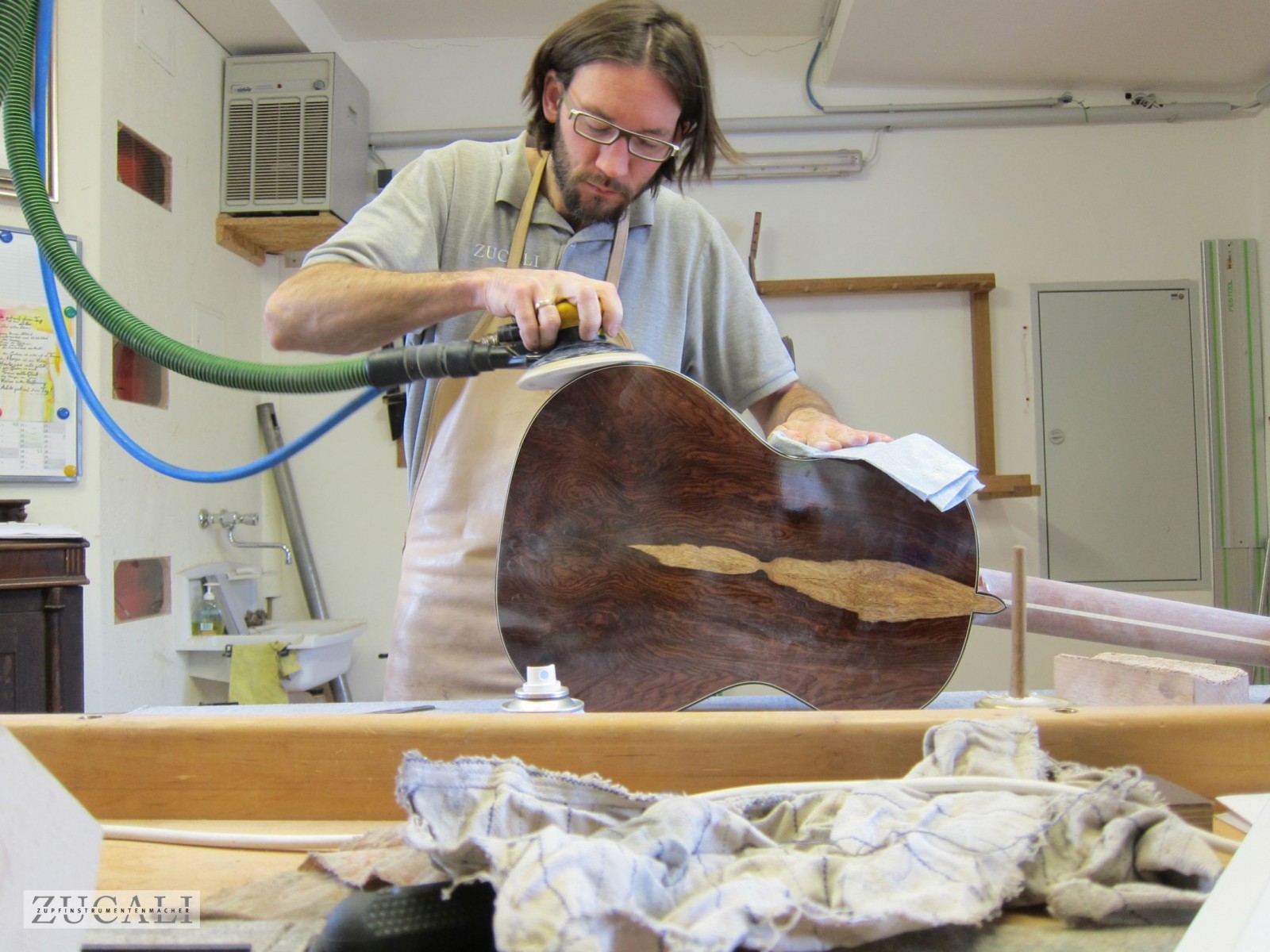
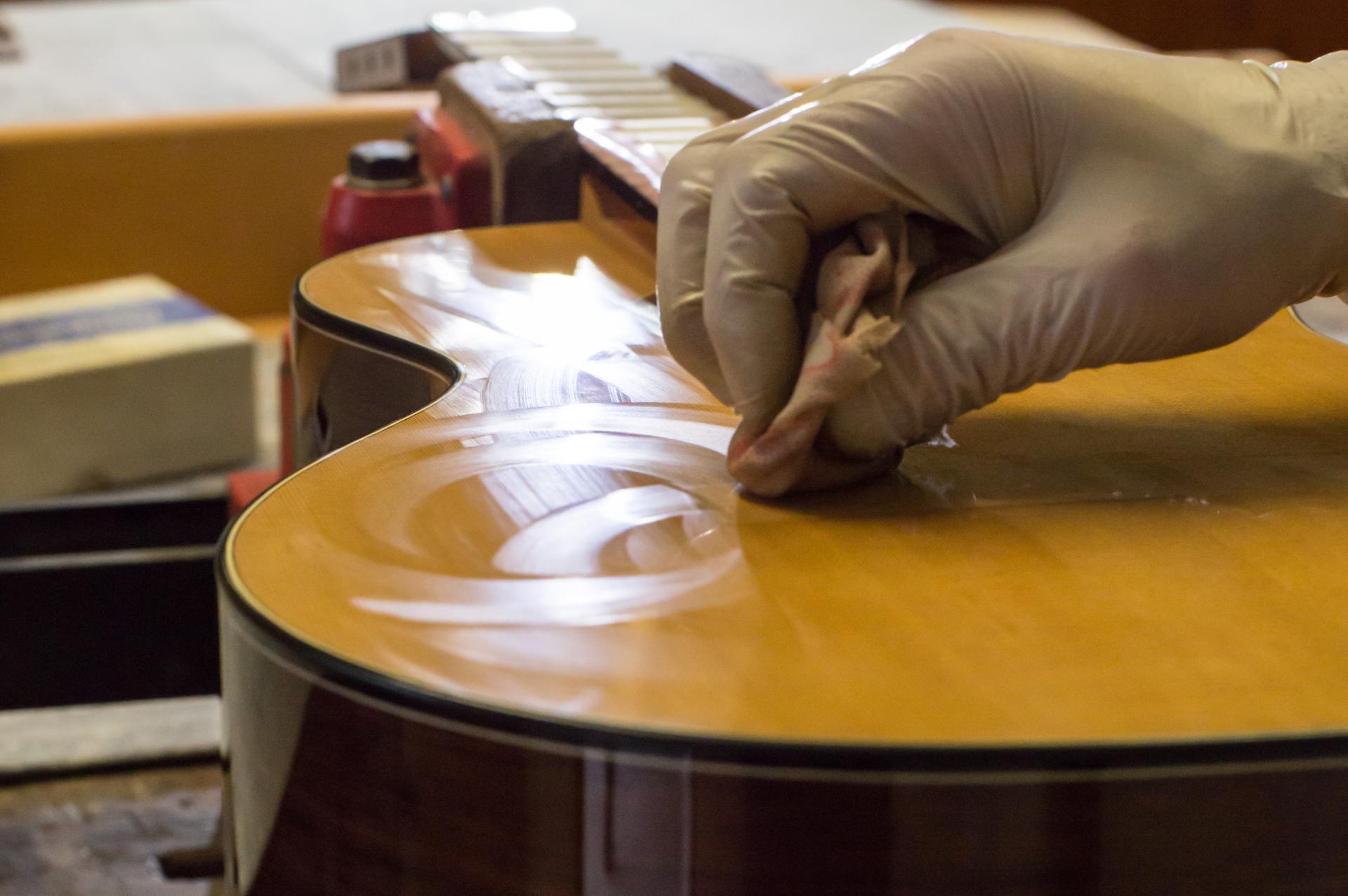
There are several methods for treating the instruments’s surface. I use these to finish my guitars… wax, open-pore matte lacquer, high gloss finish with nitrocellulose or polyester lacquer and shellac.
The material chosen will influence the sound of the guitar, and the amount of surface coating used is vital because wood changes its dimensions with the varying relative humidity. In order to withstand these movements, the surface treatment must be elastic. Last but not least, each type of surface treatment has a certain weight to it, and using too heavy a finish can make the soundboard sound dull.
- Wax
In order to seal the pores of the wood to minimize any dirt getting into them, I prime the guitar, for example with shellac. Then I apply wax, which results in a beautiful, semi-gloss surface which can easily be touched up. This is the most minimalist finish I offer.
- Open pore matte lacquer
In this case I don´t fill the pores of the wood. Only two coats of a lacquer are required for a open pore matte surface treatment: one to prime, and then a second coat. This treatment is a bit more robust compared to a wax finish, however it is also a little heavier.
- High gloss lacquer
In order to achieve a high gloss finish, all the pores of the wood must be completely filled. With most types of lacquer, the final coat is sanded with an extremely fine grit and then polished. This surface treatment is much thicker compared to wax and matte lacquer options. For this process I use two different types of lacquer: nitrocellulose and polyester.
Nitrocellulose lacquer dries through the evaporation of the solvent contained in it, and this process allows the lacquer to meld into any lower layers. This means that a good bond can be achieved between old and new lacquer, which is important for repairs and restorations. However, because it has a low count of solid particles, many coats of this lacquer are required.
I mostly use polyester based lacquer. This is a two component product consisting of hardener and lacquer, and has a slight bonding delay which means that much more care must be taken during application as mistakes cannot be easily rectified. However, because it contains high volume of solid, a beautiful high gloss finish can be achieved with only five thin layers.
Shellac is the most highly-prized finish for any guitar.
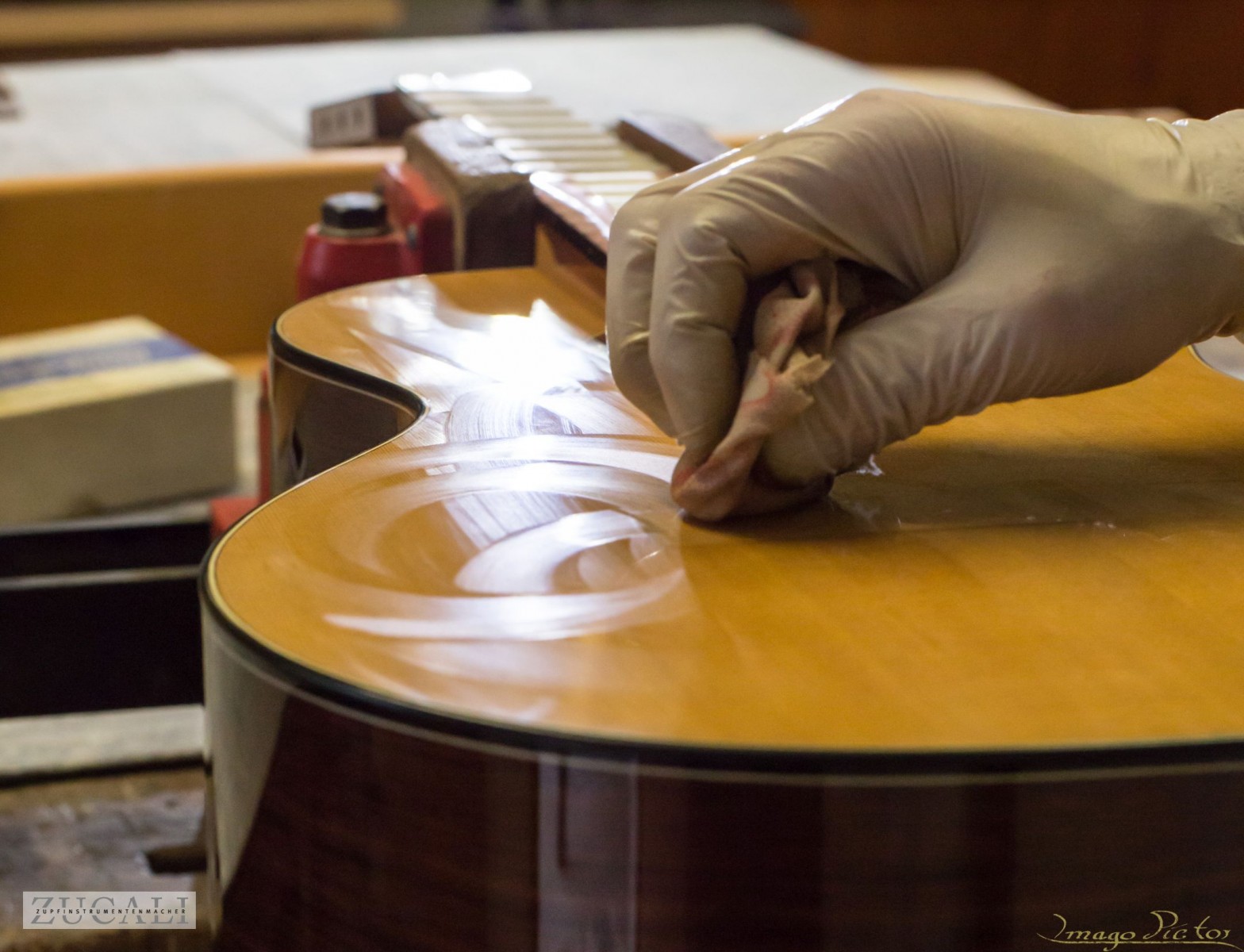
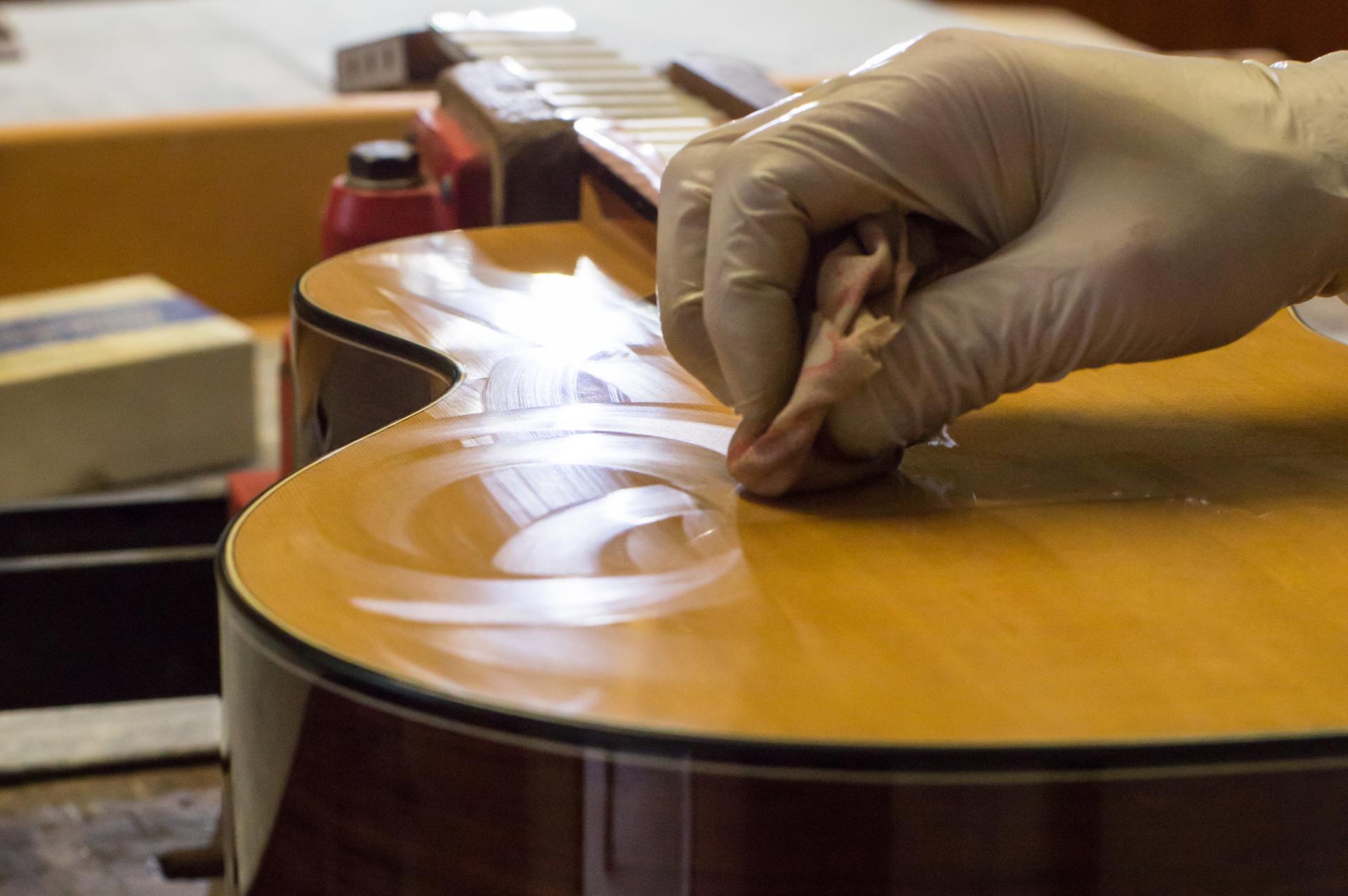
The Kerria Lacca insect inhabits a range of host plants, living off their saps. The lac insects then excrete a kind of wax through special glands, and wich they use to make their cocoons. Once the young insects hatch, the cocoon falls from the tree and is further processed, until it lands on my workbench and is dissolved in alcohol. I then carefully apply the dissolved lacquer with a polishing pad, using approximately 20 coats.
I do not know any other type of lacquer with which you can achieve a high gloss finish which is only 30µm (micrometres) thick. From an acoustic point of view this means that the shellac lacquer is the best possible option to finish a soundboard with.
Of course shellac has also disadvantages. It’s very sensitive to physical influences, perspiration or even the body heat of the guitarist can soften the lacquer. For this reason, I only apply shellac to the soundboard of my guitars.
If you always play by the rules you will miss a lot of fun.Katharine Hepburn (1907 – 2003)
German / Spanish construction
A very basic decision and much-discussed topic is the subject of German or Spanish construction.
Both methods can by carried out in high or low grade. I’m of the opinion the style is not a quality feature.
A brief historical review: … With the conquest of 1805 by Napoleon, Vienna became a cosmopolitan melting pot. In hope for a better life, many people now moved into this thriving metropolis. For 50 years, until the March revolution and the arrival of Empress Elisabeth I. Vienna was the center of the guitar world. For luthiers there now was a lot of work and some used this opportunity to make a name for themselves. Much knowledge was developed and carried into the world, namely to Germany. This established the so-called “German construction”.
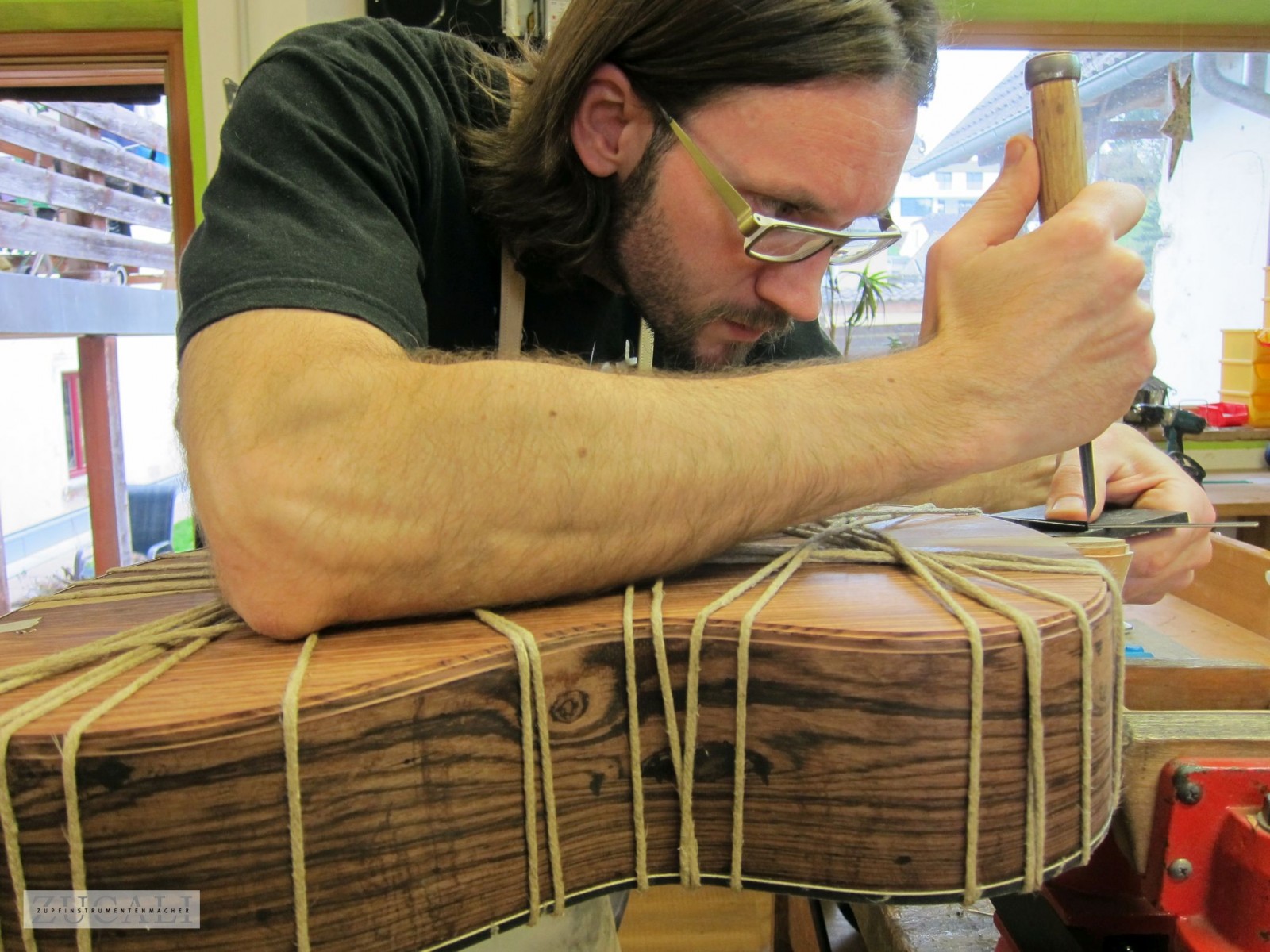
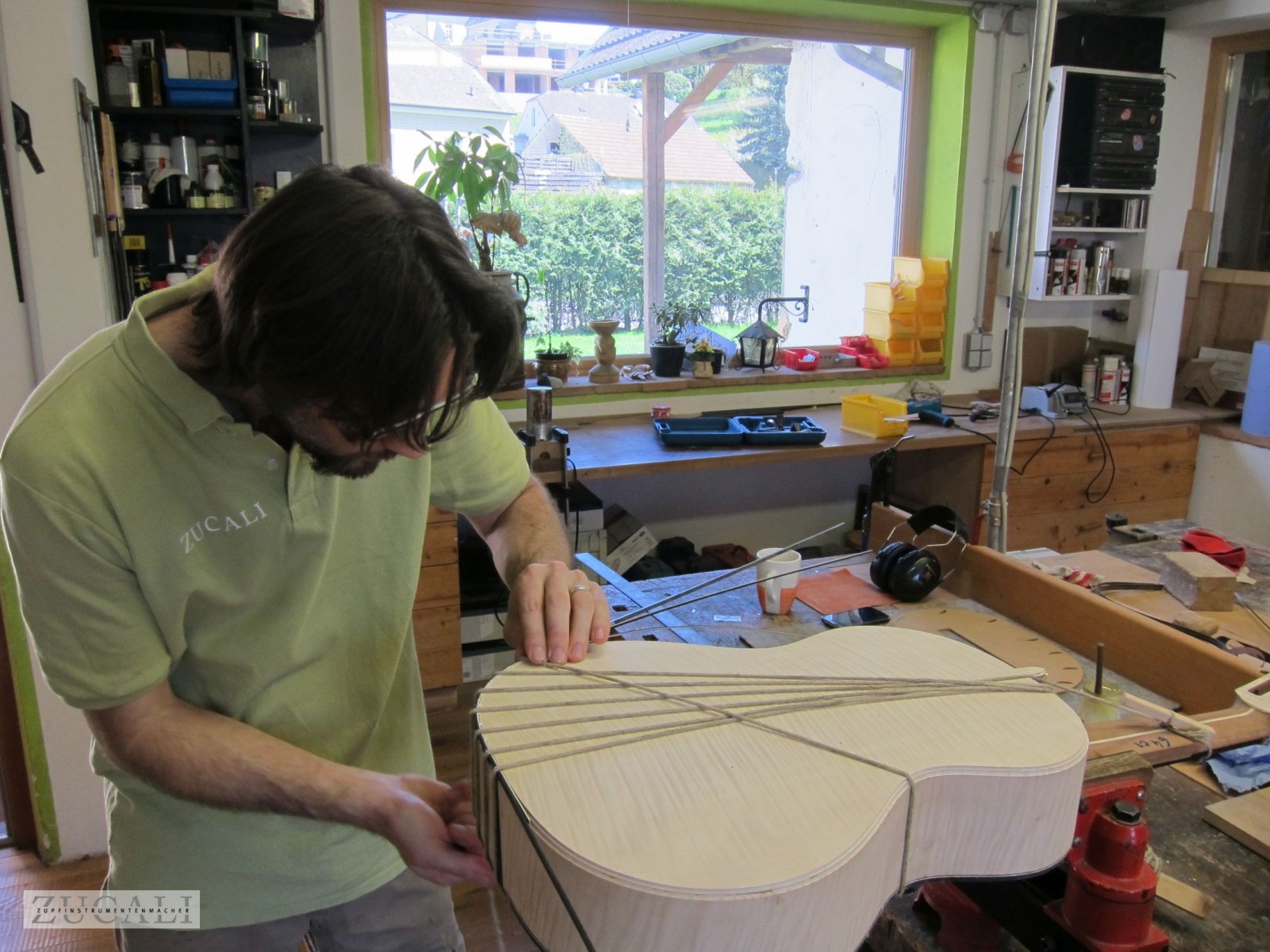
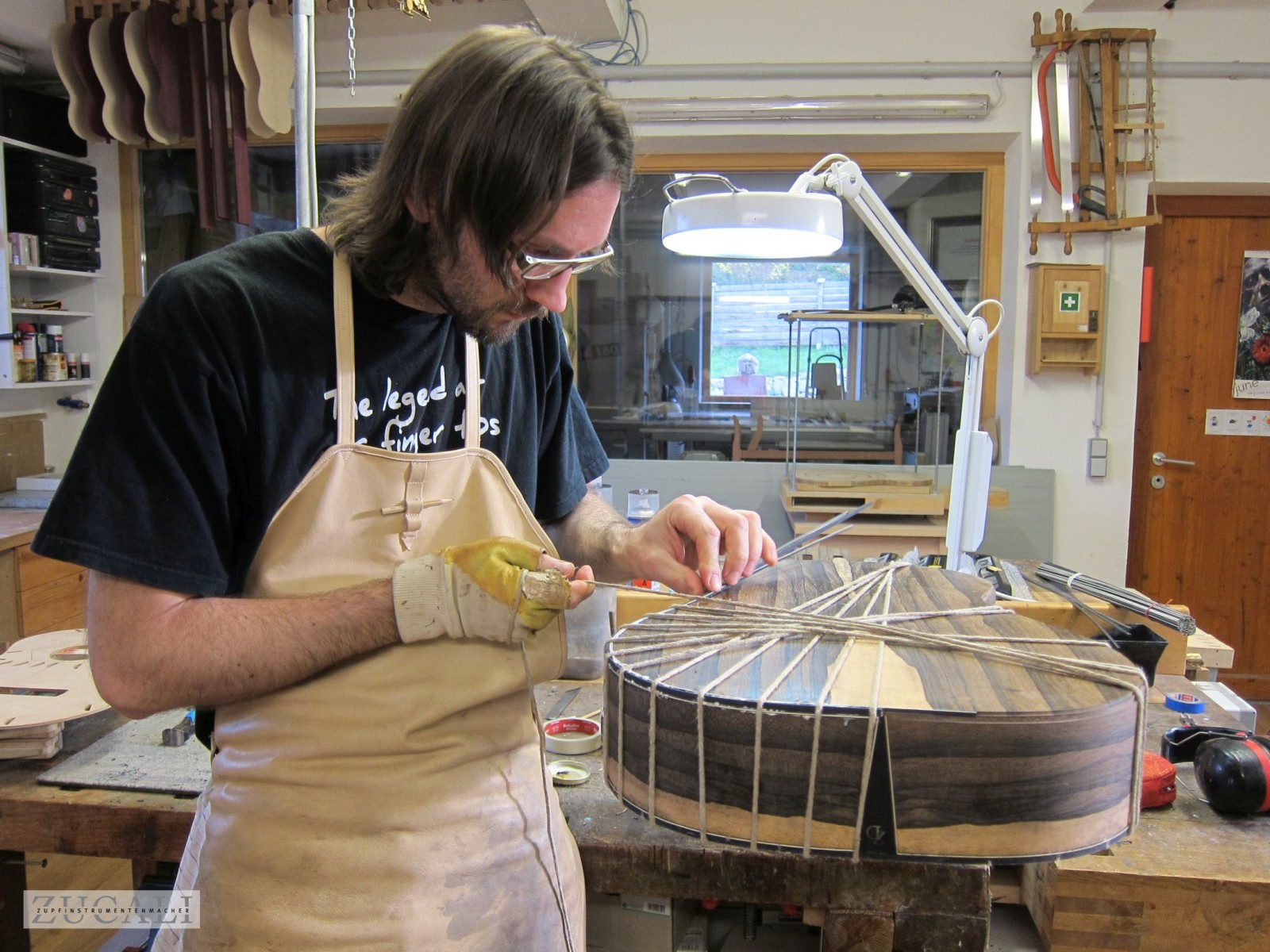
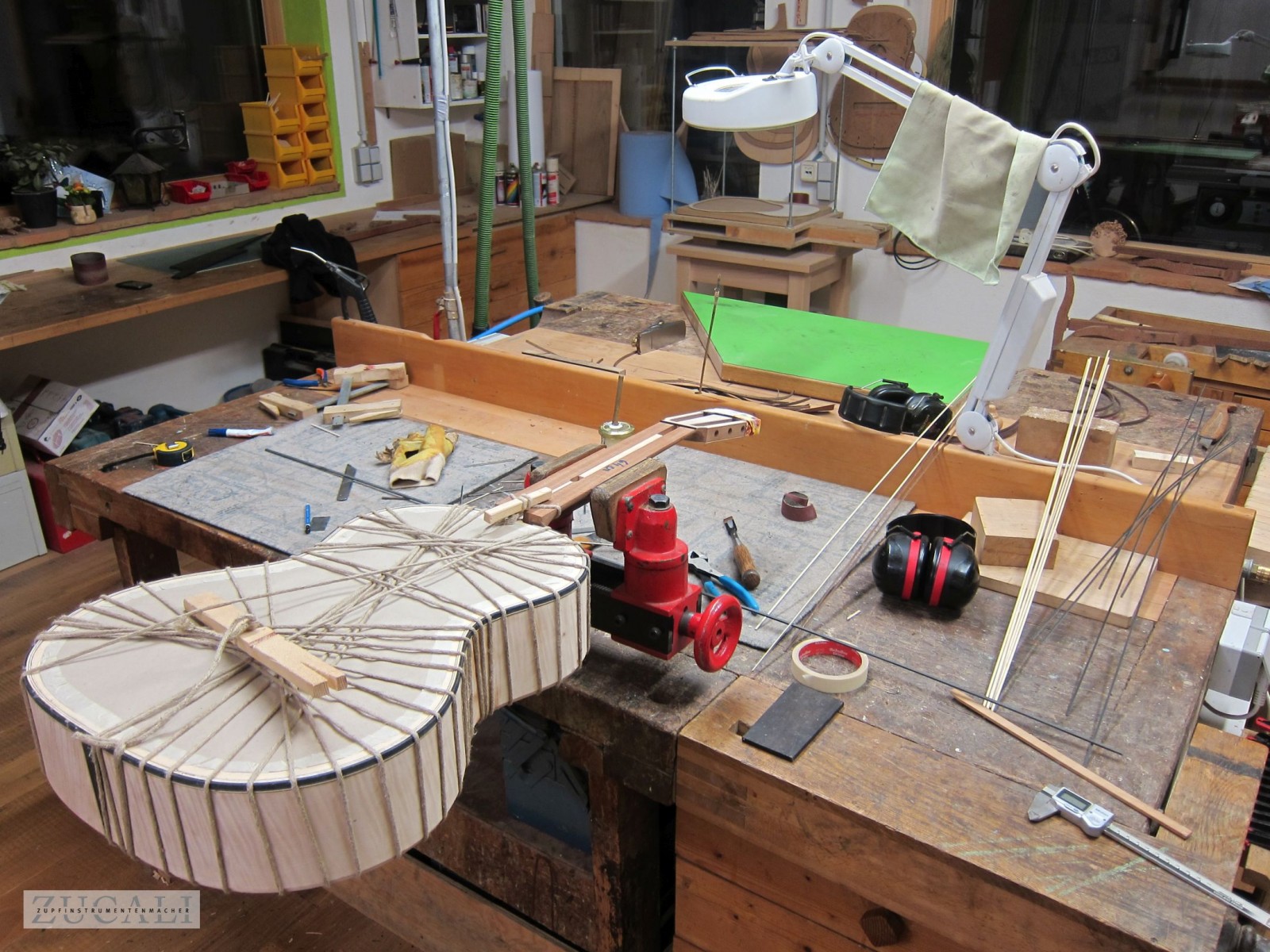
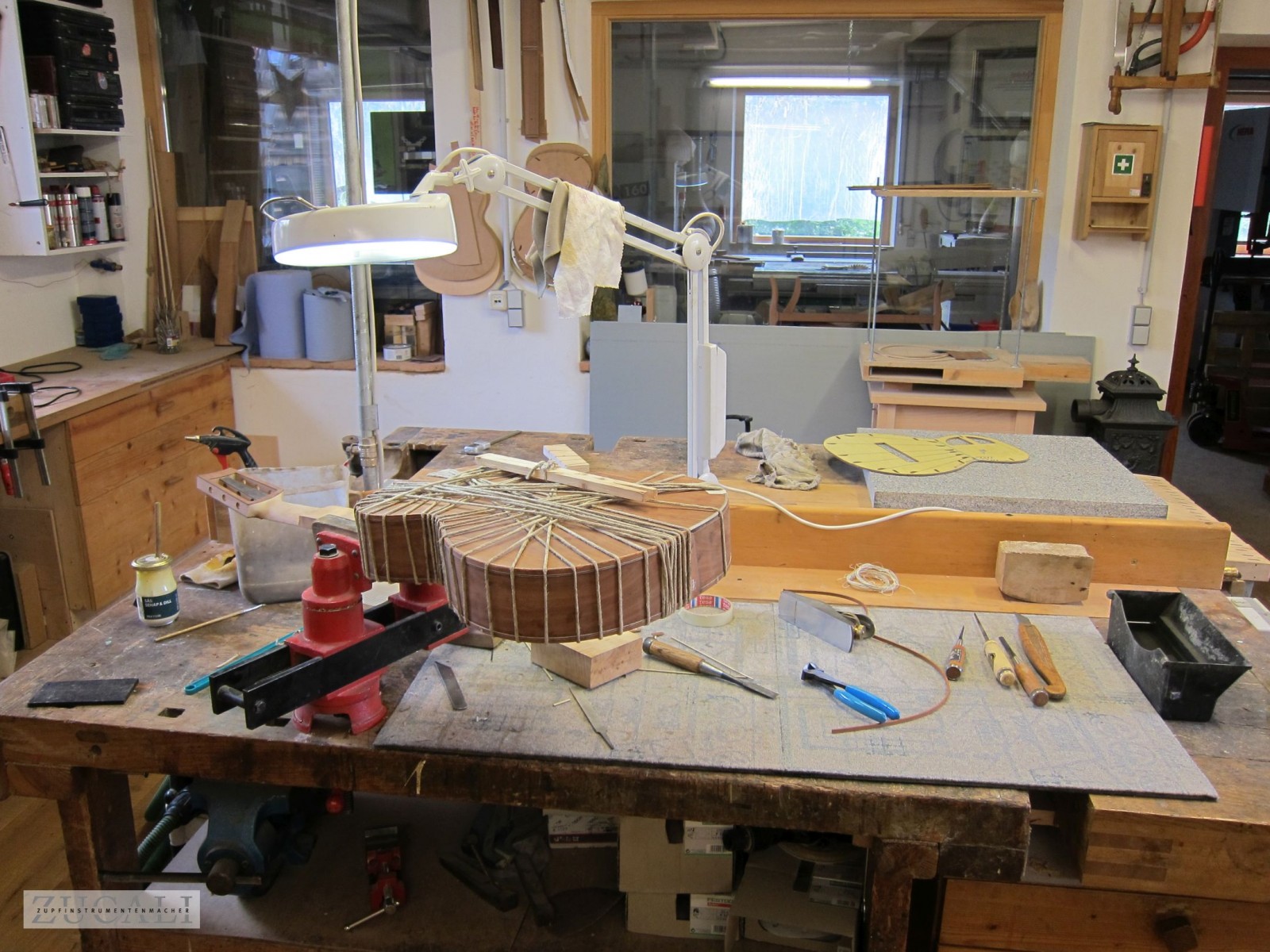
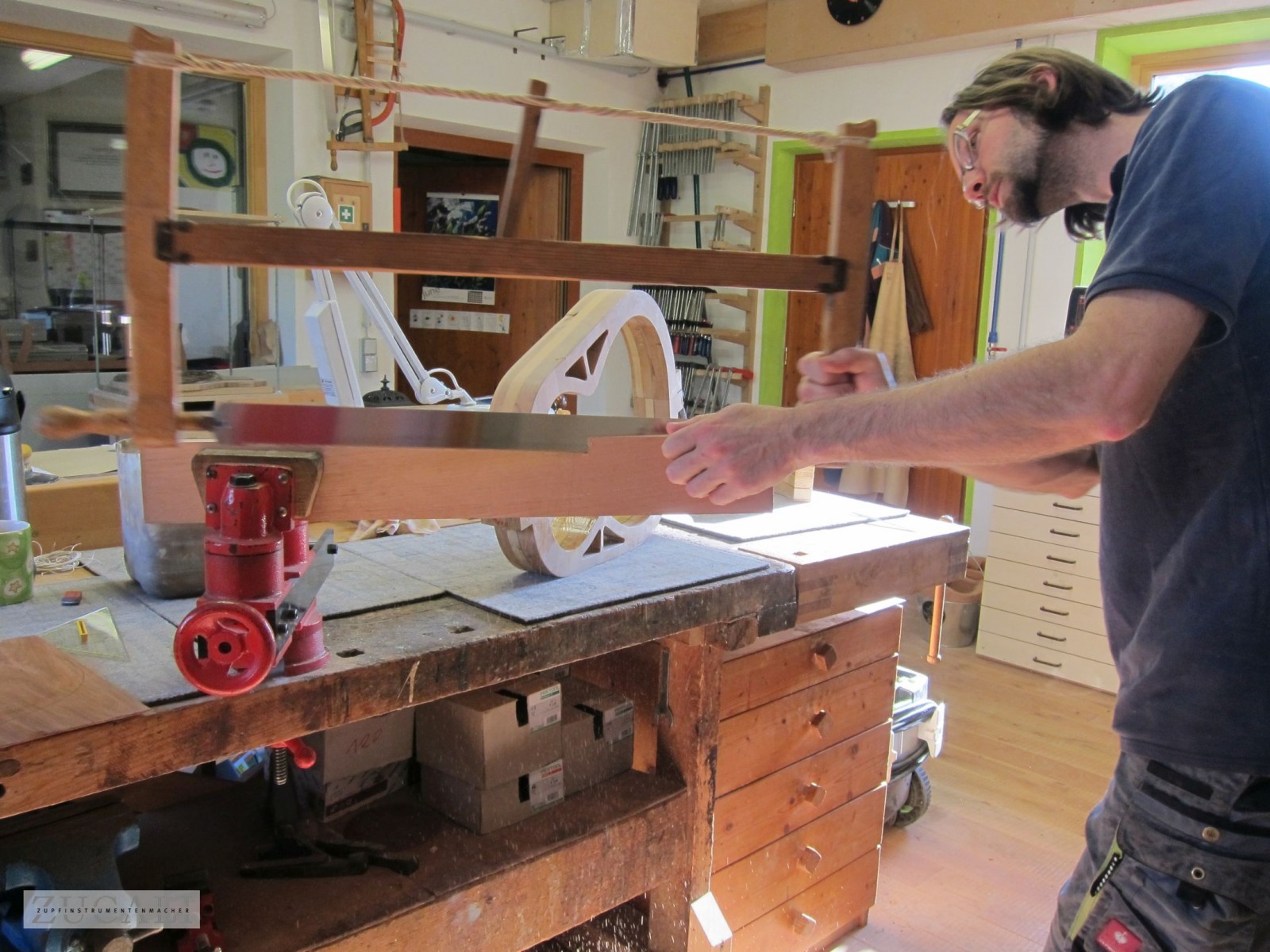
Let’s look at Spain during this time and we see many political upheavals which make life difficult in the country. The luthier worked with minimal tools in their tiny workshops. And thanks to mother of invention the Spanish luthiers were able to replace vises commonly used today with a single string. This tool is one of the most important in my workshop! While the guitar experienced a boom in Vienna with everyone inclusive nobility, it was “only” the instrument of the common folk in Spain and rarely seen at the royal court. Simultaneously with the mid-19th century collapse of the guitar scene in Vienna, the rise of the guitar building art began. With Antonio de Torres pioneering this, the “Spanish construction” became known throughout the world in the Spanish guitar.
So what is the difference between the Spanish construction and the German? Essentially, it is how the guitar is assembled.
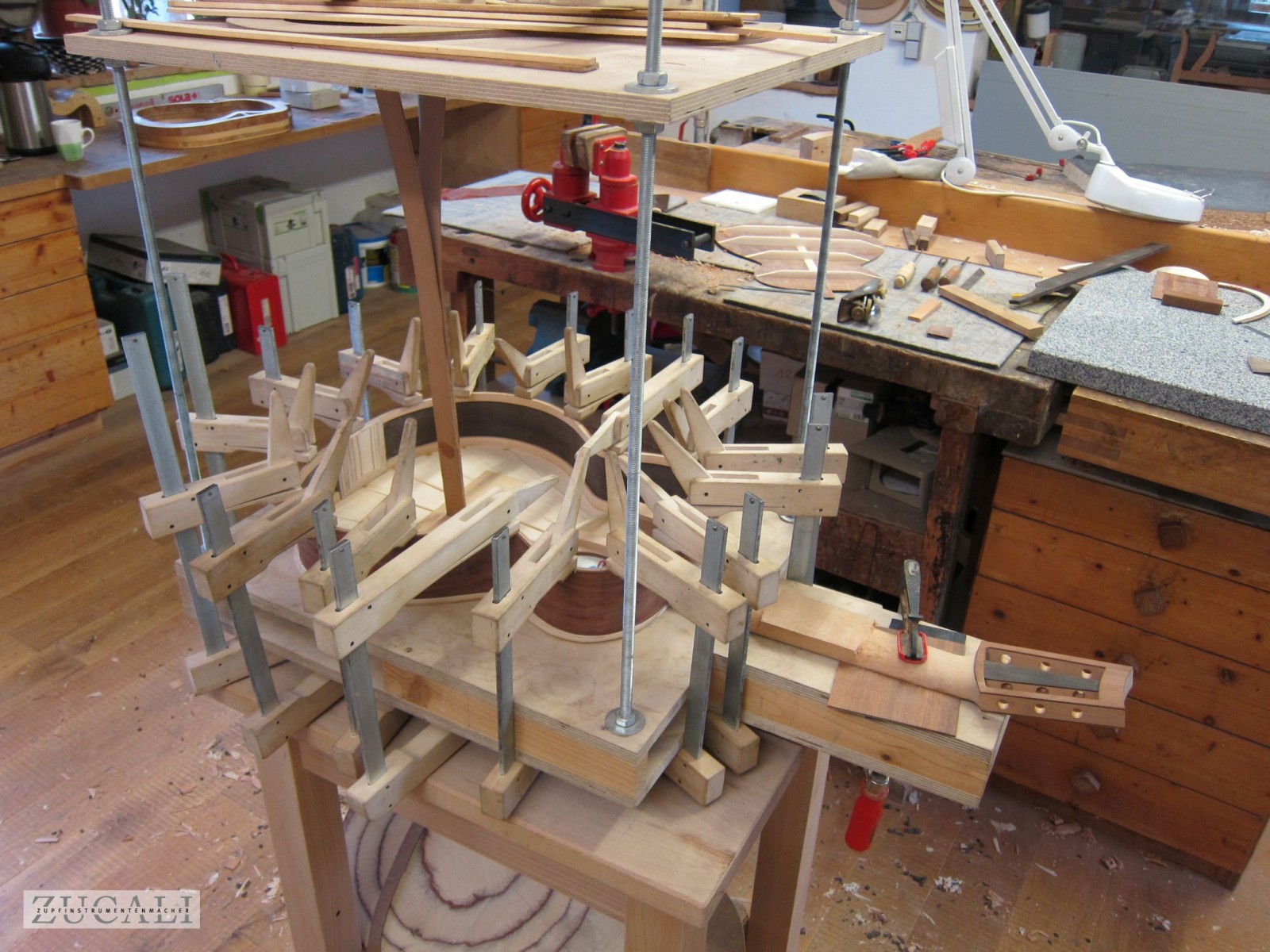
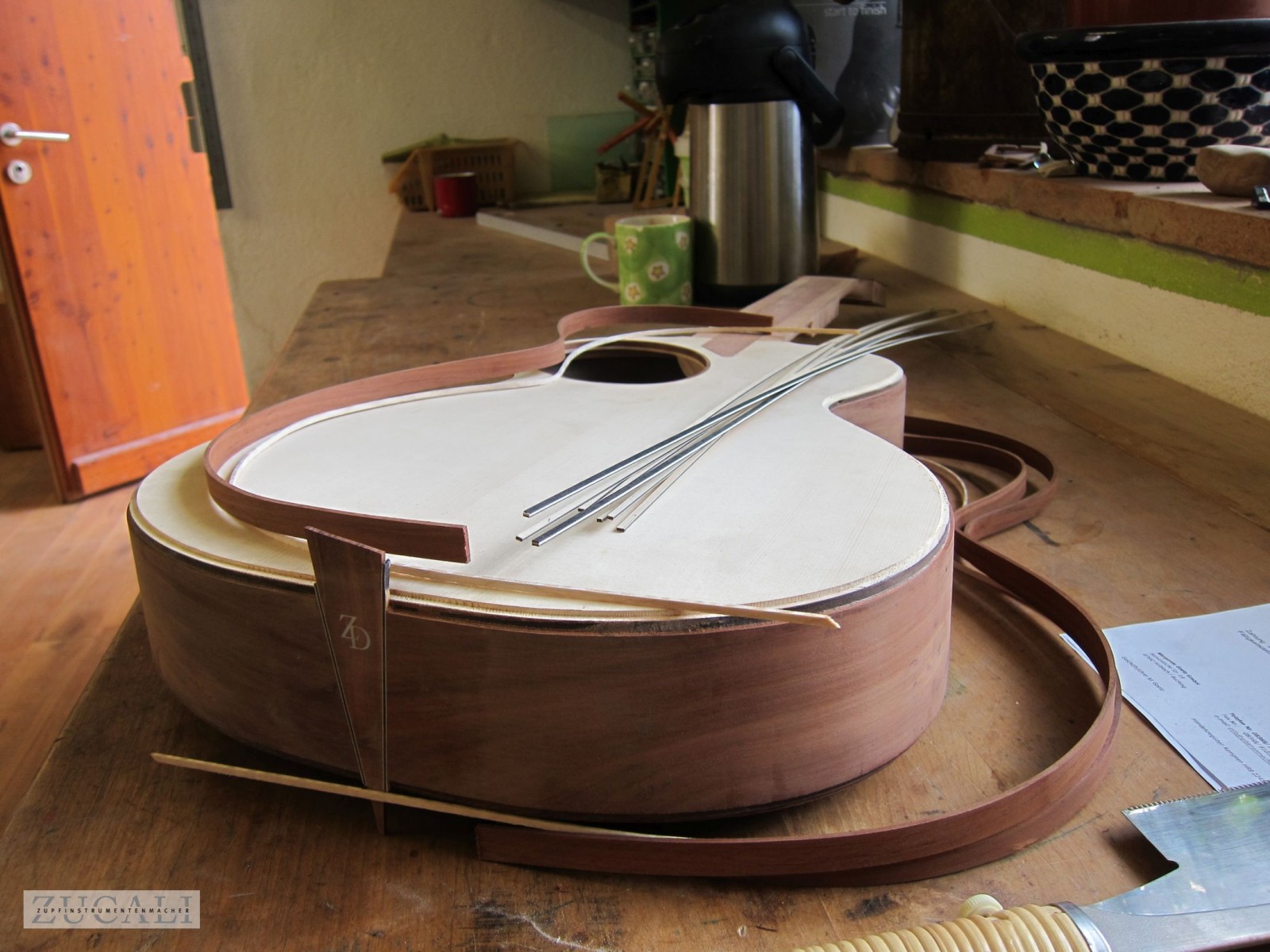
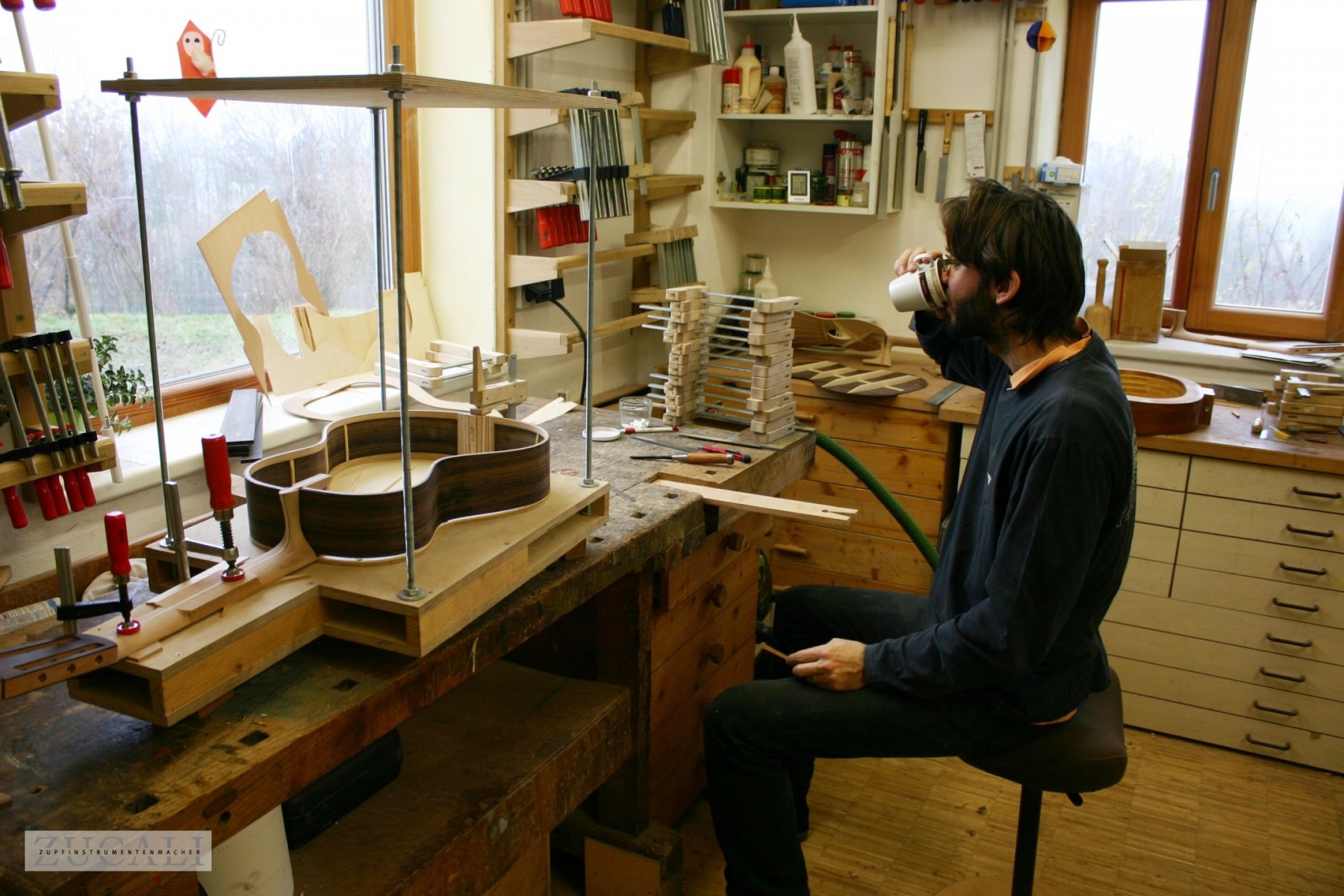
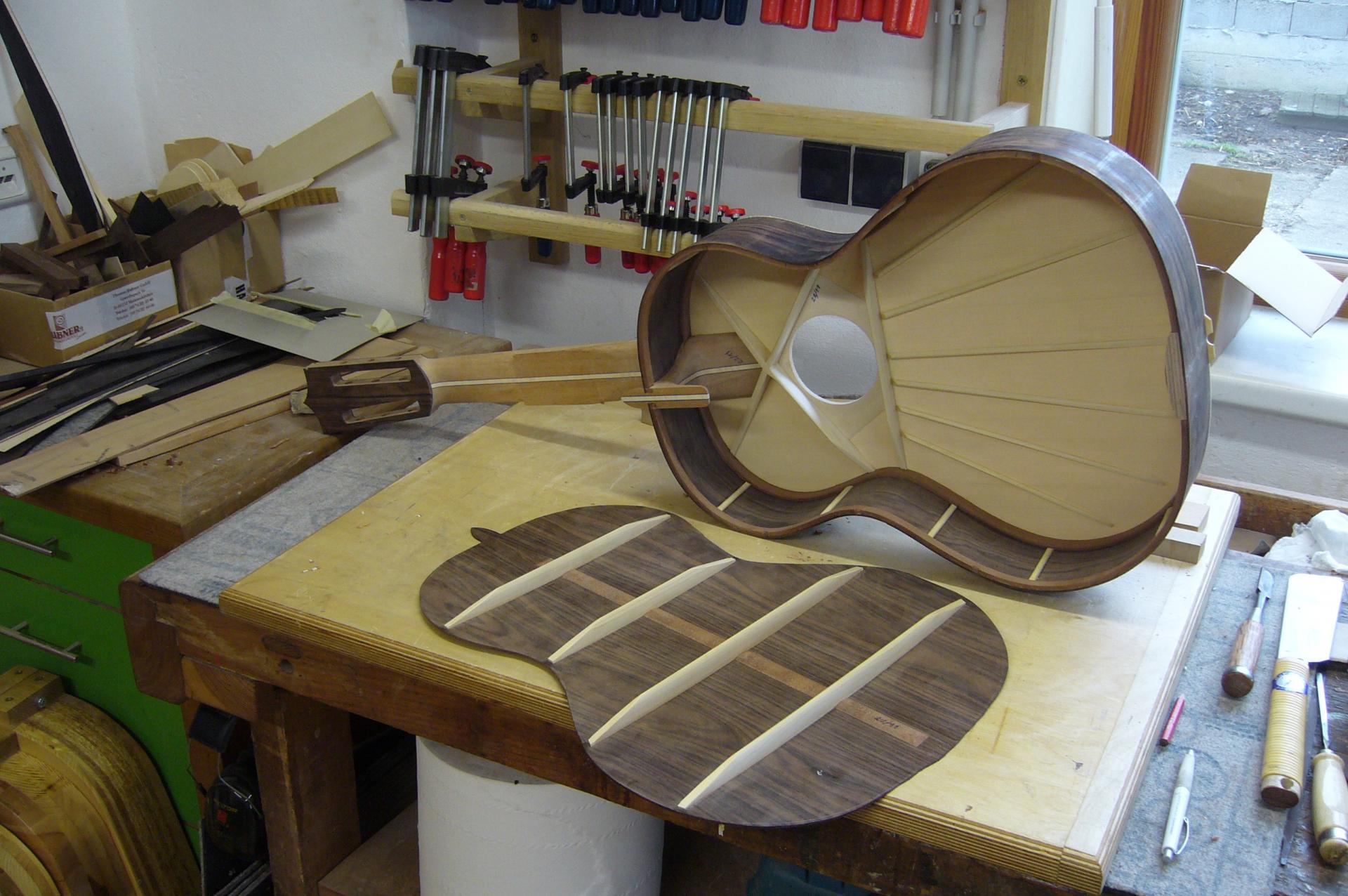
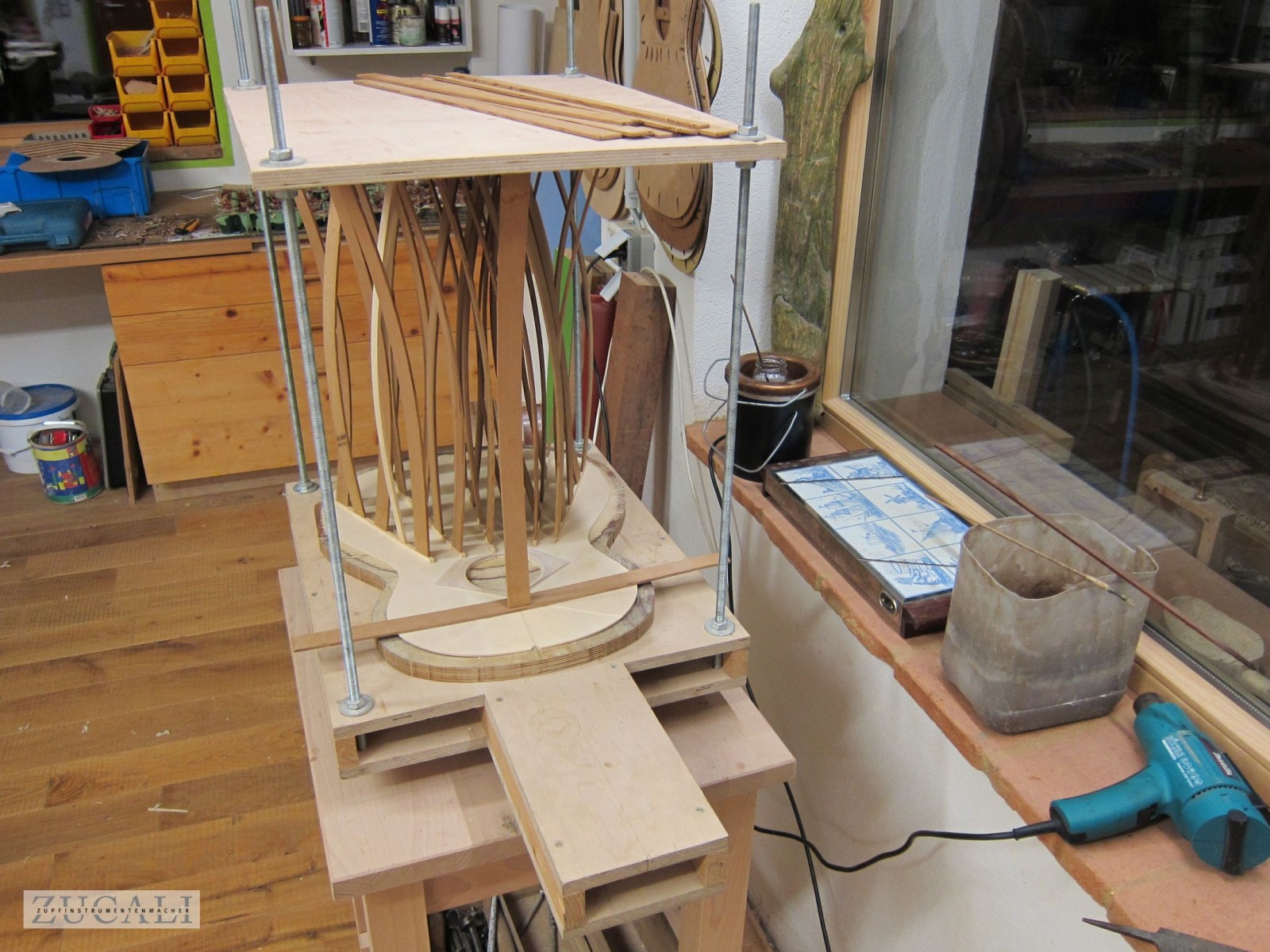
In the Spanish construction all components such as soundboard, neck, sides etc. are made. Then the neck, which extends into the body, is glued to the soundboard. Both are fixed together onto a “Solera”, which defines the exact neck angle. On this Solera the two side halves are glued onto the soundboard and into two slots of the neck. Once the sides are outfitted with various small components and are adjusted to the convexity of the bottom, the body is closed with latter.
Mostly I build “Spanish” whilst using many elements of the German construction …
Here, the body and neck are made independently and then joined together. Other differences include the nature of the sound board convexity, the neck-head connection bracing etc.
Only he who is different from the broad mass is able to stand out from itChinese wise saying
Soundboard construction
On a guitar energy is transposed only for a split moment to the string, which is then supposed to vibrate well and long. This means the soundboard must be constructed so it is dampened minimally.
Weight is another parameter. Due to the string tension (nylon strings) of a mere 40-45 kg’s, the available energy to make the guitar resonate is clearly defined. In relation to the soundboard…the lighter it is, the easier it can be brought into vibration. At the same time, the soundboard must still be able to withstand the 45 kg string tension!
At the moment there are three soundboard structures going around the world. On the one hand the traditional bracing with over 150 years of history. Then the lattice bracing by Paul Fischer, made especially popular by Greg Smallman and thirdly the Doubletop-Soundboard established by Gernot Wagner.
- The traditional bracing
The soundboard has depending on the material composition and the vision of the luthier a thickness of 2mm and 3mm. It is reinforced with the aid of five or more braces arranged in a fan shape. Thus, the soundboard can withstand the string tension.
The traditionally built instruments of mine are in comparison to the Lattice-Bracing guitars a bit harder to “open up” as more force is needed plucking. Once they start singing though, then you have incredible variety of timbres especially in combination with a spruce soundboard. These guitars are not overly loud, yet can carry their sound next to loud instruments or a choir and be heard into the last corners of a room.
- Lattice-bracing
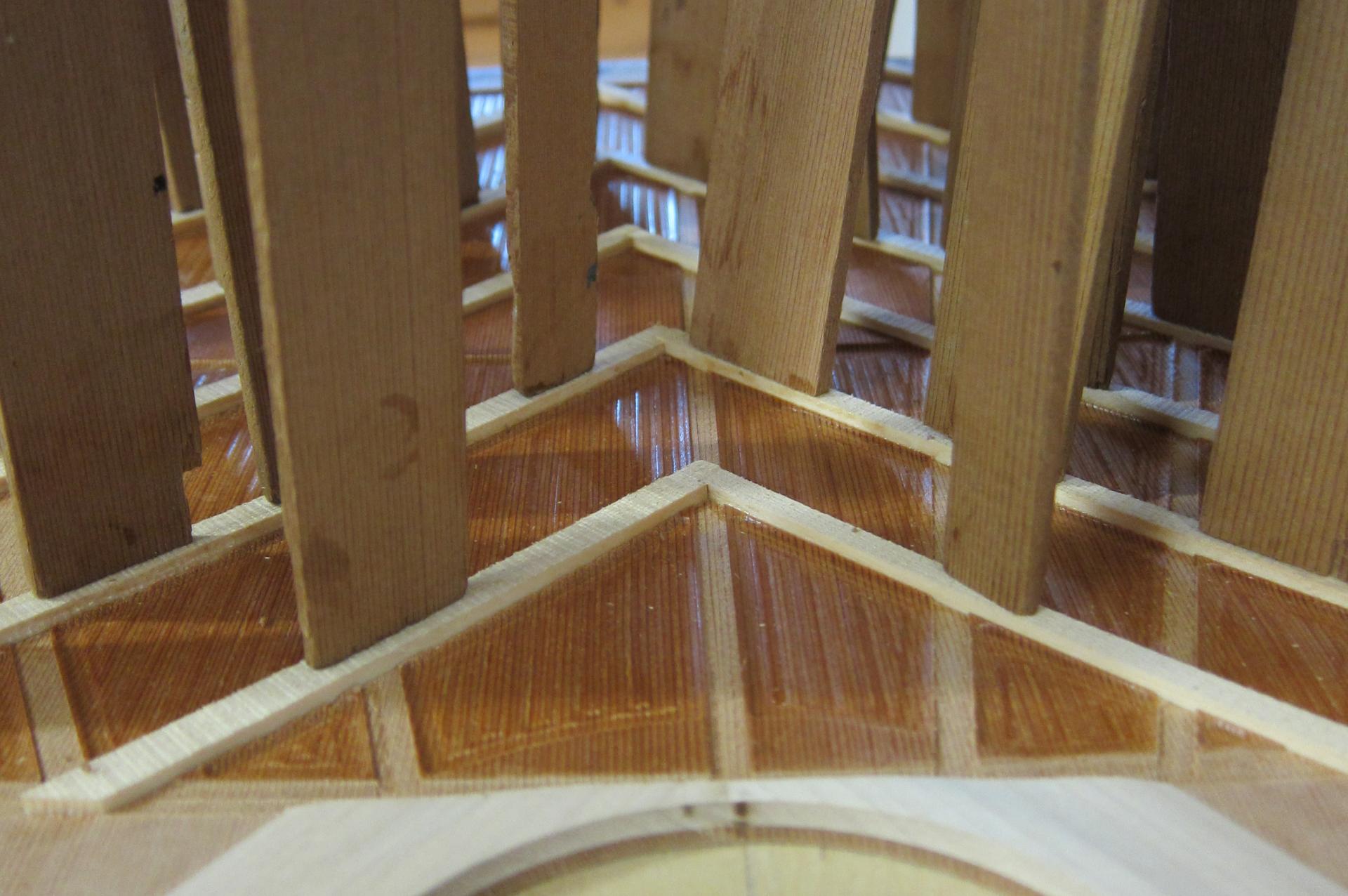
As the name suggests, in this bracing method the braces are arranged in an overlapping lattice pattern. This allows the soundboard to be reduced to a thickness of as little as 1 mm, significantly reducing its weight. The aim of lattice bracing is to produce an instrument with maximum volume. However, this often comes at the expense of tonal diversity. I have encountered many guitars of this type that sound very loud at close range but still fail to project sufficiently to fill a concert hall.
After years of observation and consideration, I built my first instruments in 2014, successfully combining the advantages of a traditionally constructed guitar with those of lattice bracing.
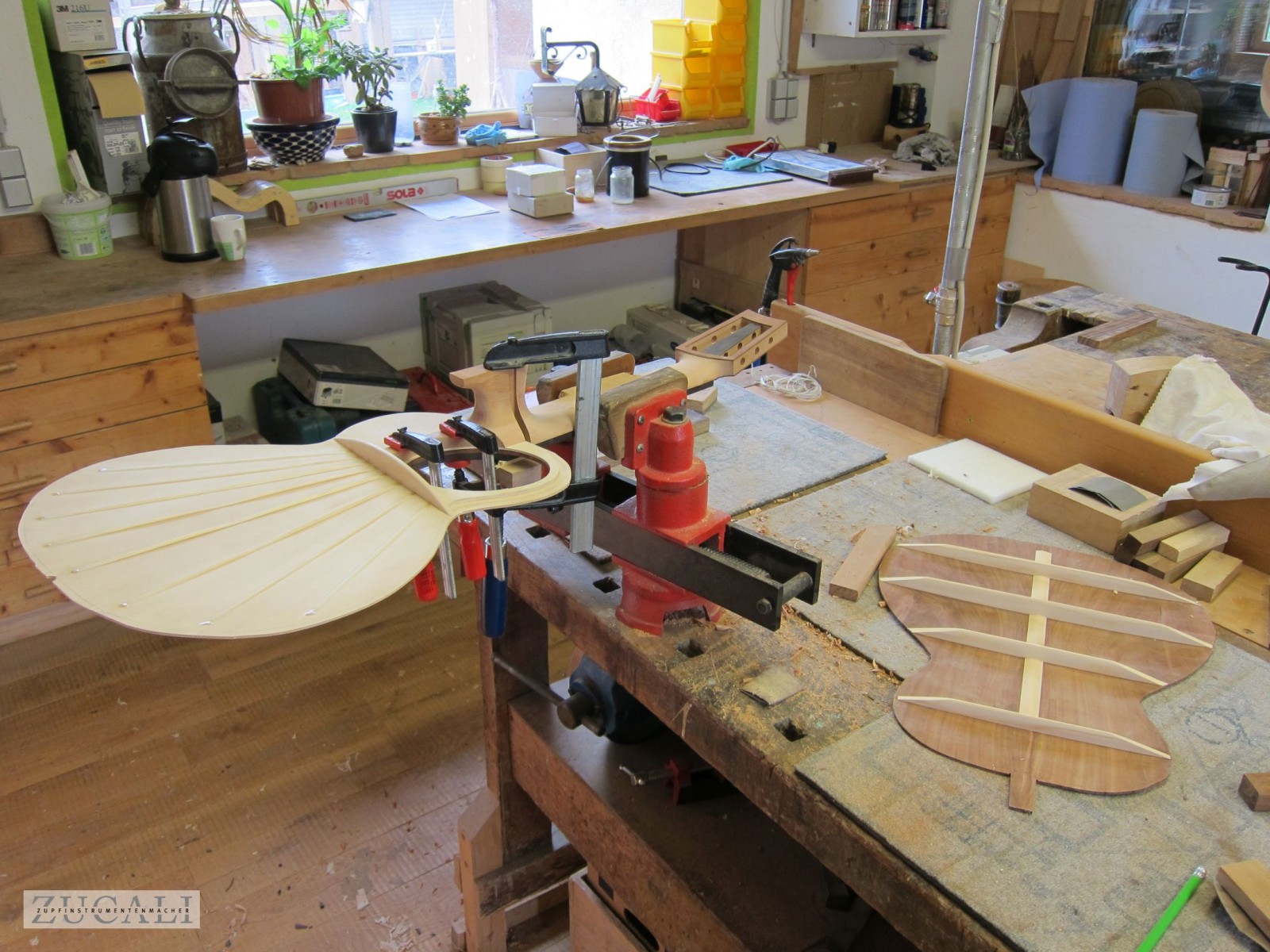
To achieve this, I developed an elaborate, proprietary lattice-bracing system. The soundboard consists of almost 100 three-dimensionally milled surfaces of varying sizes. Through subsequent hand-finishing of the braces, which vary in height, the flexibility and stiffness of the soundboard are precisely defined. In traditional construction, this task is accomplished primarily by hand-planing the soundboard and carefully adjusting its thickness. Particular attention is paid to the 43 intersections of the braces, where each joint is crafted with extreme precision to prevent unwanted damping.
- Doubletop
A Doubletop could also be described as a sandwich construction. In most cases, it consists of two thin layers of wood, each approximately 0.6 mm thick. Cedar is often used for the outer layer, as spruce at this thickness can allow the underlying internal structure to show through. A lightweight, honeycomb-like lattice structure is usually bonded between the two wood layers.
There are now numerous variations of this construction method, incorporating a wide range of materials and design principles.
The basic principle is similar to that of lattice bracing: the aim is to reduce the weight of the soundboard while maintaining the flexibility and vibrational properties required for optimal performance.
One significant advantage of the Doubletop construction is its comparatively high stability under changing climatic conditions. This is particularly beneficial for guitarists who travel frequently and expose their instruments to different climates.
As important as the soundboard is to a guitar’s sound, it is only one part of the overall design. The tonal and playing characteristics that make an instrument truly desirable emerge from the interaction of all its components. The construction and design of the sides, back and neck, as well as the choice of body shape and many other factors, have a considerable influence on the final result. Ultimately, it is not just the construction of the soundboard that matters, but the harmonious interaction of all the elements.
I have personally specialised in lattice bracing because it allows me to remain faithful to a construction method based primarily on wood and glue. The long-term durability of modern adhesives can be difficult to assess. My aim is to build guitars that will stand the test of time and last for generations.
Perceiving things is the seed of intelligenceLaozi (died 531 B.C.)
BACK and sides
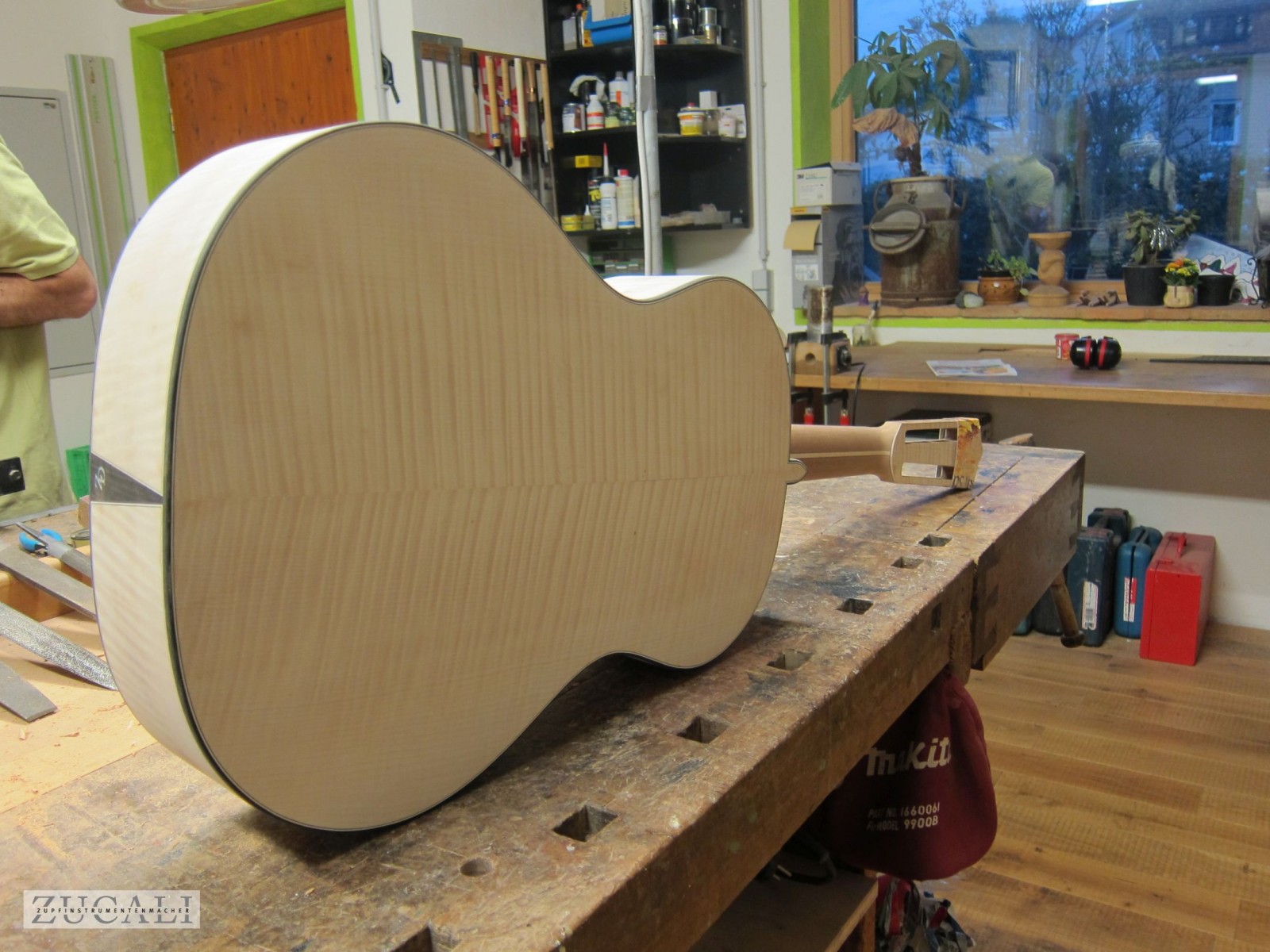
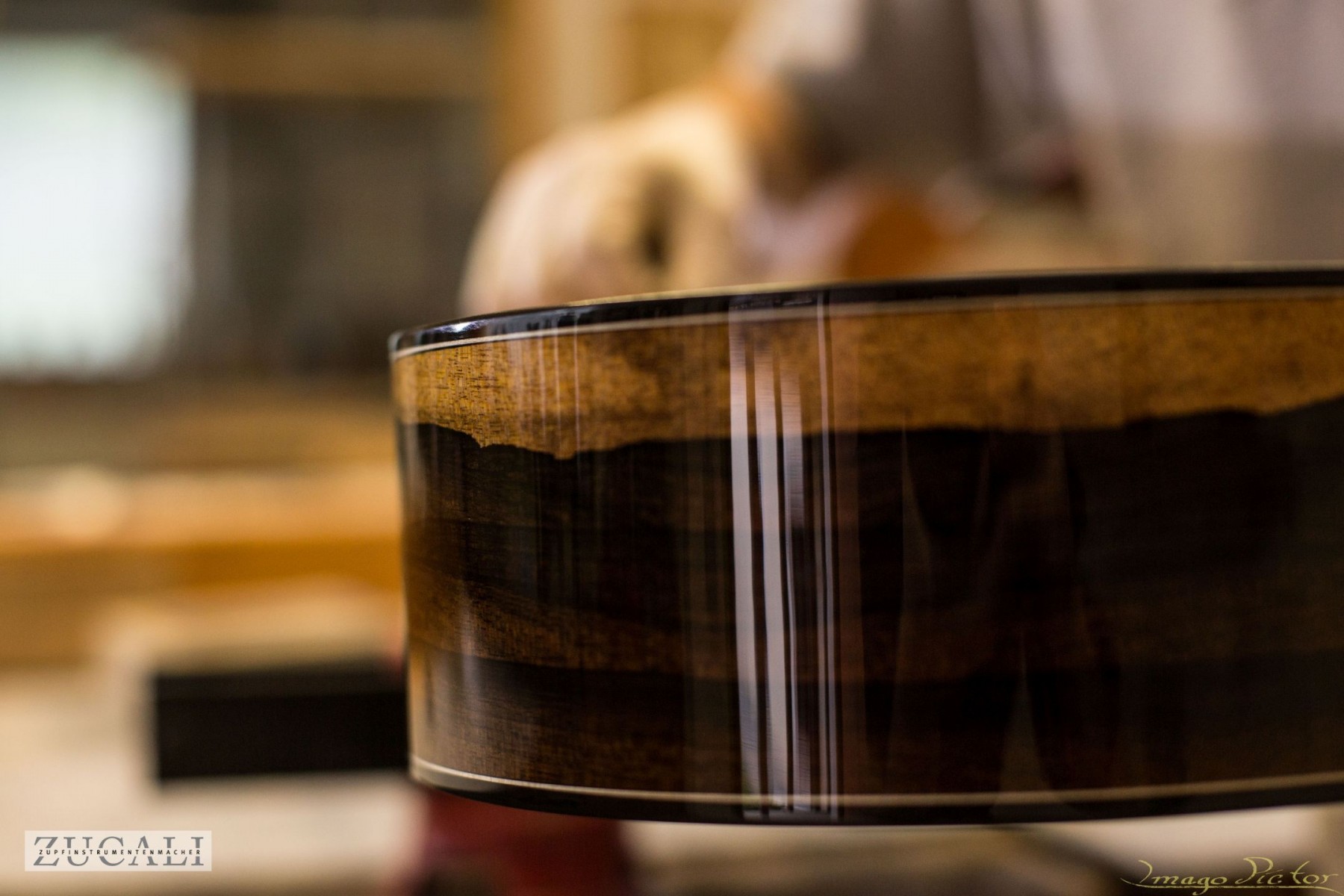
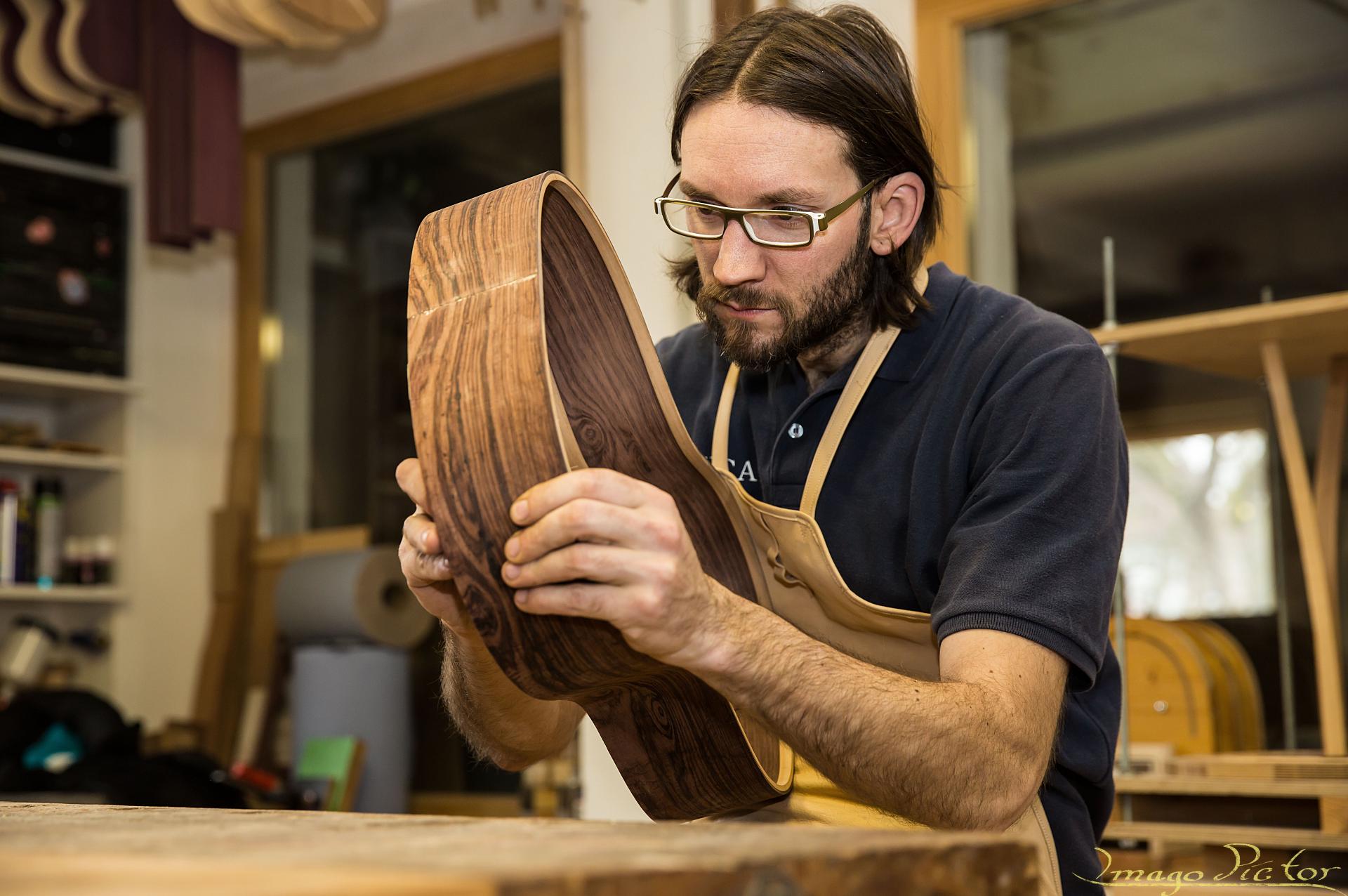
The backand sides have more influence on the character of a guitar than most people imagine. The body construction, the type and quality of the wood influence the sound of a guitar. These are a few details which enable me to build a instrument for each individual guitarist.
I see two different directions amongst luthiers in relation to the tasks a back and the sides have to accomplish. Some want to have the back work together with the soundboard. It is then built very light, possibly even from spruce and braced very extensively.
The others only want the soundboard to work and construct the back very stiff and heavy. Thus, the vibrations are reflected very well.
The same concepts are applied with Sides and neck.
Using different construction methods and modern materials make it possible to build extremely rigid, heavy or light. But only the correct interaction of all components finally determine the qualities of a guitar.
Building phase 1
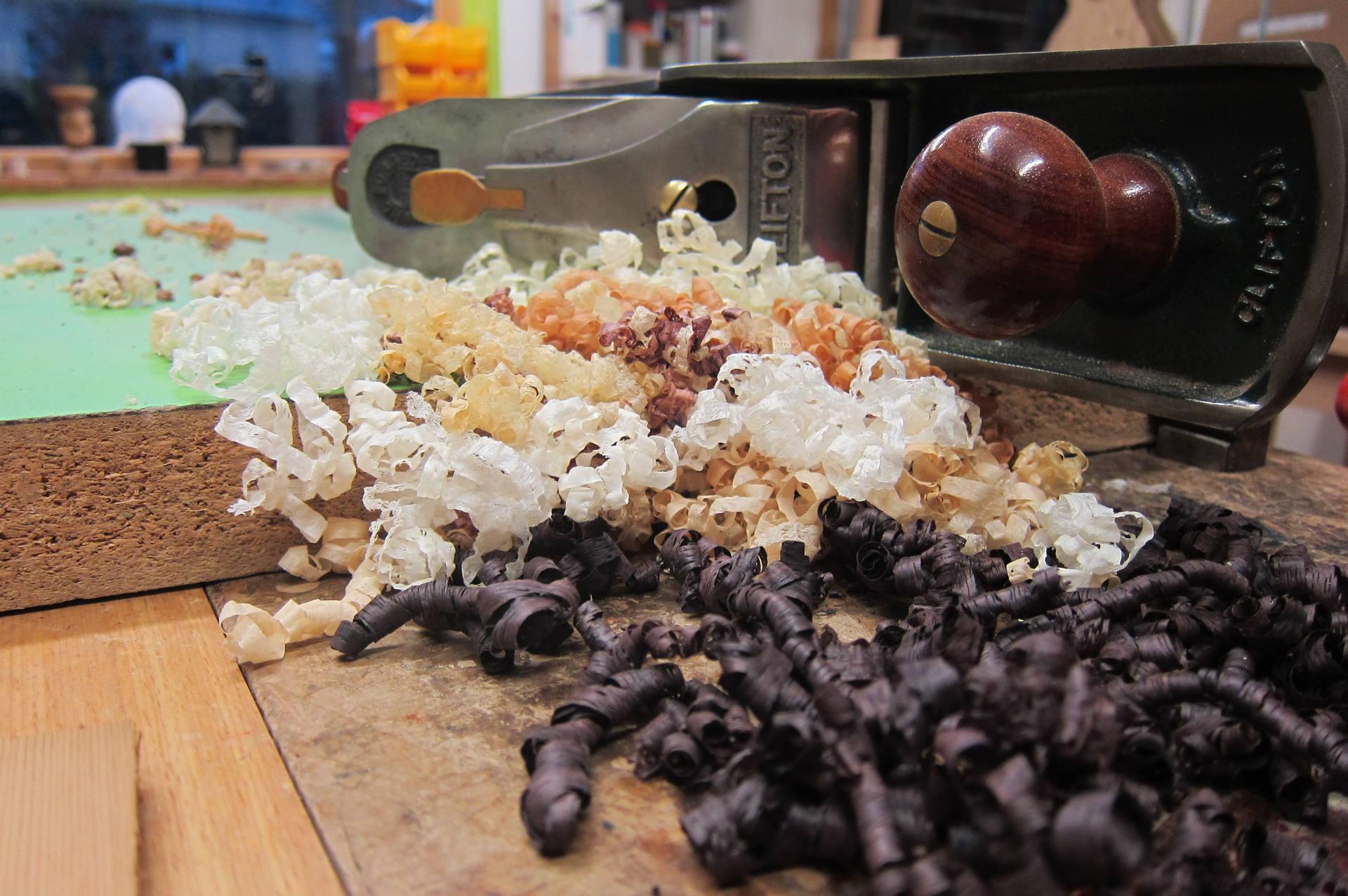
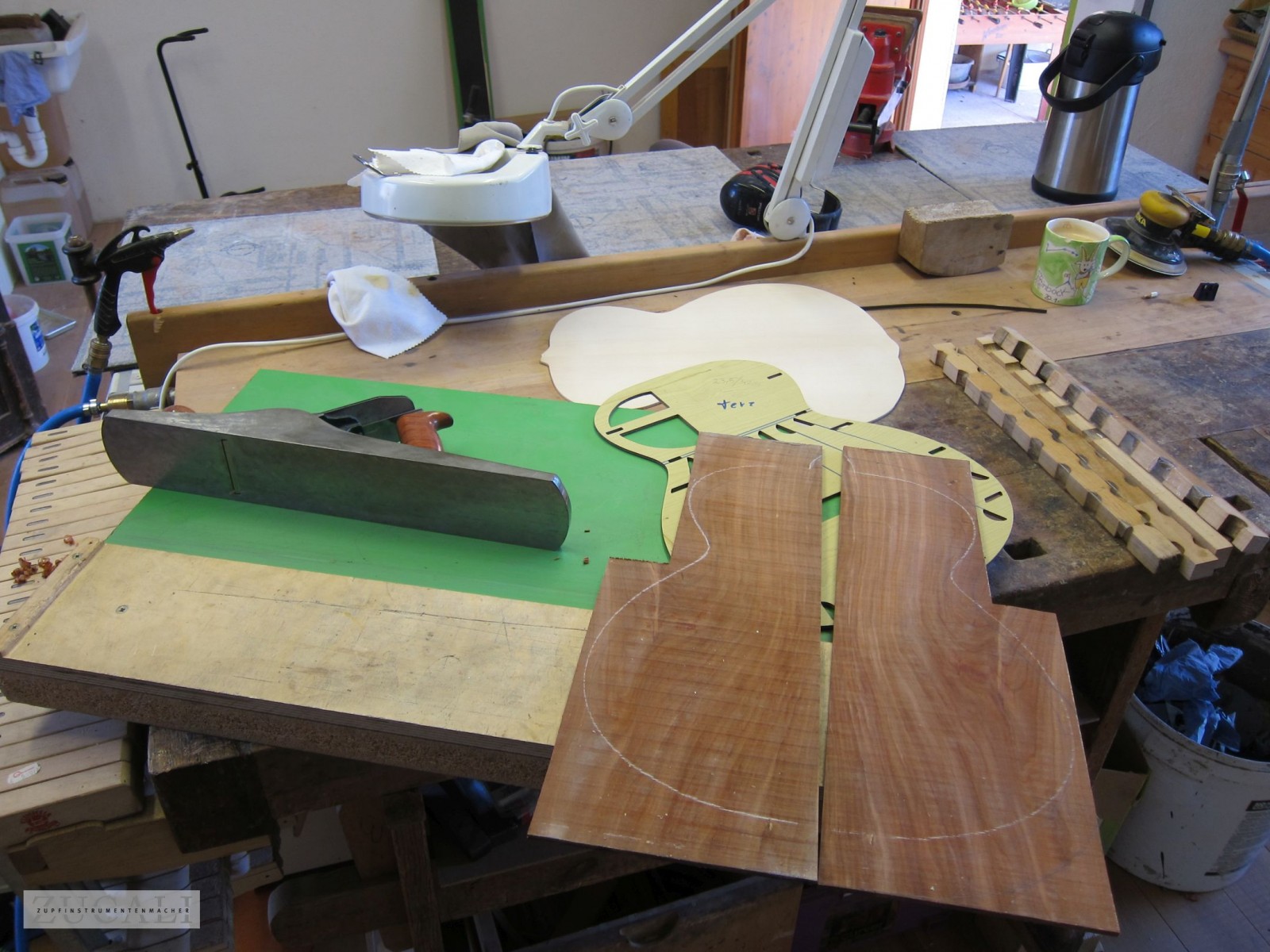
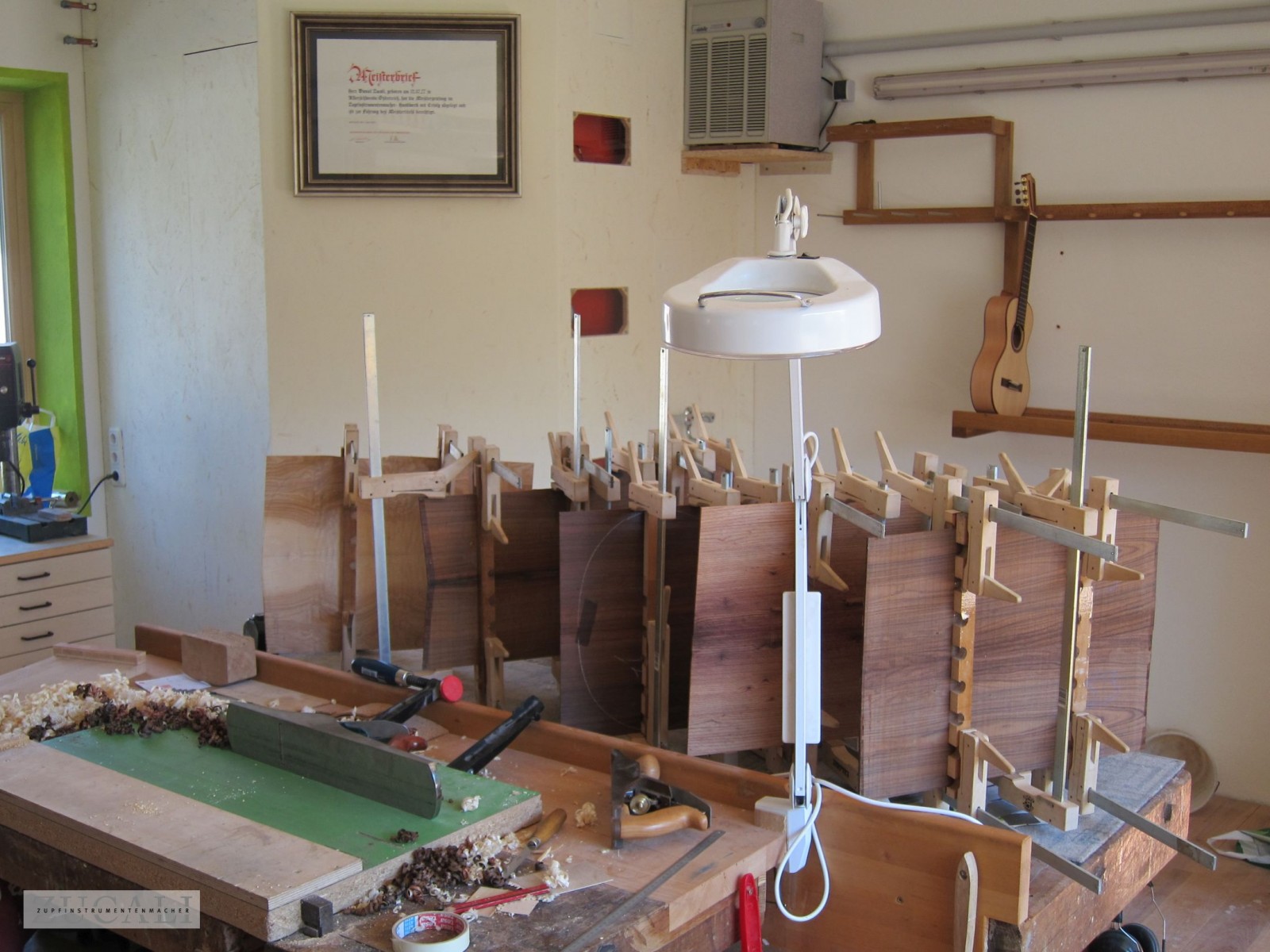
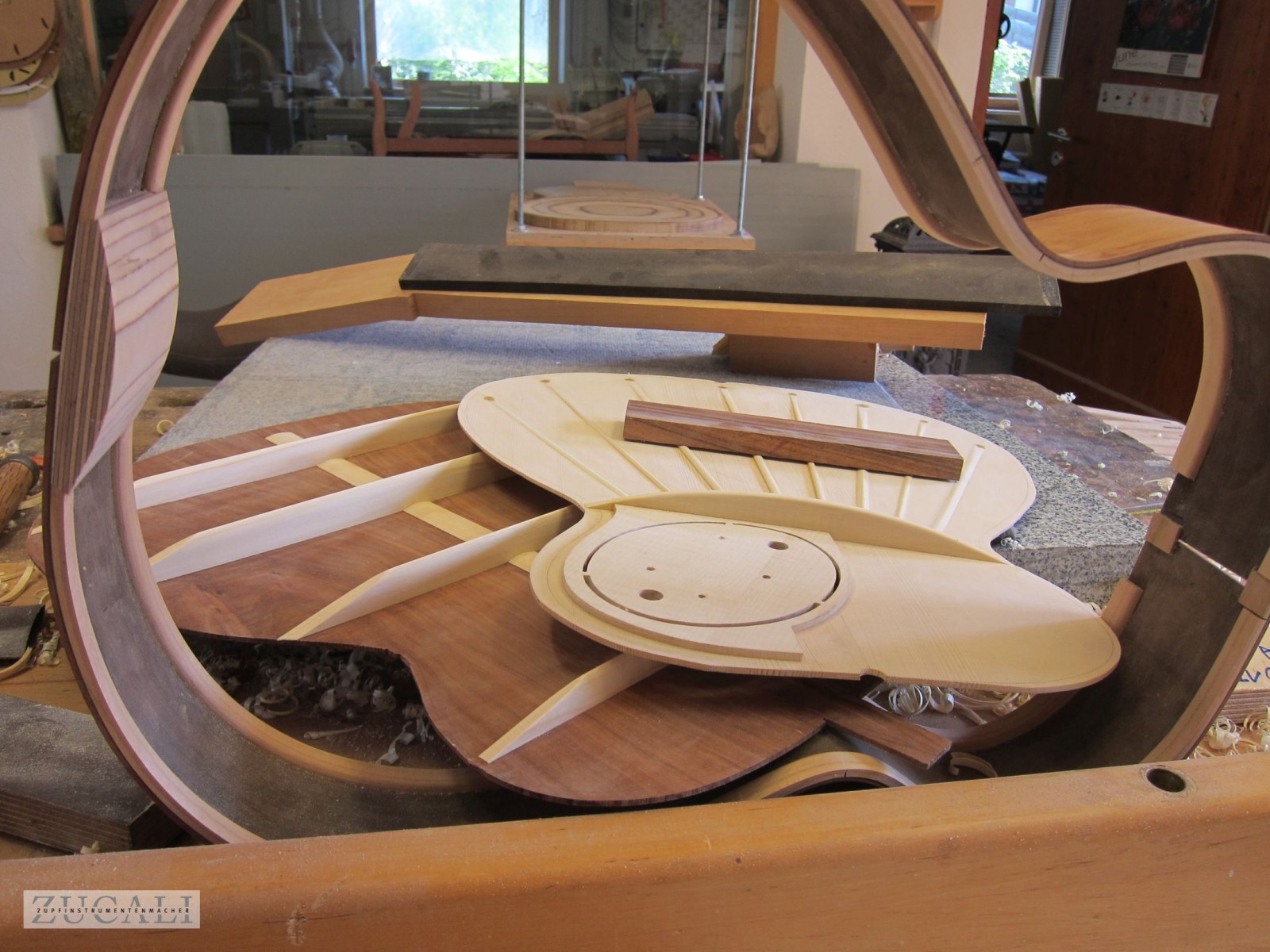
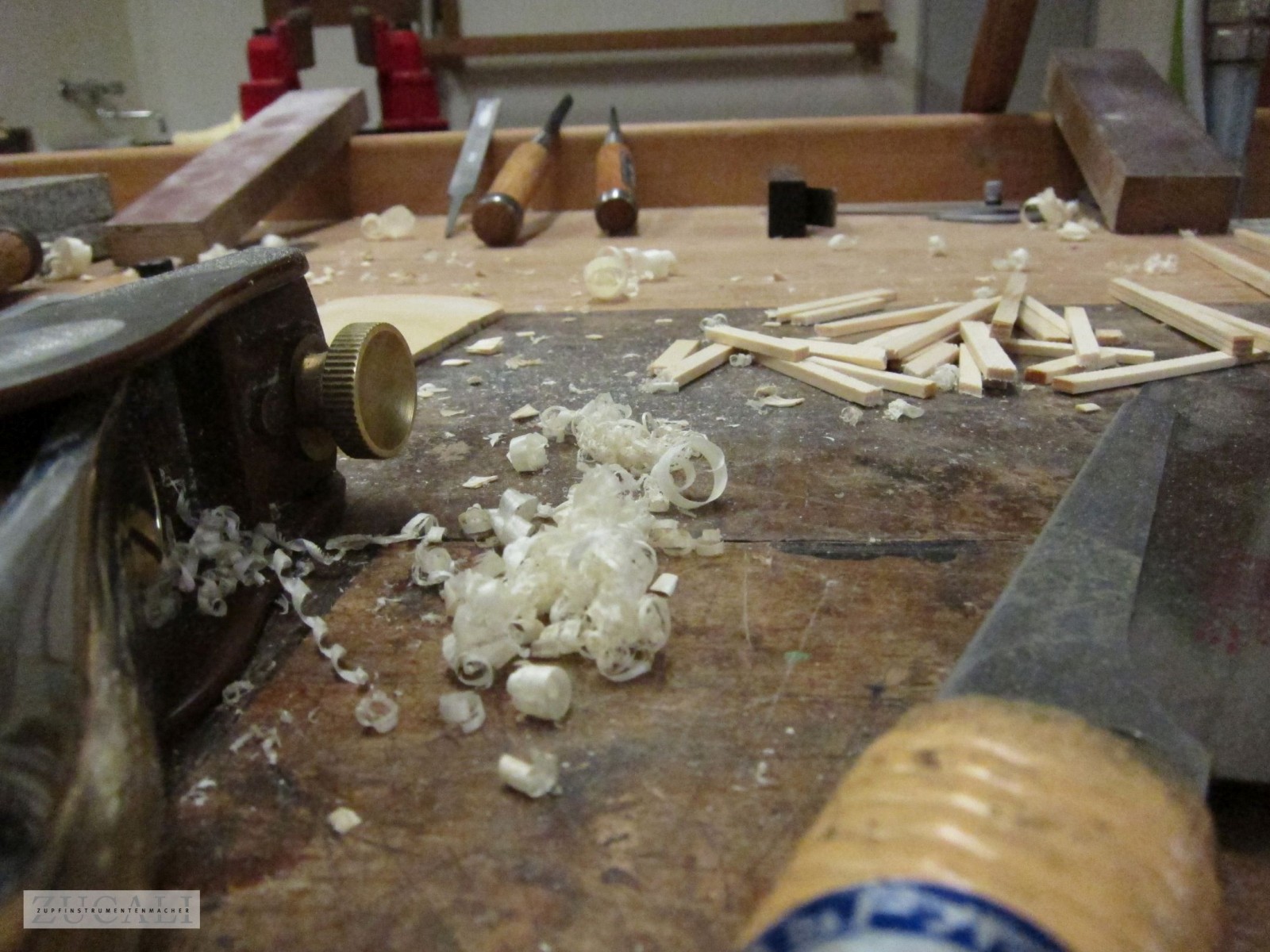
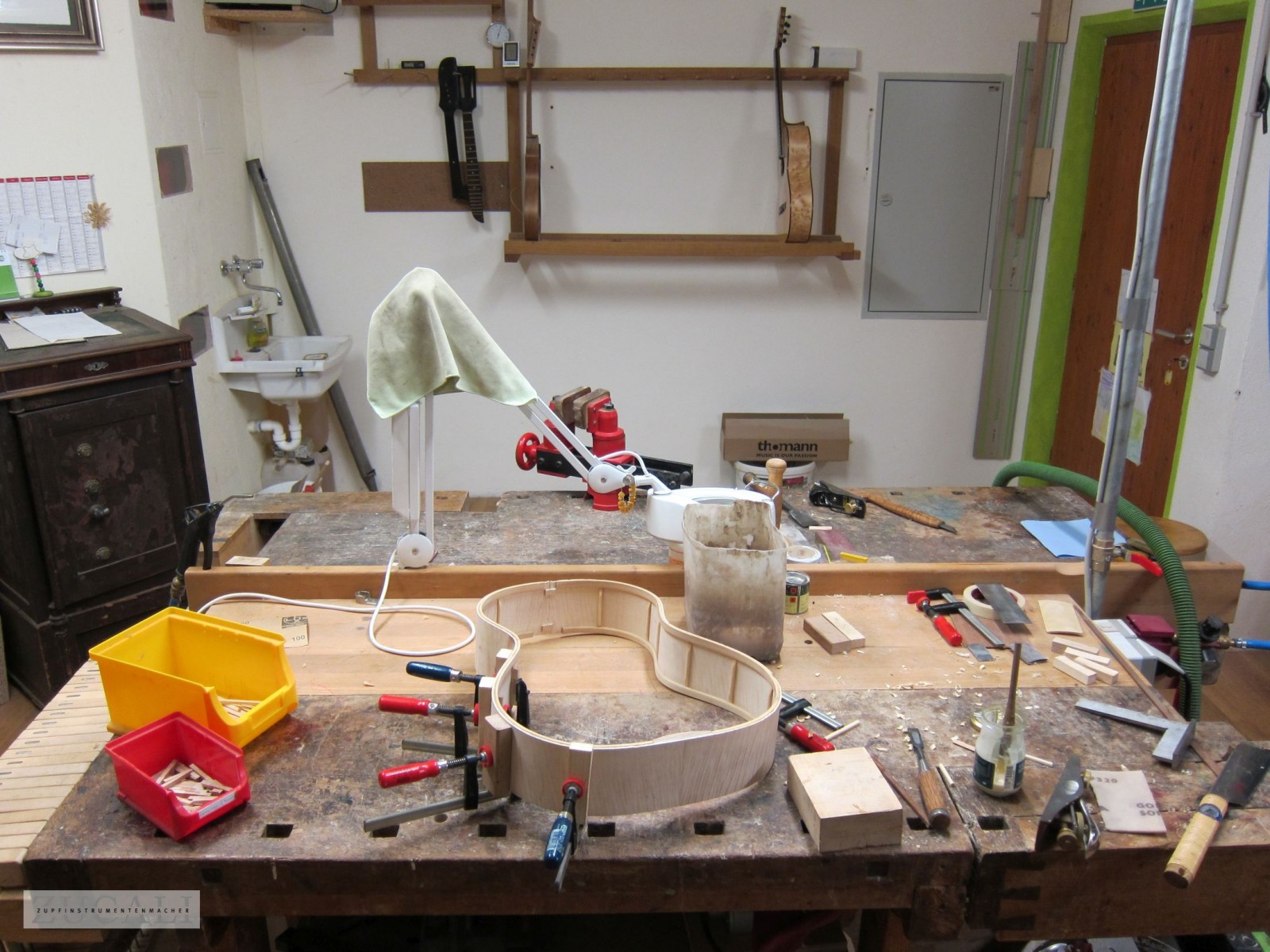
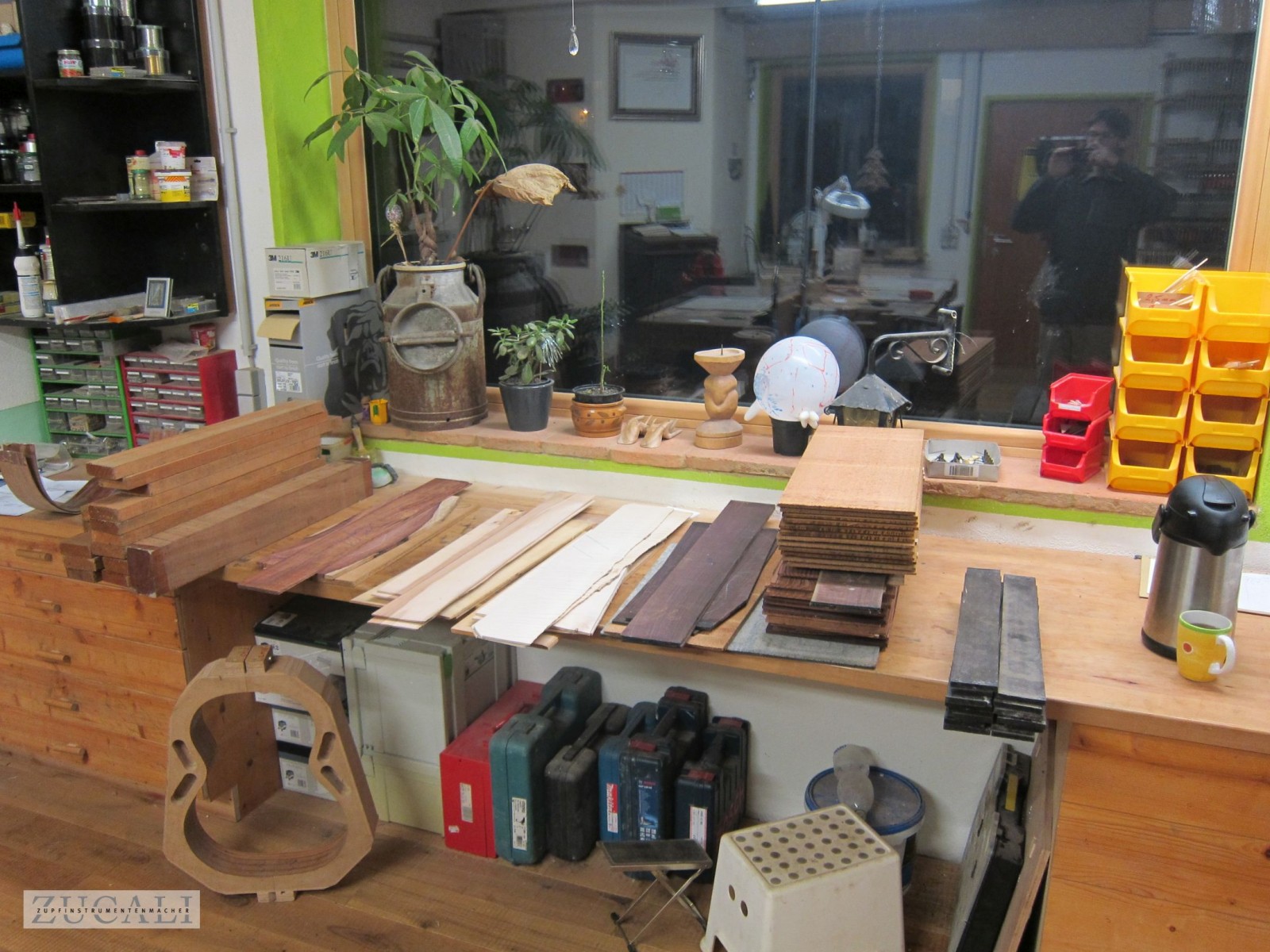
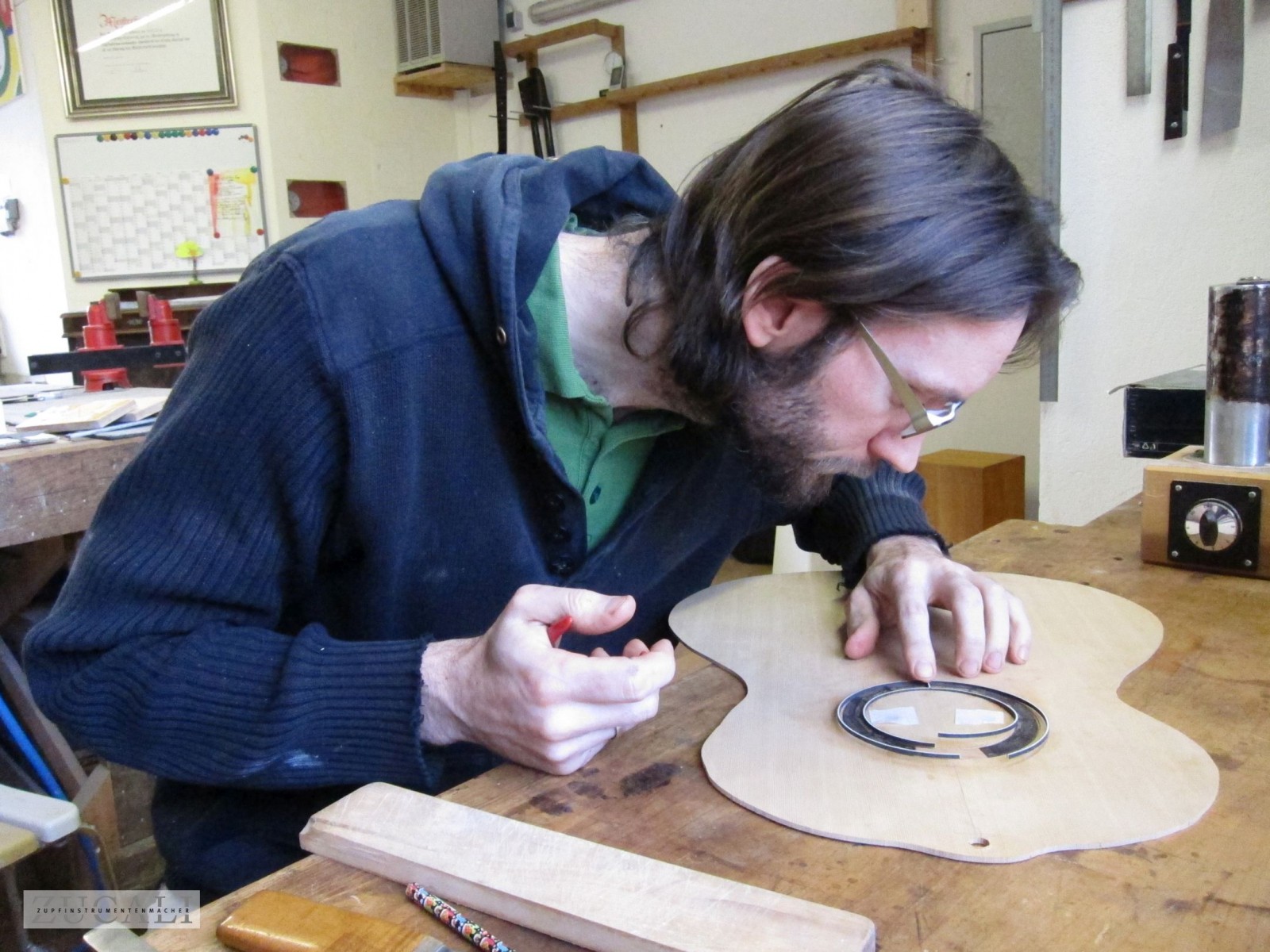
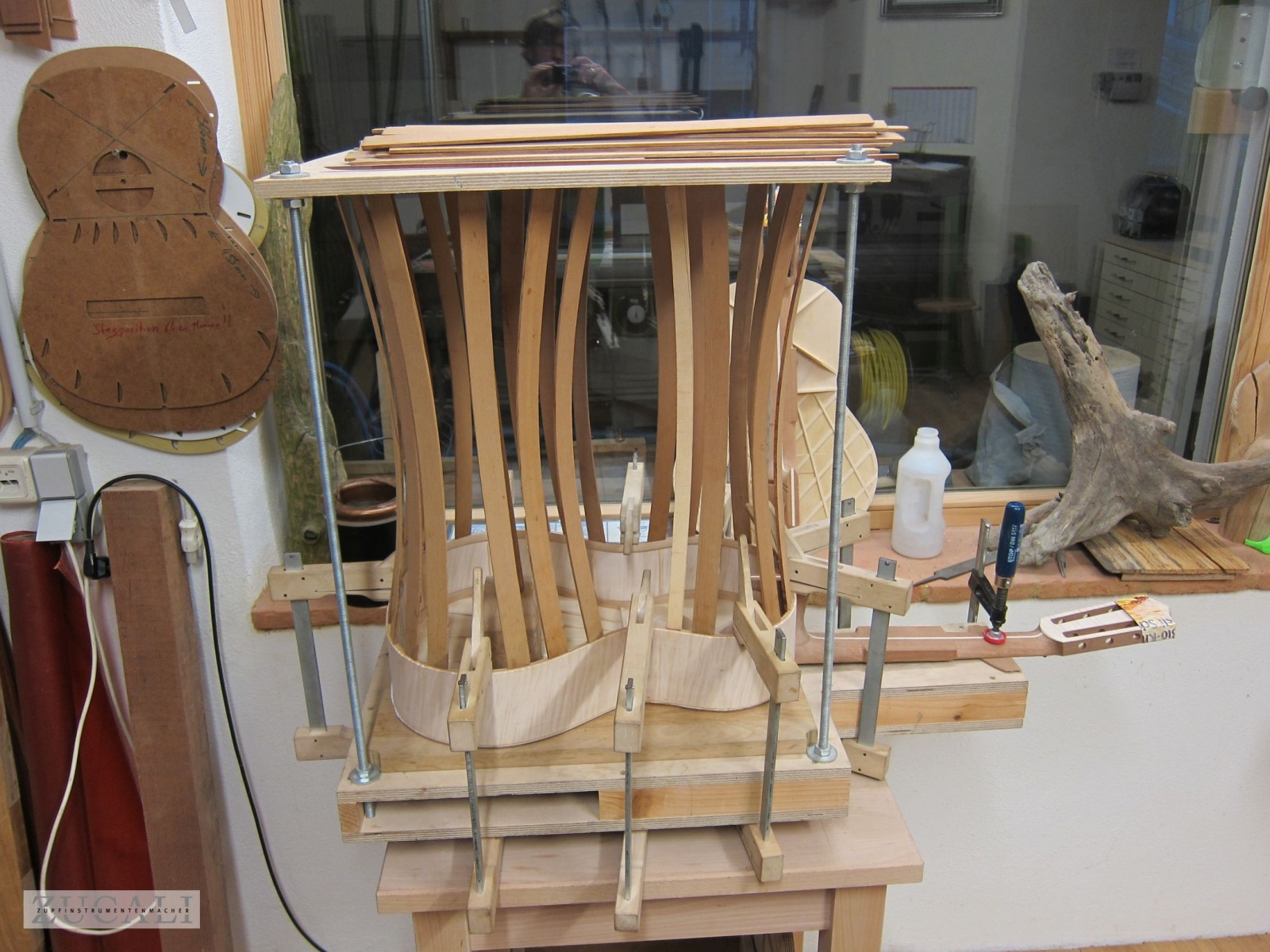
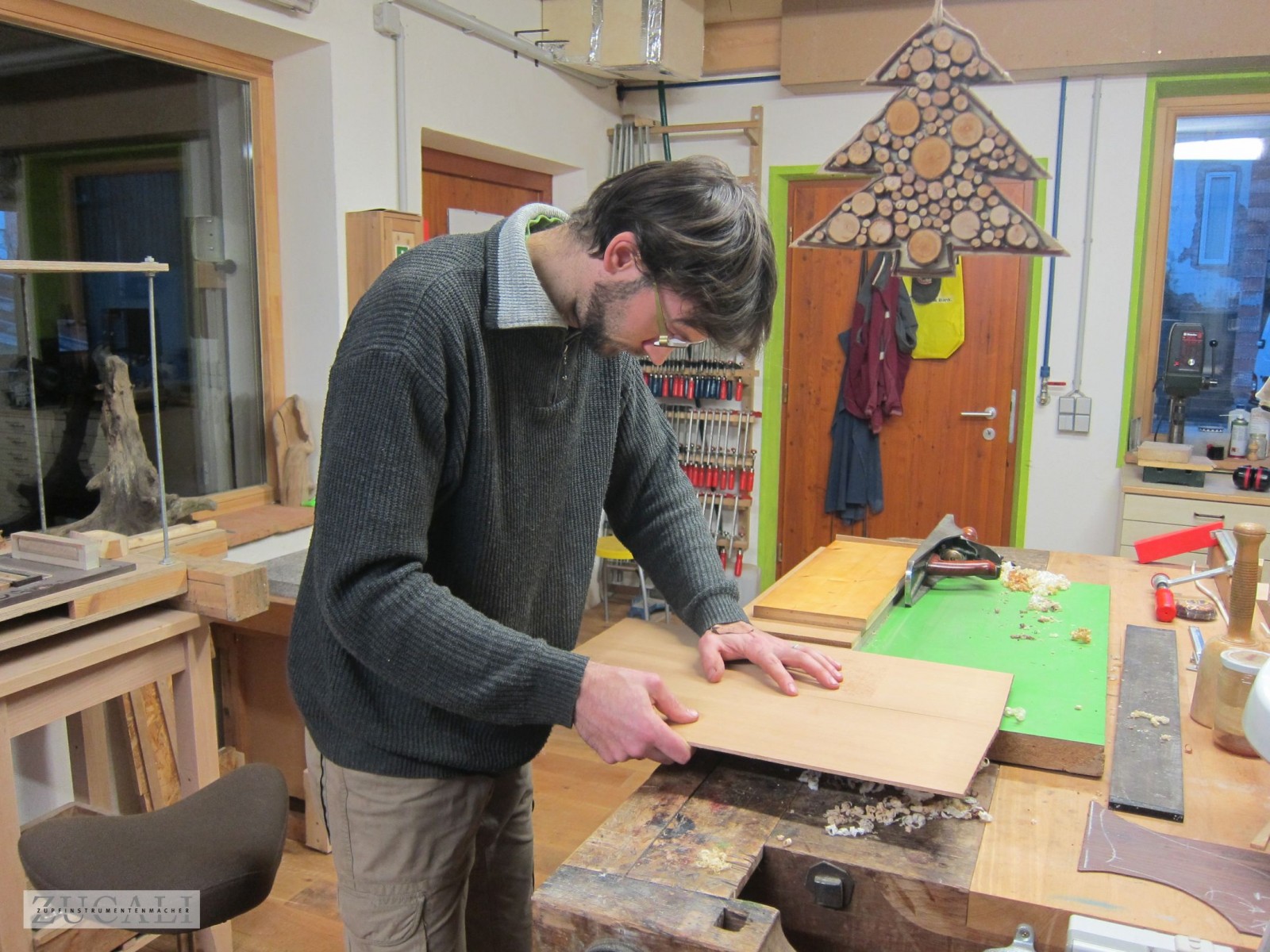
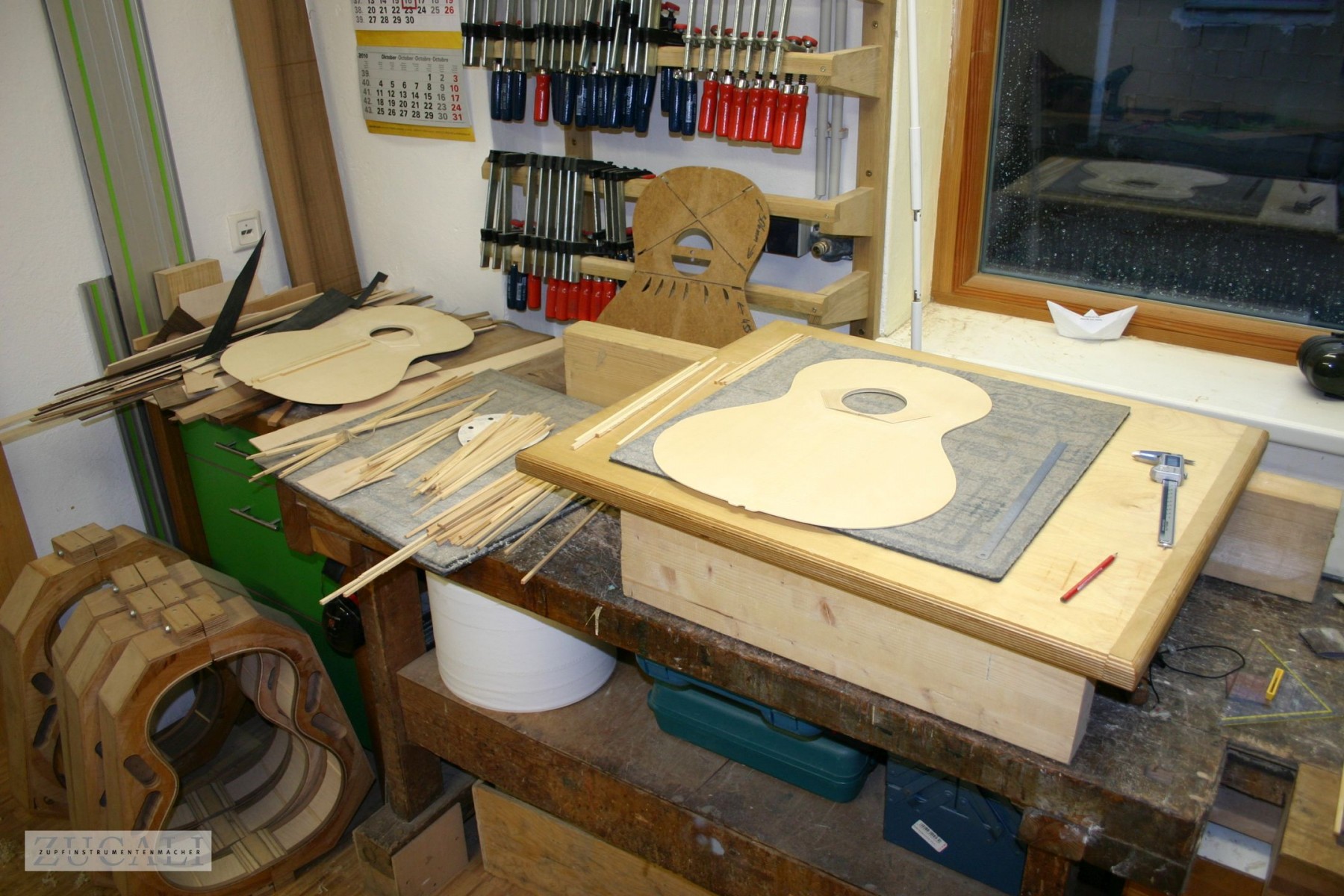
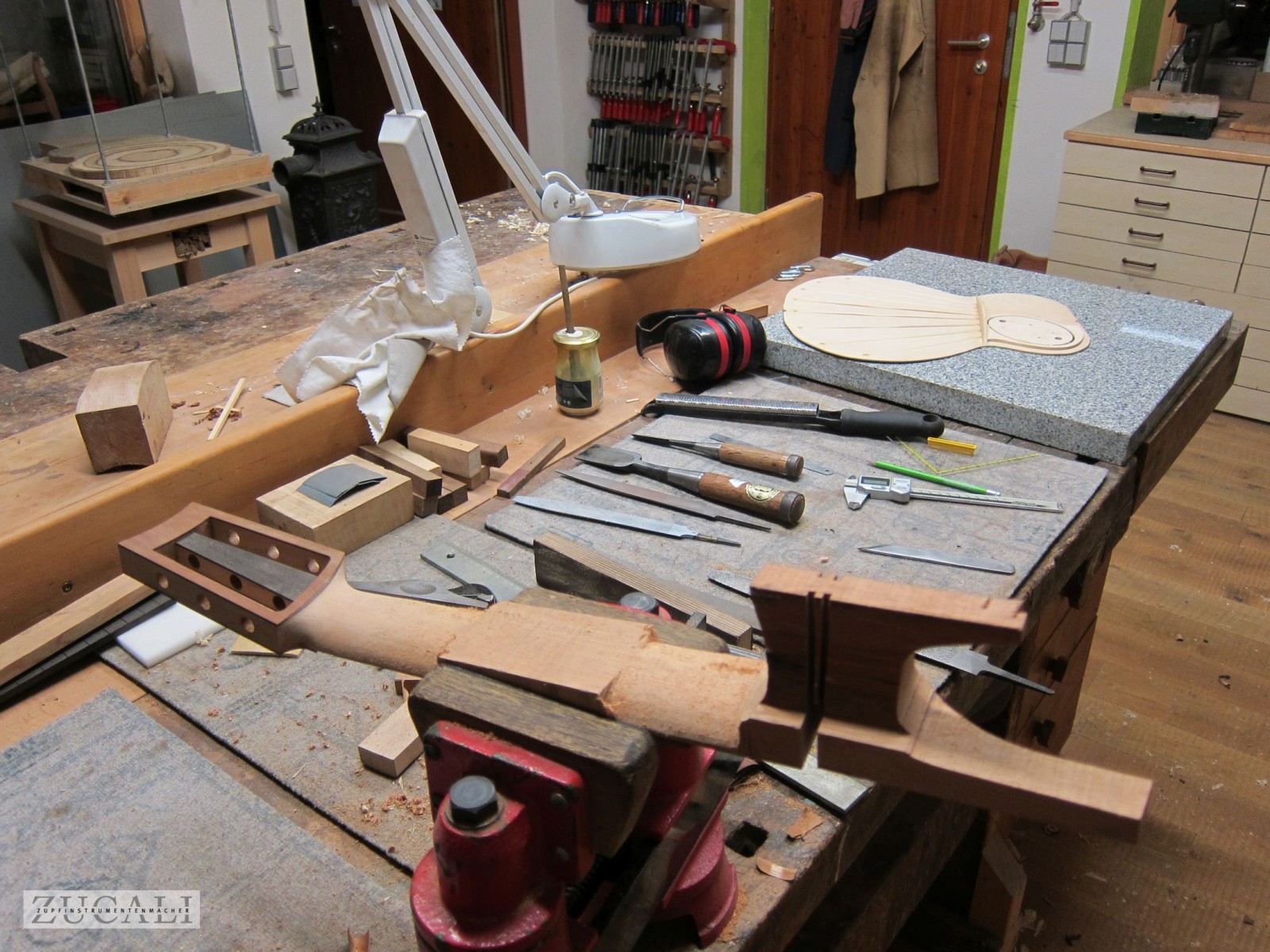
In the first half of the construction time, there is little to see from a distance, but a lot to observe in the details. I begin by building the individual components.
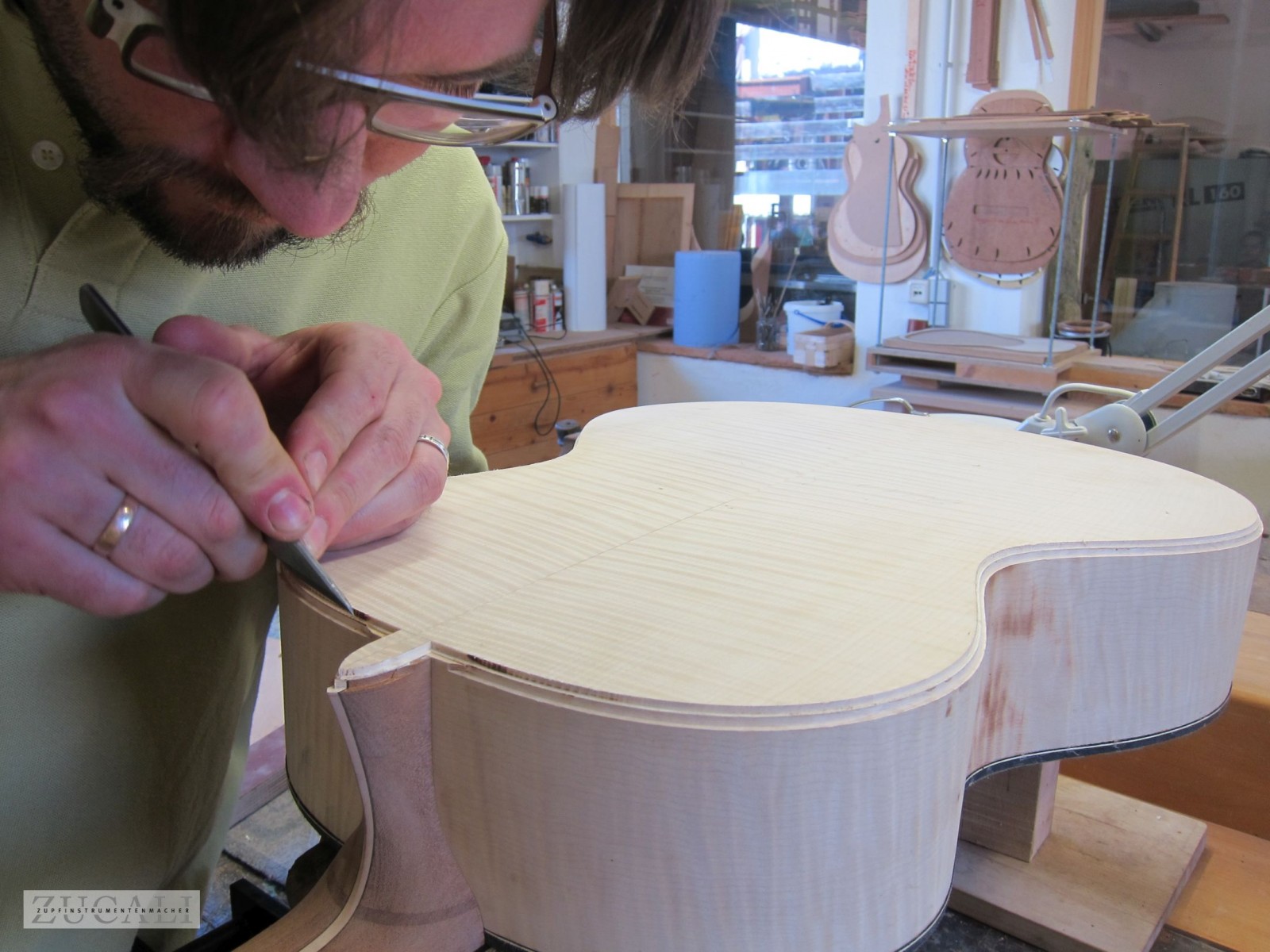
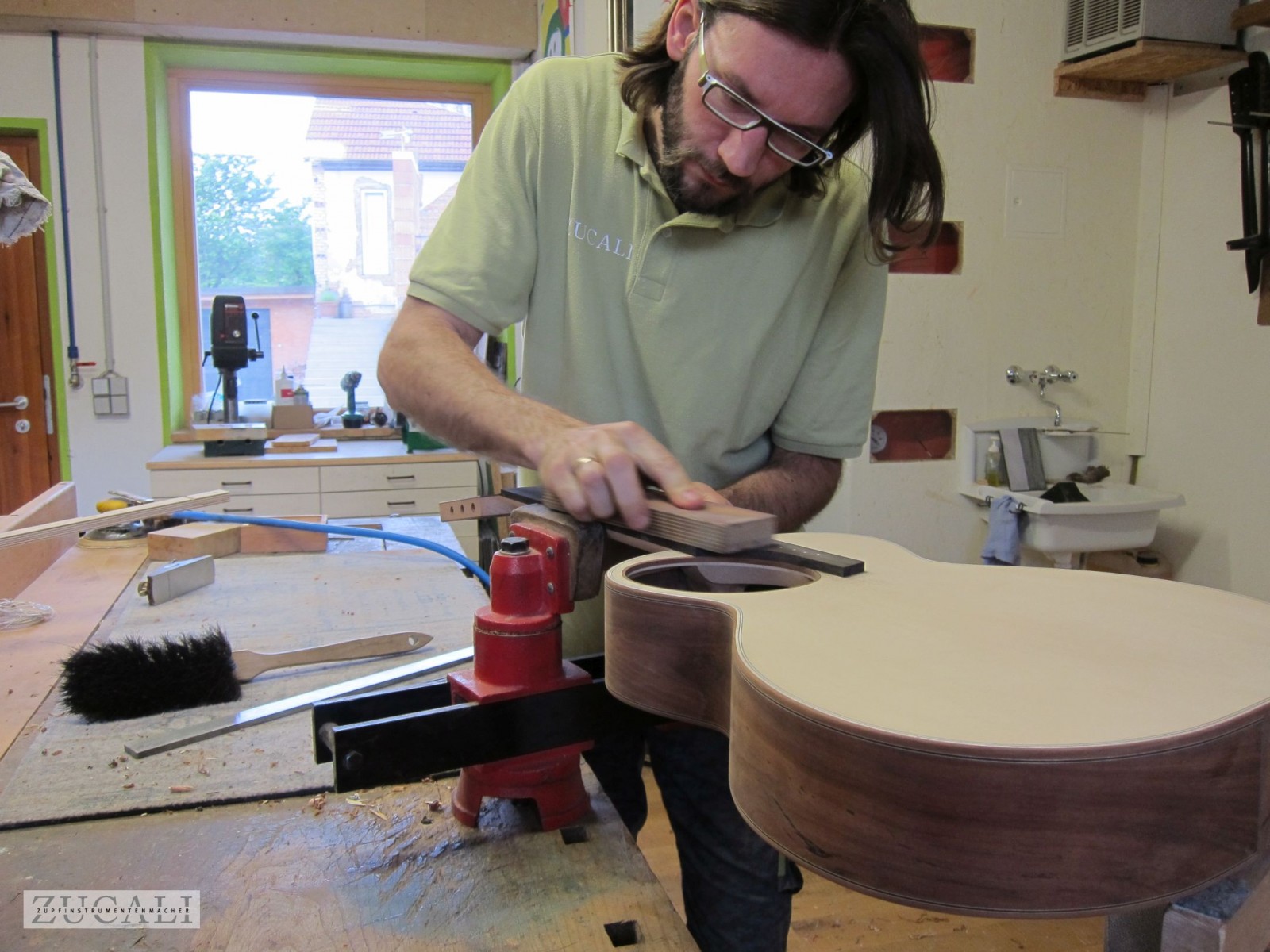
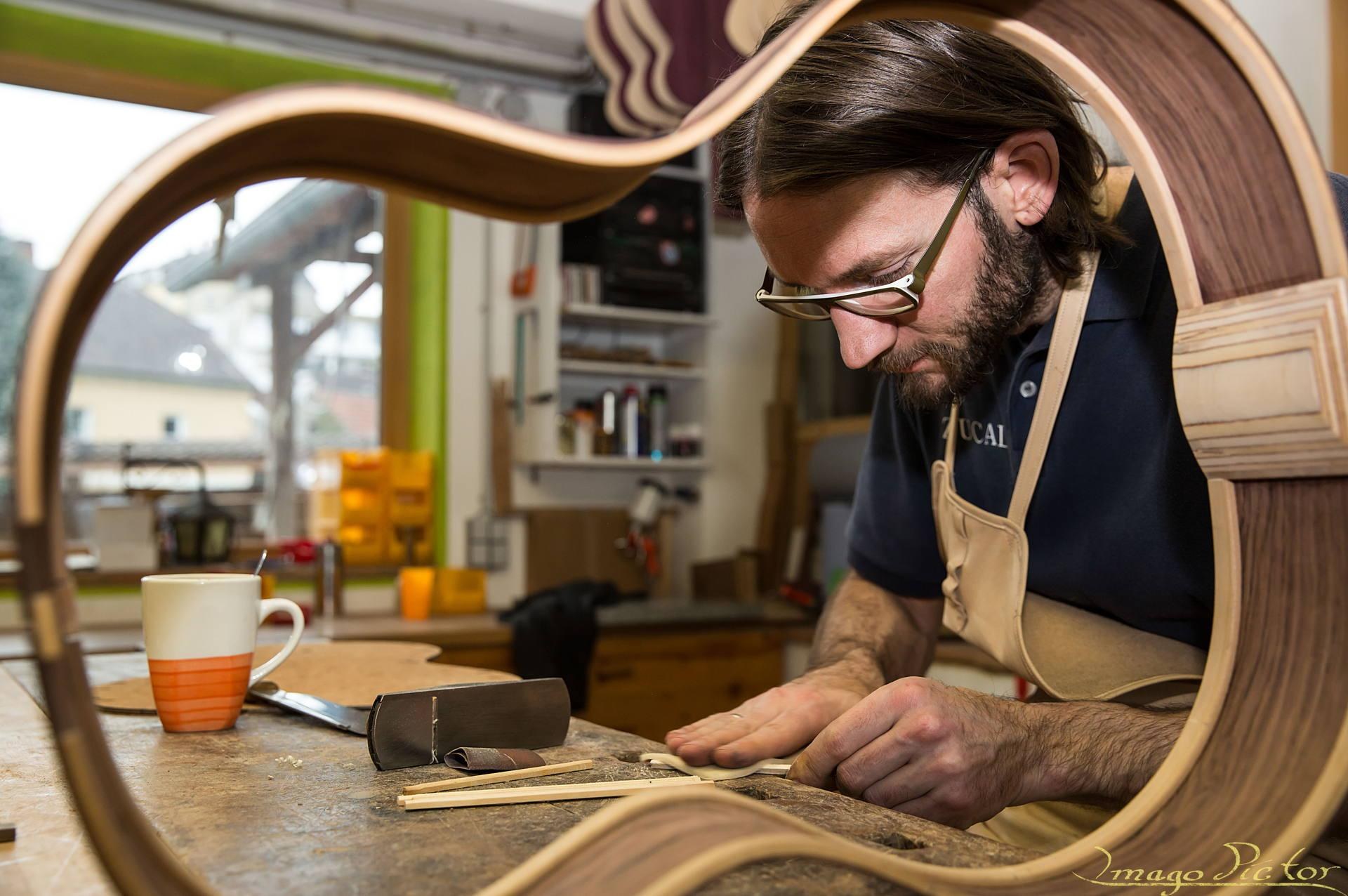
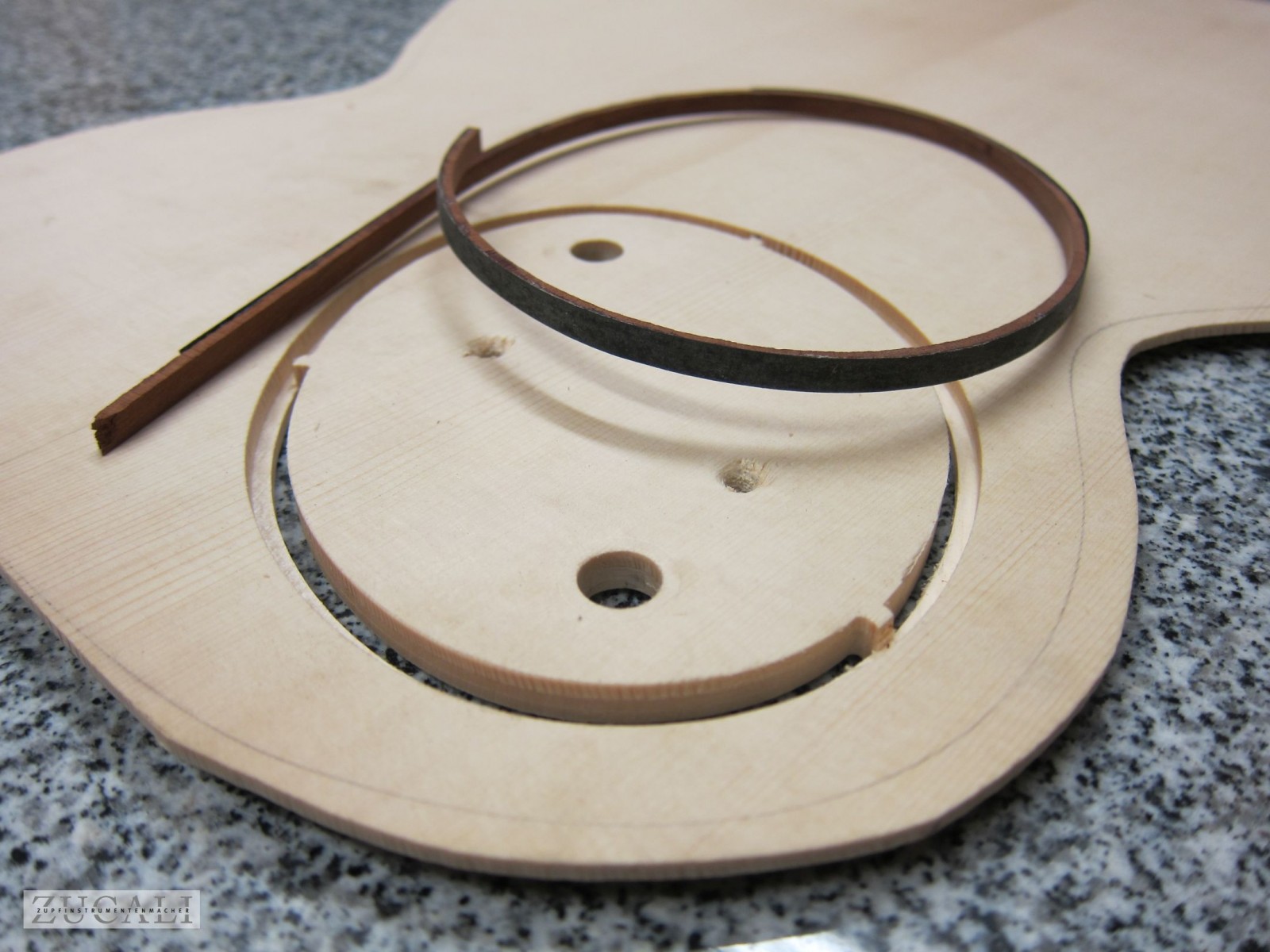
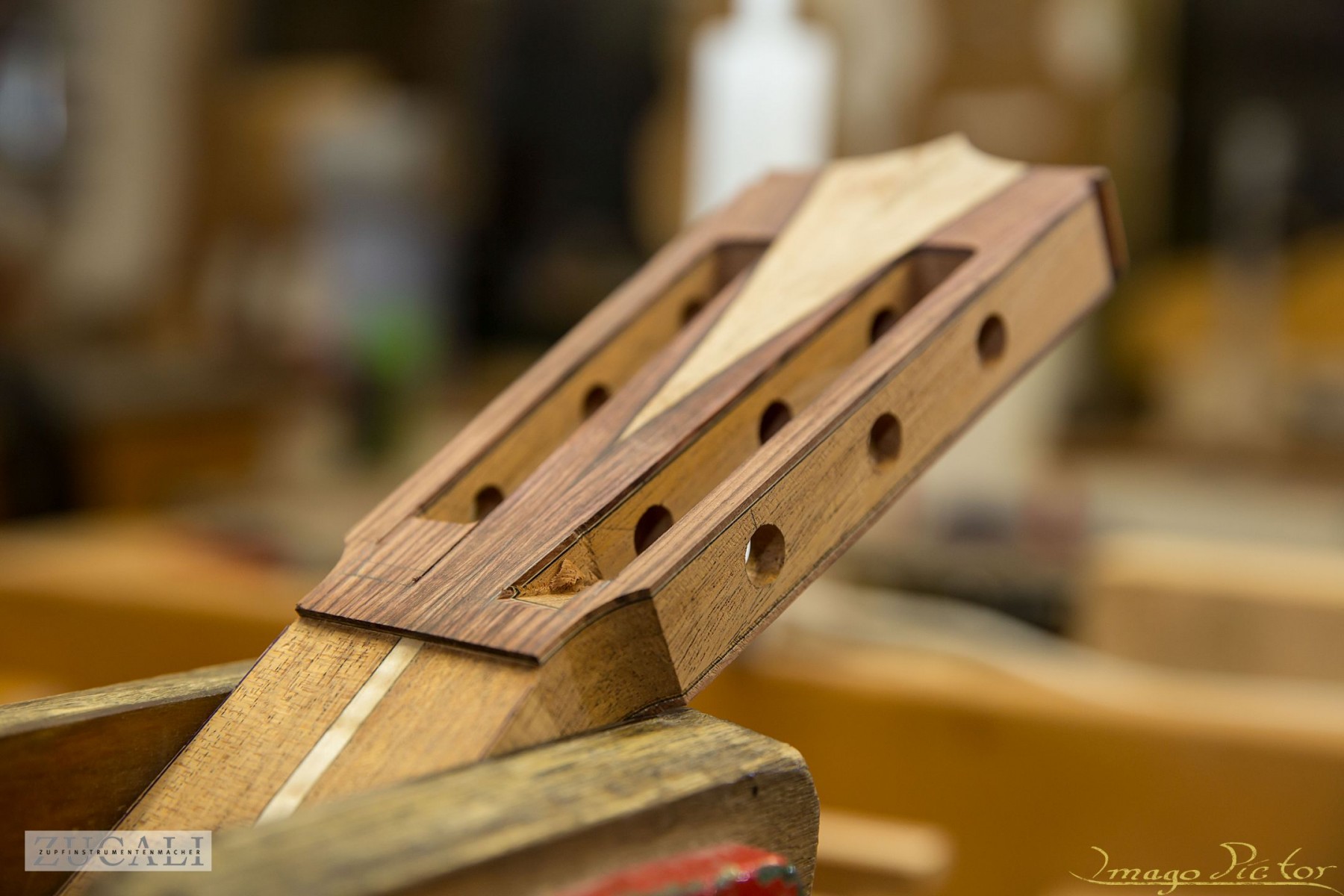
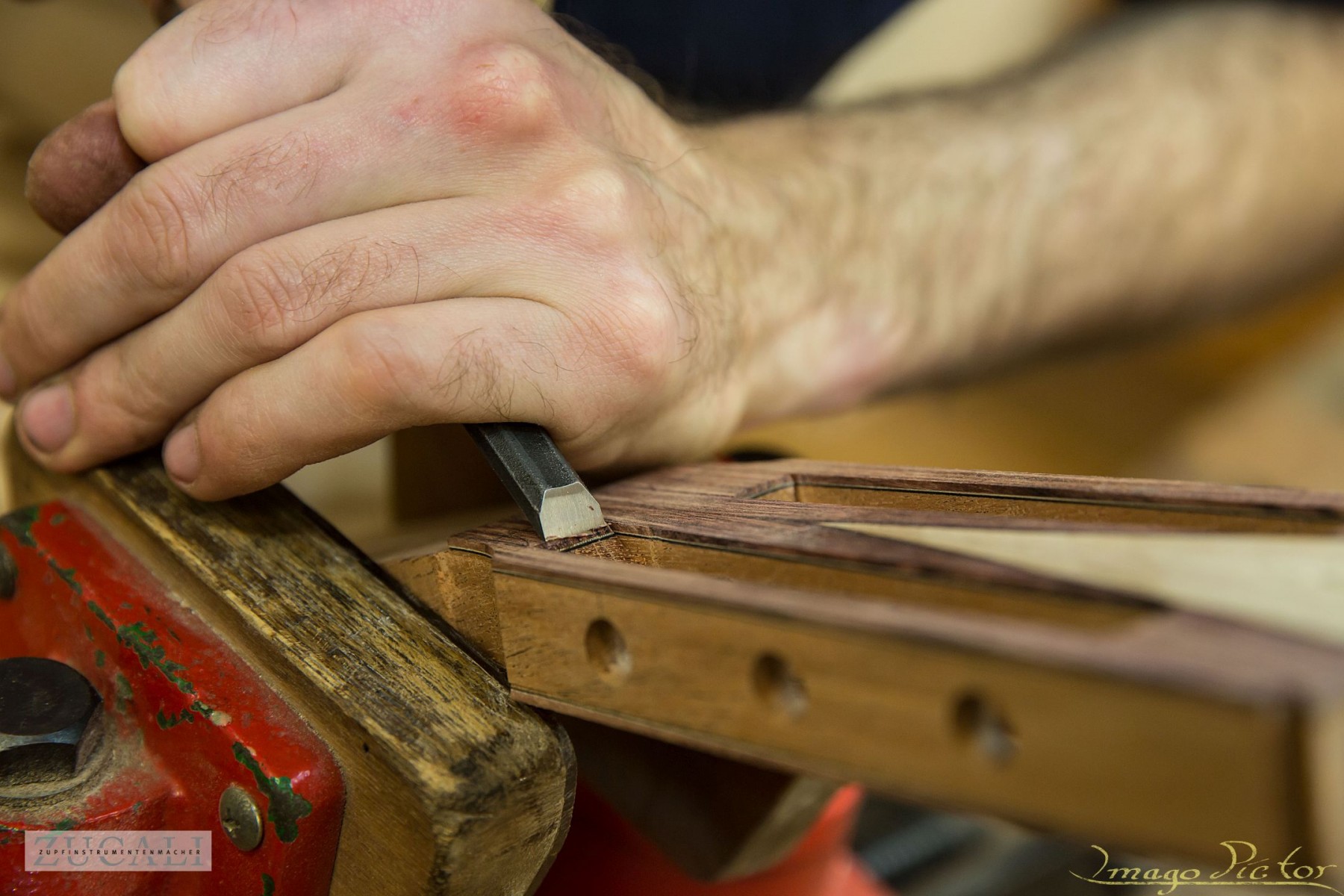
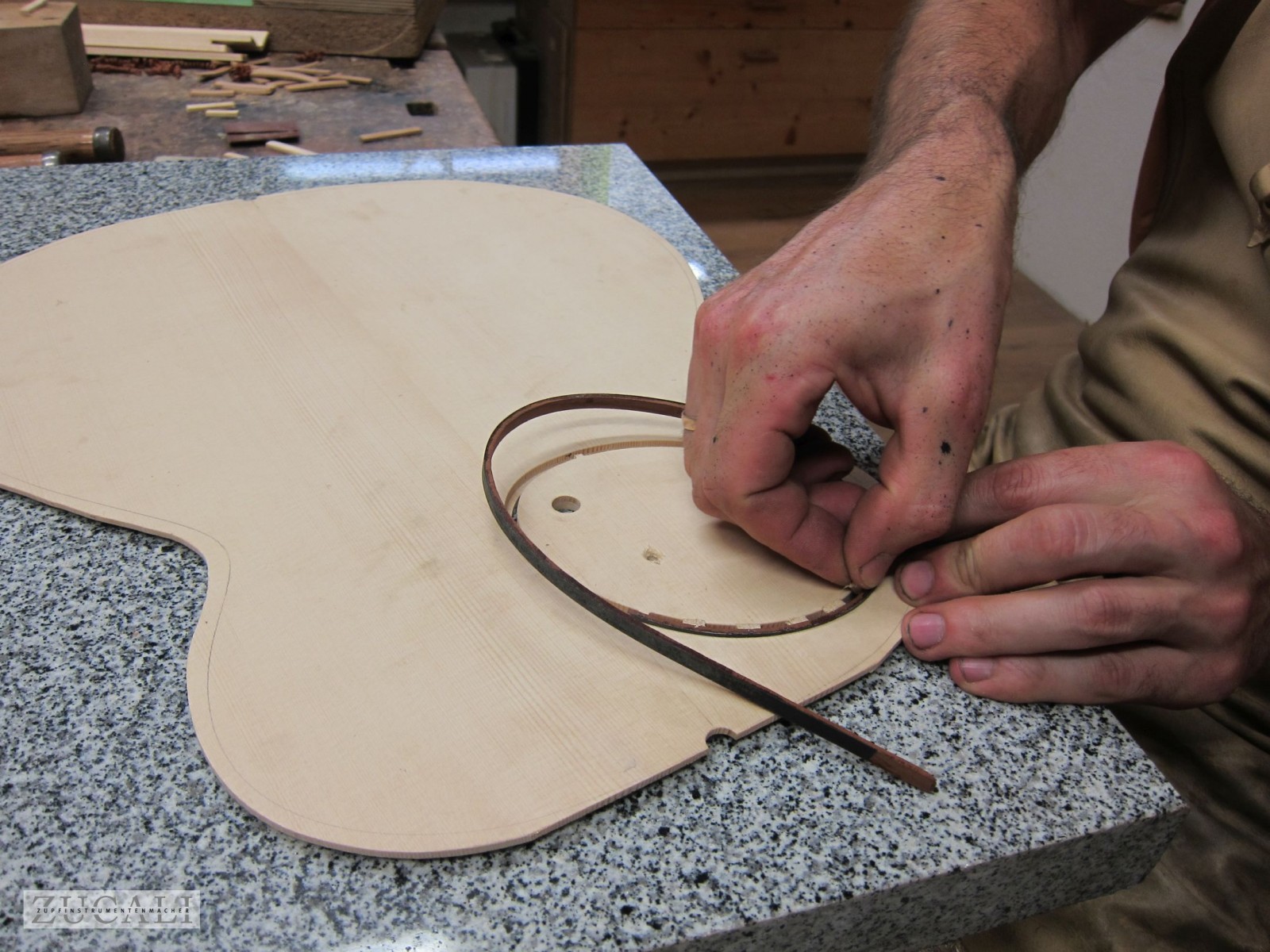
I often start by assembling the top. Then I plane it to the correct thickness, insert the rosette, glue the sound hole lining, the braces, and the struts, and work all of them out. I also craft the other main components (side rings, back, and neck) piece by piece.
Then …
Doing it” is the only way to prove a skill.Marie von Ebner-Eschenbach (1830 – 1916)











Building phase 2
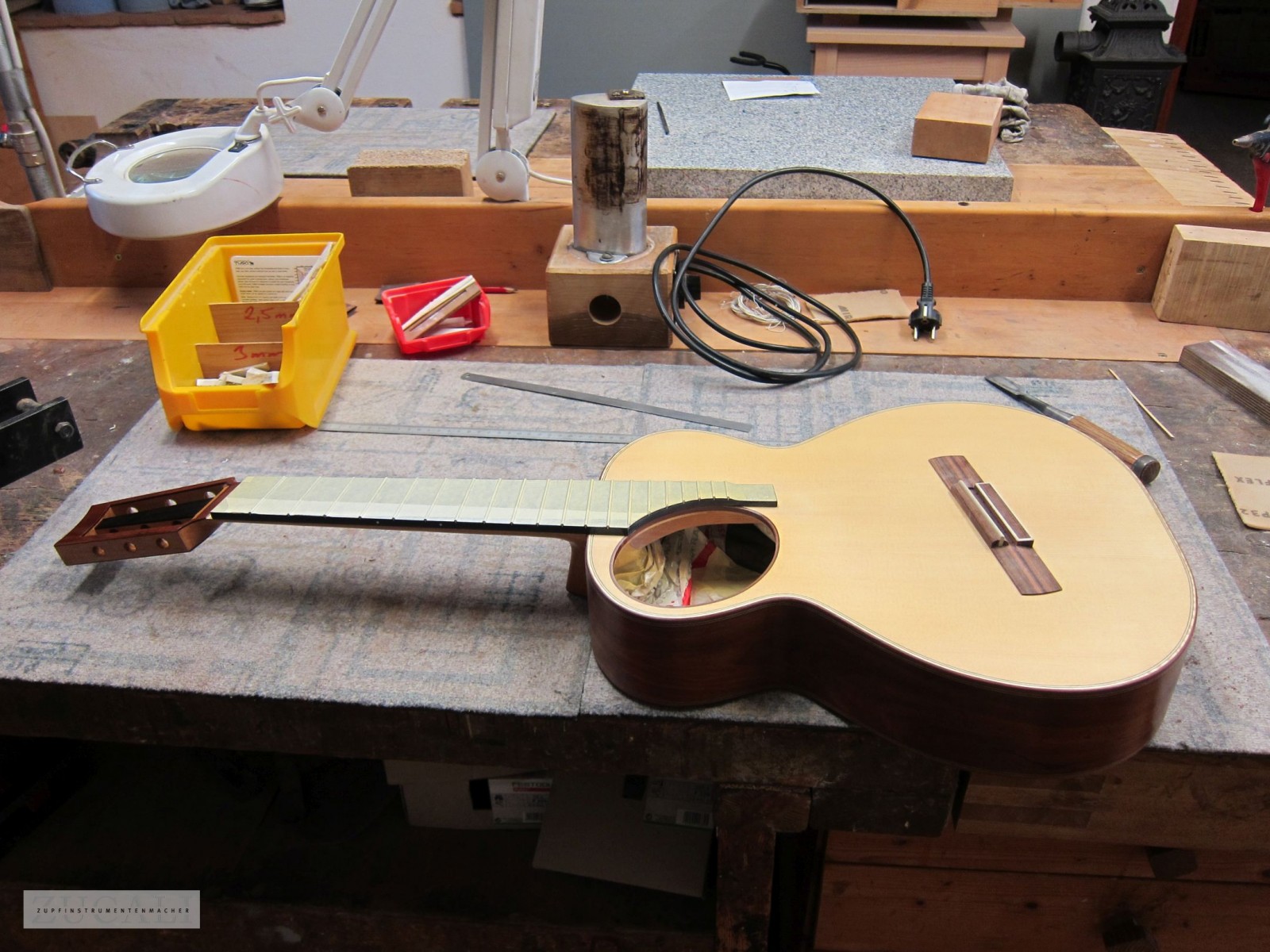
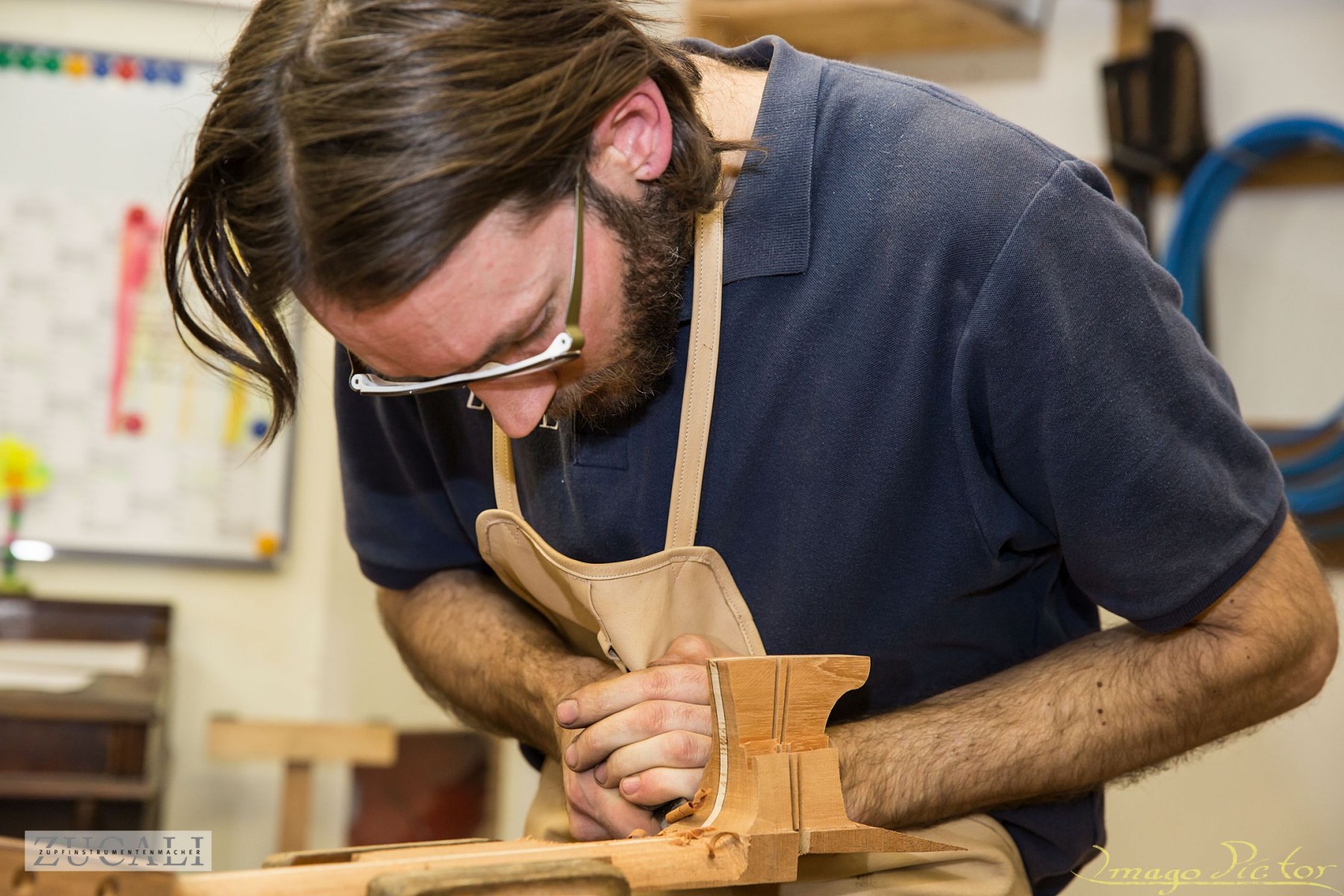
… then I assemble all the components, and suddenly a guitar begins to take shape. However, it’s still not finished, and many more steps are still required.
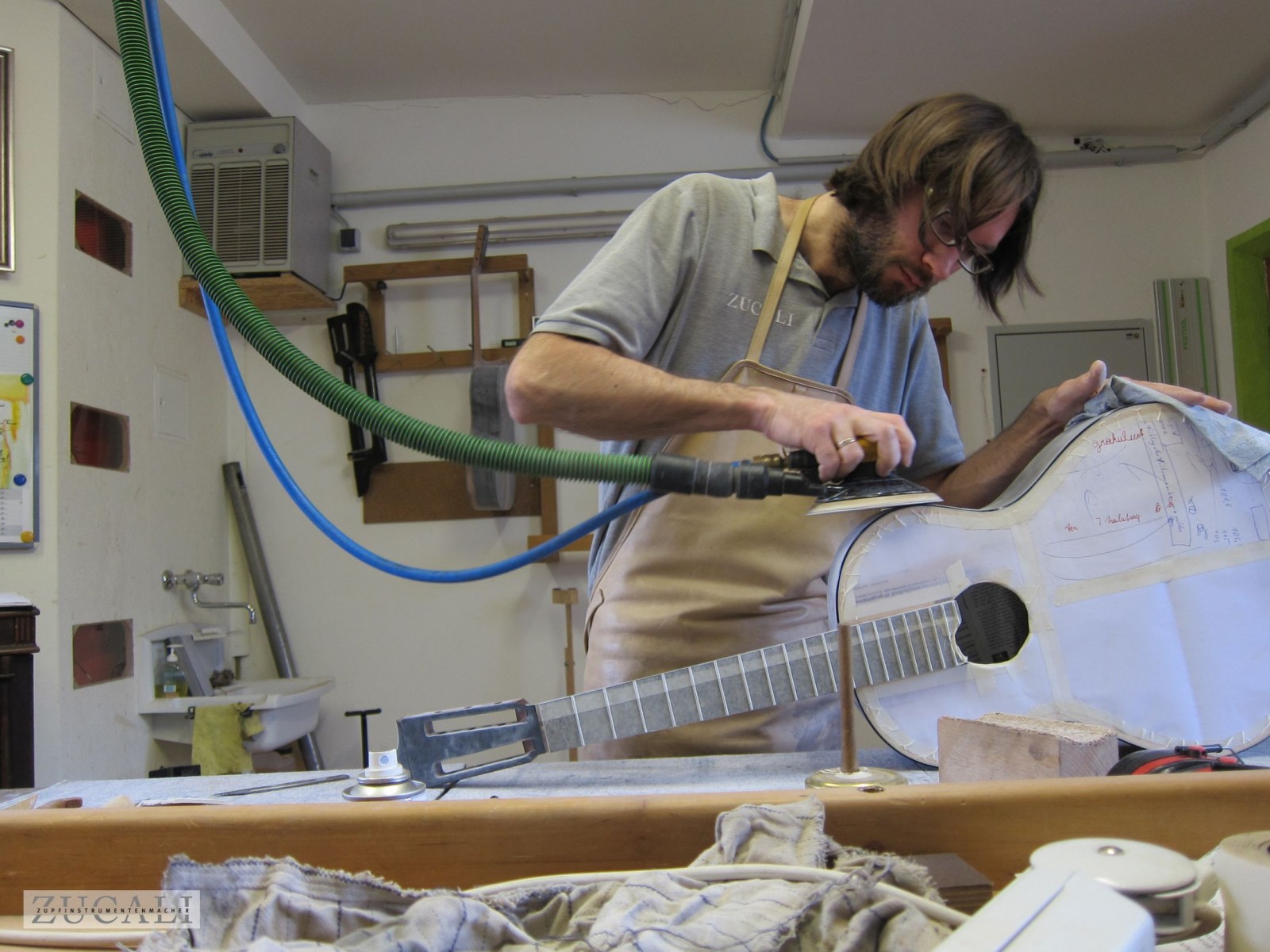
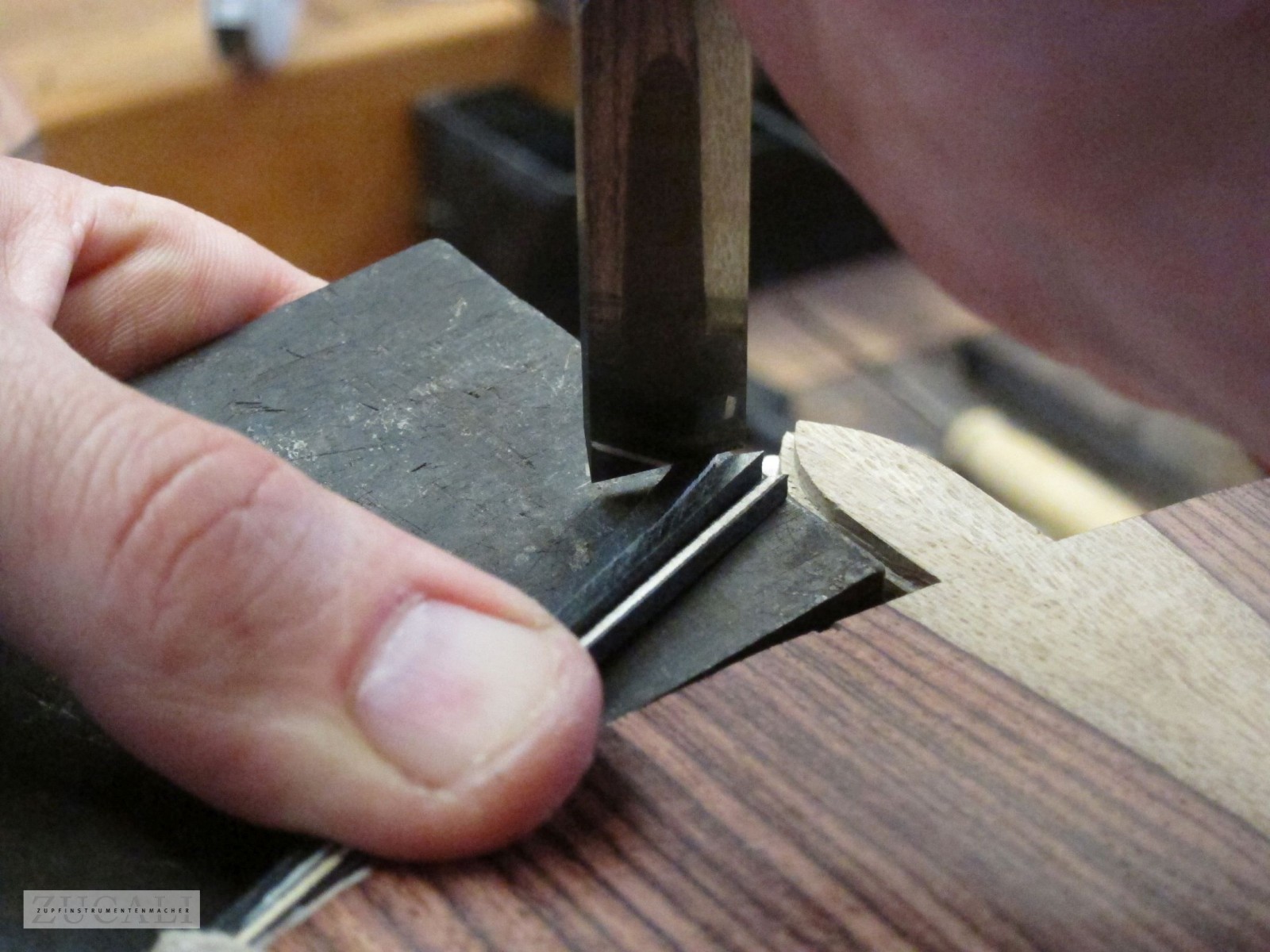
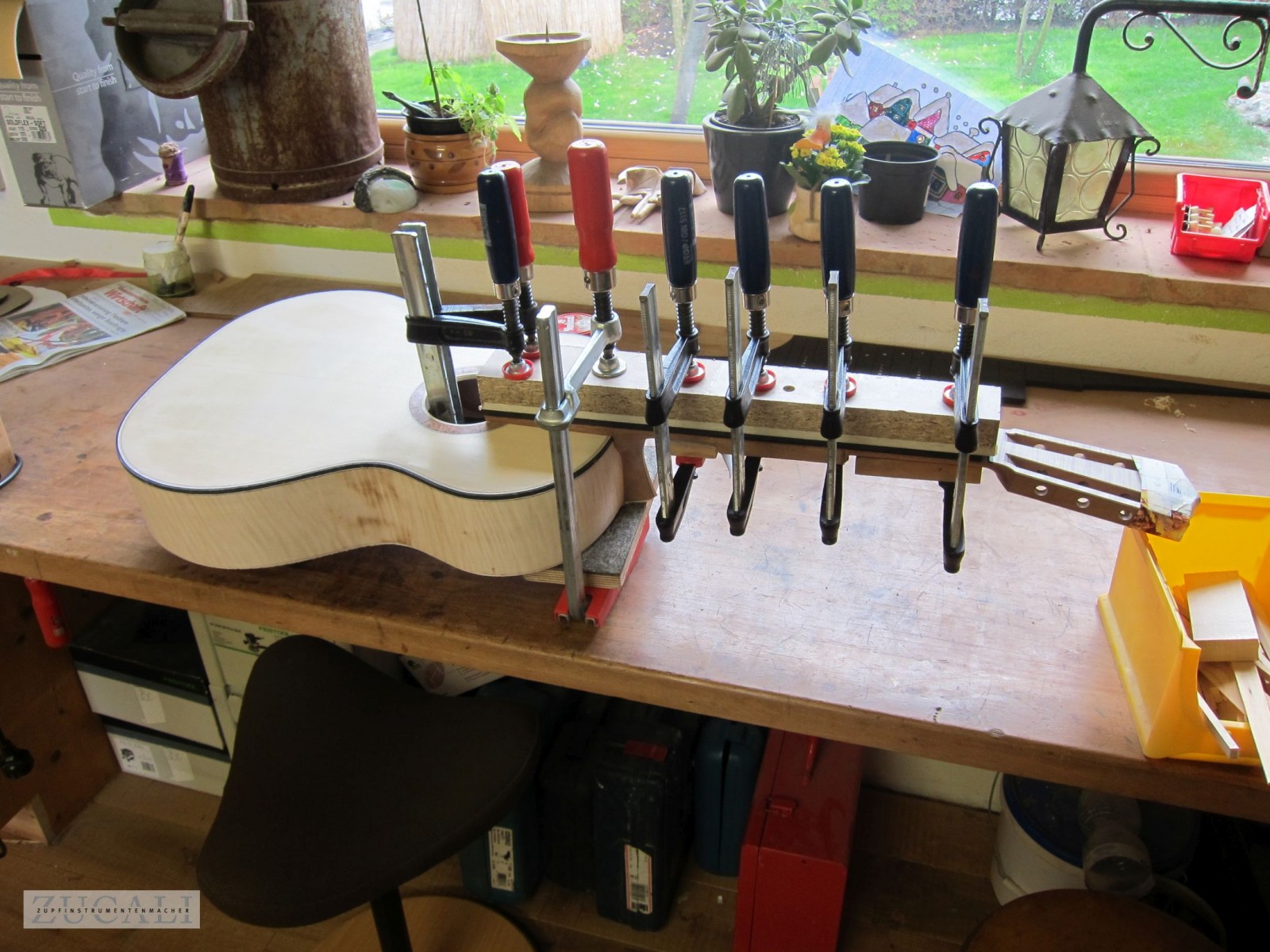
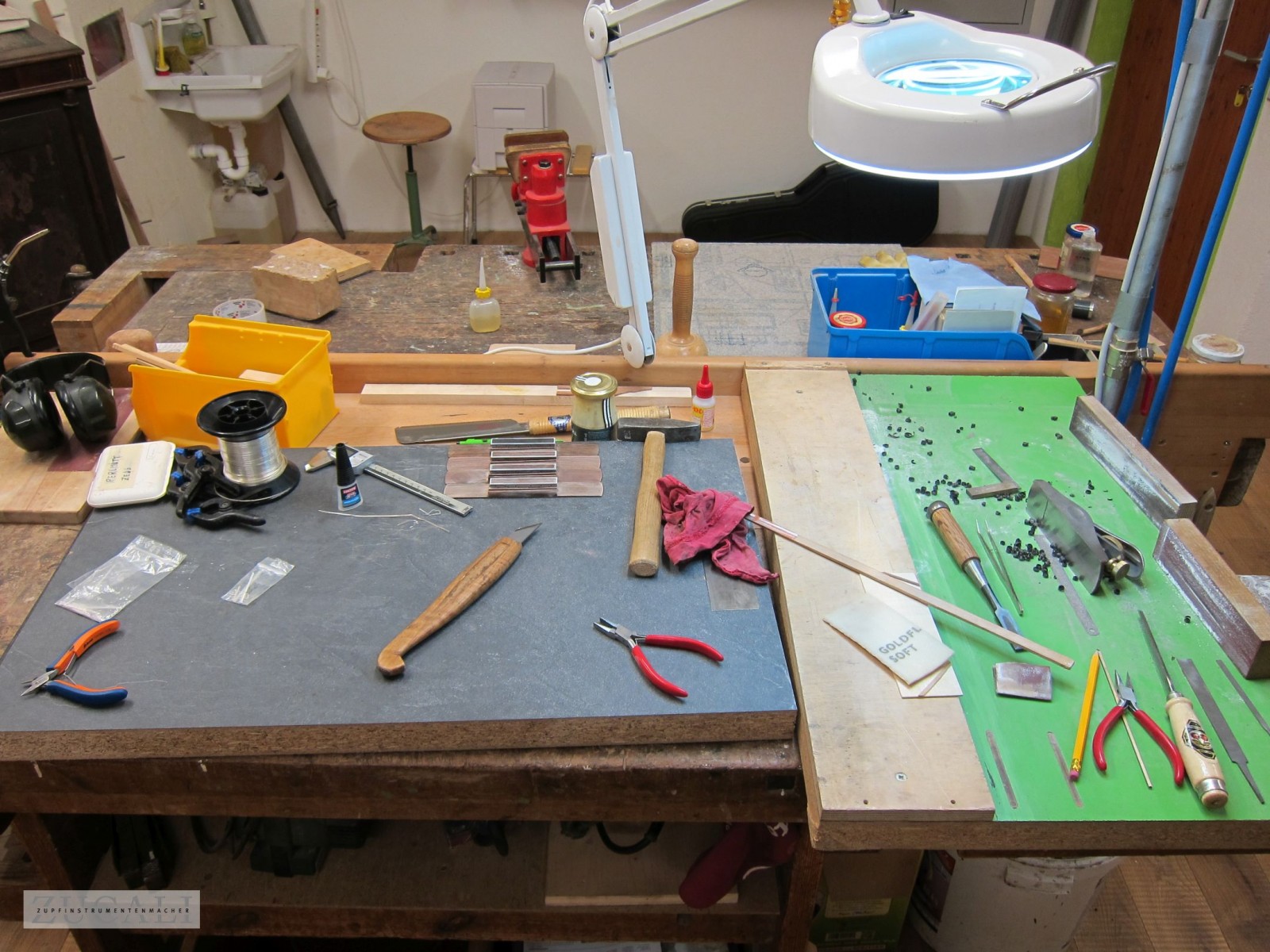
I insert all the edges and decorative strips, clean the body, prepare the fretboard, and glue it on. After fretting, the guitar is sanded and polished once again to the finest detail. When the bridge is also finished, I tape off all areas that will not be painted. Finally, the guitar is ready for varnishing. A proper shellac polish takes about three weeks.
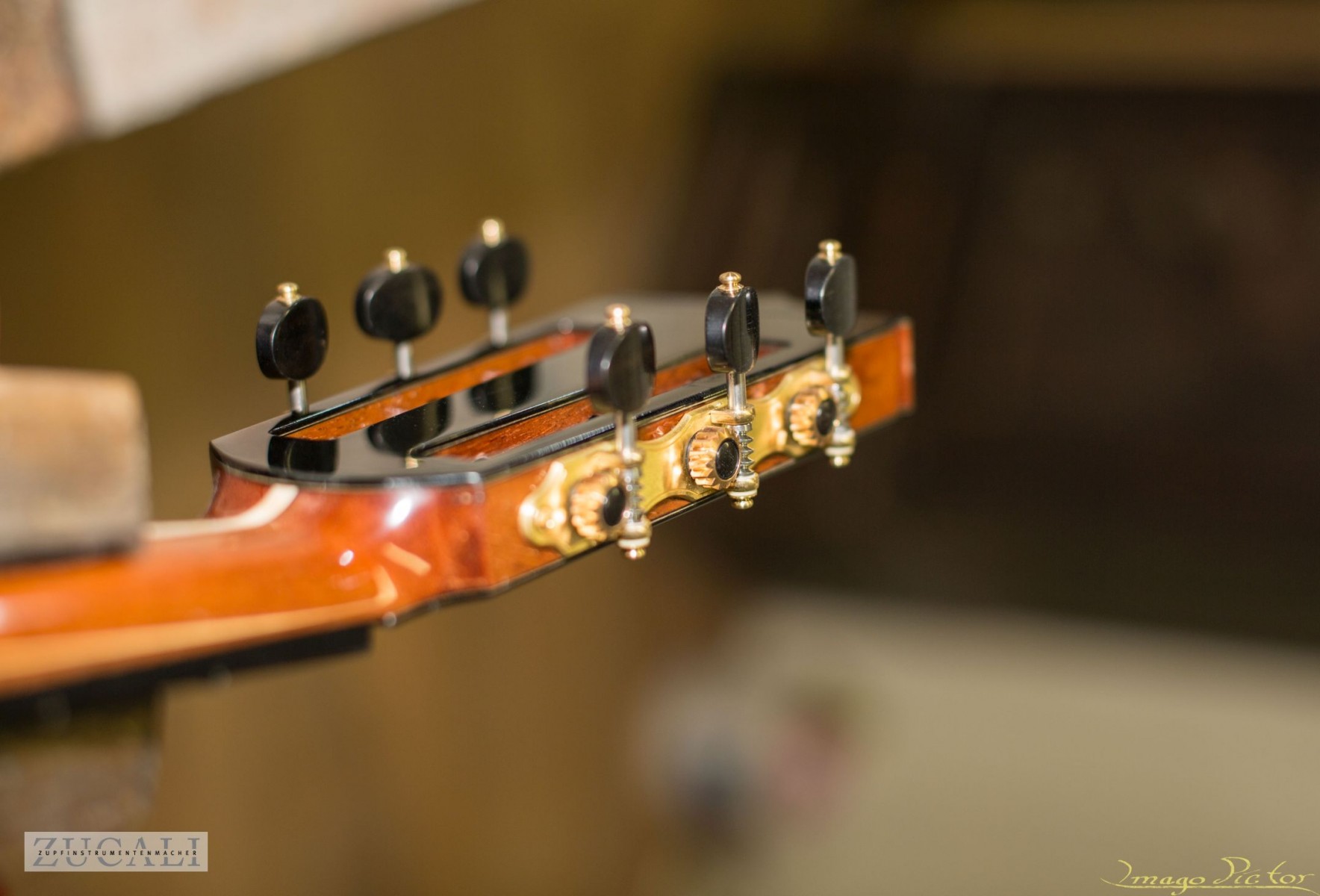
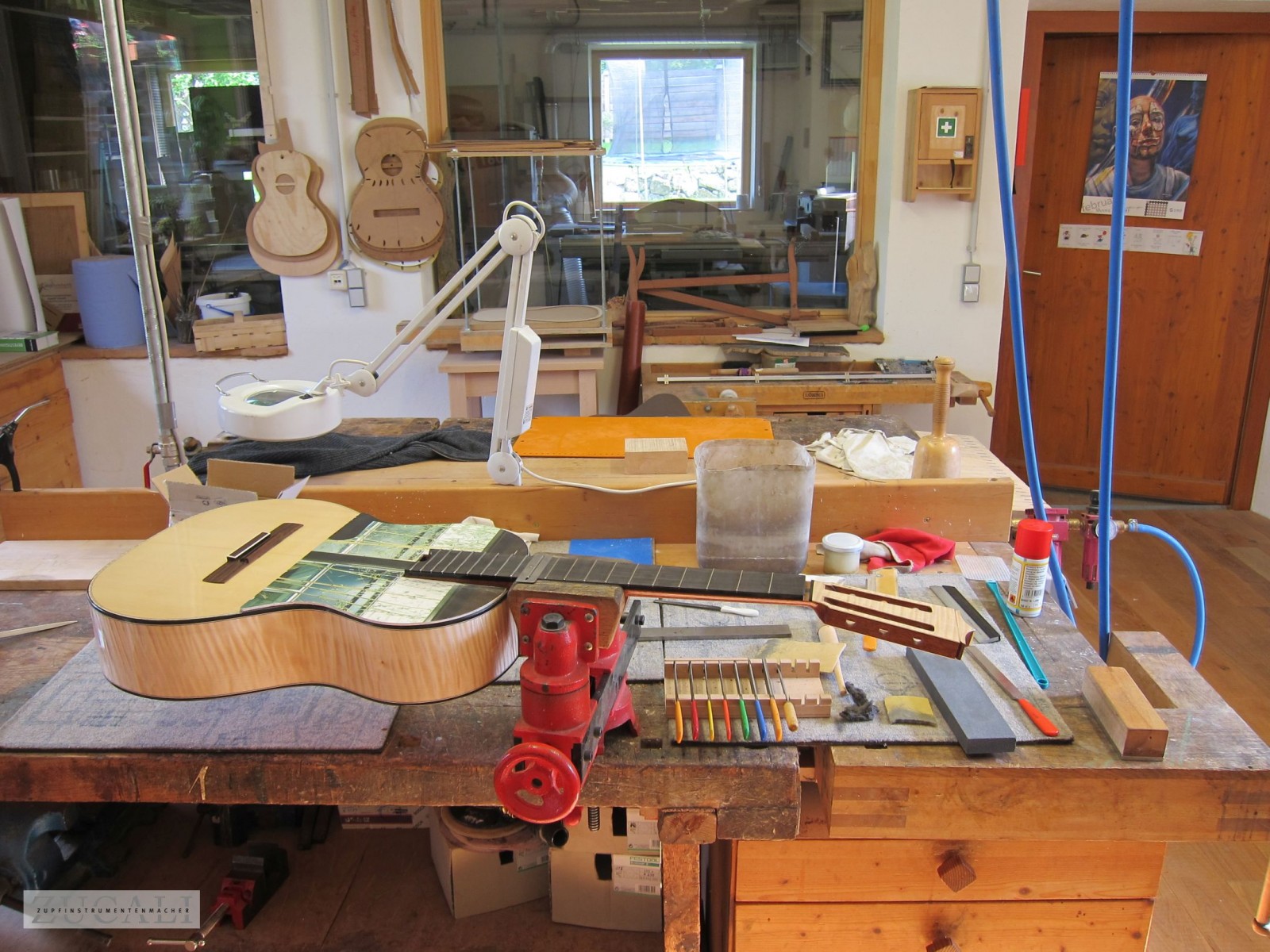
Once that’s done, I carefully work on the frets to ensure the guitar is perfectly playable. Then I glue the bridge on and install the tuning machines.
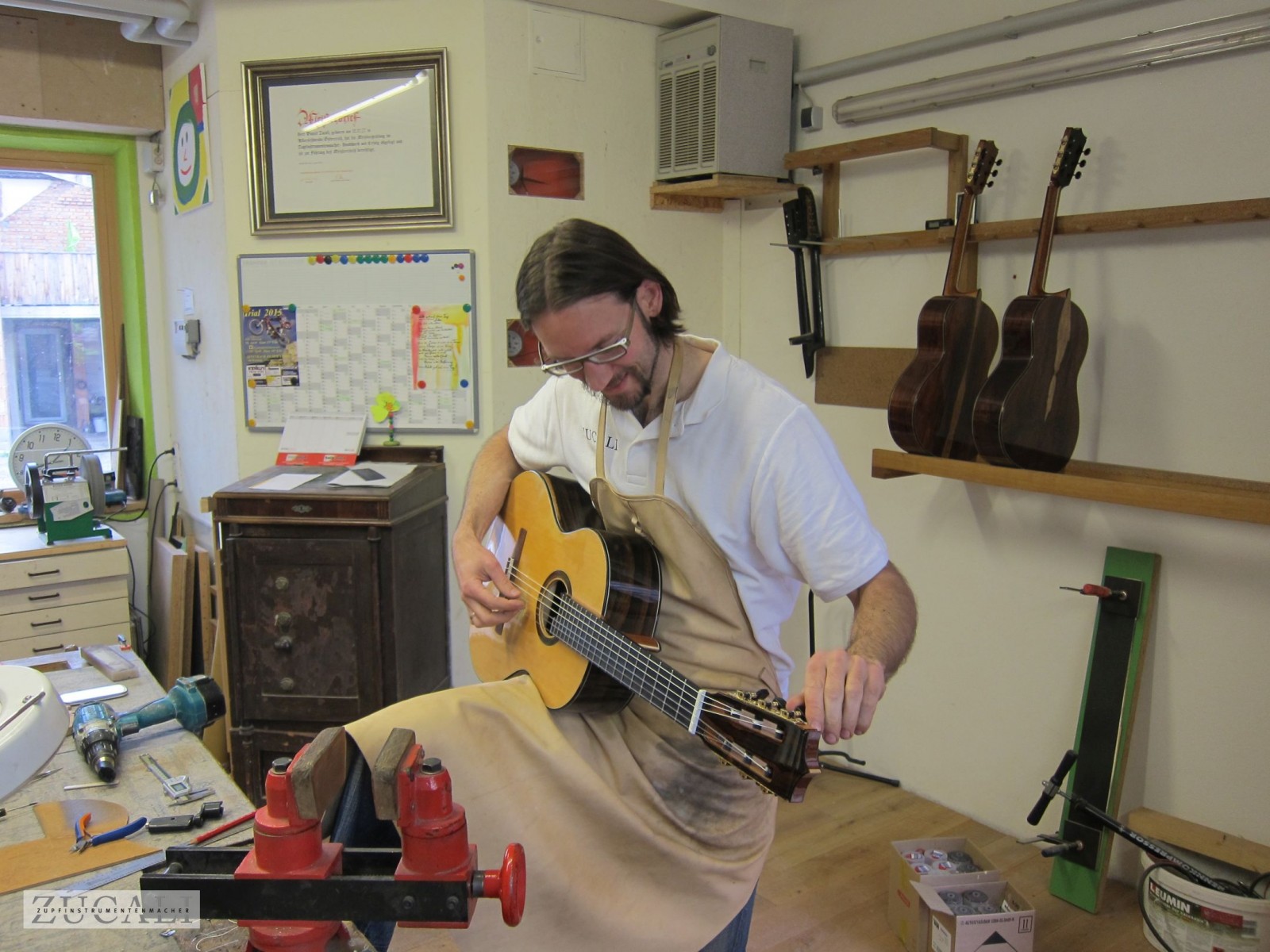
Finally, there are two very important details left, which must be fitted with utmost precision. These are the nut and the bridge saddle, which are usually made of bone.
These final touches determine whether the guitar will sound excellent or just good …
Perseverance will be rewarded sooner or later … but, mostly later.Wilhelm Busch (1832 – 1908)